What Size AC for 2500 Sq Ft House? (BTU & Tonnage Guide)
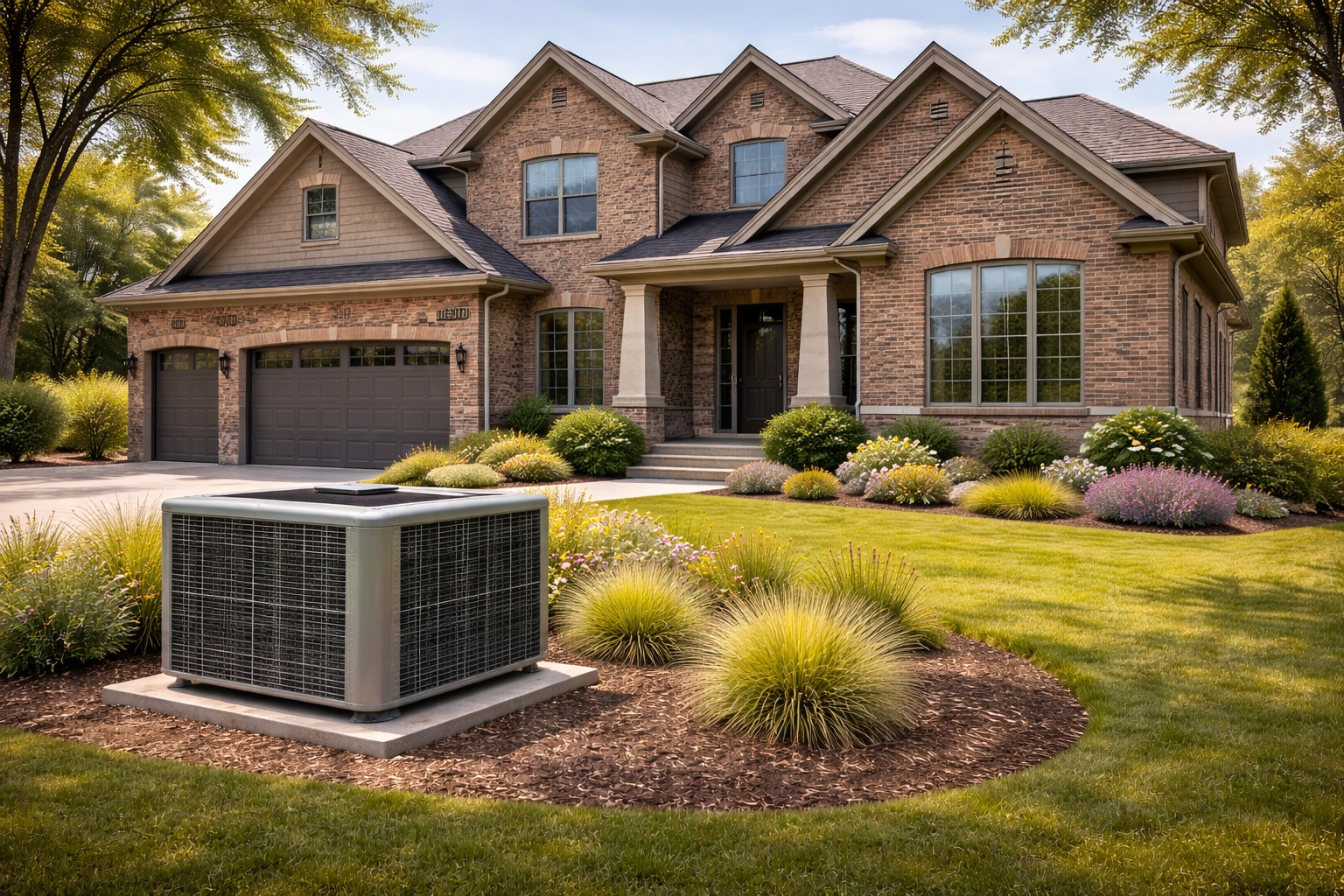
What Size AC for 2500 Sq Ft House? (BTU & Tonnage Guide)
For a 2500 sq ft house, the usual AC size range is 48,000 to 60,000 BTU, which works out to about 4 to 5 tons of cooling capacity. In many homes this size, the bigger decision is not only whether you need 4 tons or 5 tons. It is whether the layout, ductwork, and floor plan are better served by one larger system or two smaller ones.
That matters because once a house reaches this size, airflow distribution starts becoming just as important as raw cooling output.
Why 2500 sq ft is a transition point
A 2500 sq ft home is often where simple square-foot rules begin to break down. Many houses in this range have features that increase cooling complexity, such as:
- two-story layouts
- open-concept living areas
- larger window surfaces
- higher ceilings
- longer duct runs
That is why two homes with the same square footage can end up needing very different HVAC solutions. One may work well with a single 4-ton unit, while another may perform better with 5 tons or even a dual-system layout.
If you want the basic capacity concepts first, read What Is BTU in Air Conditioning? and What Is a Ton in HVAC?.
Is 4 tons or 5 tons usually right?
Most 2500 sq ft homes fall into one of these two directions:
- 4 tons (48,000 BTU) for more efficient homes in moderate climates
- 5 tons (60,000 BTU) for hotter climates, higher ceilings, or homes with heavier solar gain
The right answer depends on how much heat the home gains during the day and whether the duct system can actually support the larger airflow demand.
Before choosing a larger system, it is important to understand how oversizing affects comfort, humidity control, and operating costs. Many of the same principles are explained in our 3 Ton vs 3.5 Ton AC comparison guide, where we break down the real-world differences between two closely sized air conditioners.
When 4 tons is often enough
A 4-ton AC is often the better choice when the house is reasonably efficient and does not face extreme cooling conditions.
It usually makes sense when:
- the climate is moderate
- the insulation is strong
- the duct layout is efficient
- the ceilings are standard or only slightly above standard
- sun exposure is balanced rather than extreme
In those homes, a 4-ton system can often deliver good comfort without introducing unnecessary oversizing risk.
For broader sizing comparisons, see the AC Size Chart.
When 5 tons becomes more realistic
A 5-ton AC is more often justified when the home takes on more heat than average. That can happen in hot southern climates, homes with large west-facing glass, or layouts with high ceilings and strong attic heat gain.
Leaning toward 5 tons is more reasonable if:
- you live in Texas, Florida, Arizona, or another hot climate
- the home gets intense afternoon sun
- the ceiling heights are above average
- there is significant solar heat gain through windows
- the house struggles to recover during peak summer heat
But the larger unit only makes sense if the home’s airflow system can support it.
The airflow problem behind upsizing
This is where many 2500 sq ft decisions go wrong.
Air conditioners typically need about 400 CFM per ton.
- 4 tons = about 1,600 CFM
- 5 tons = about 2,000 CFM
That is a major jump in airflow demand. If the duct system was originally designed around 4 tons, moving to 5 tons without adjusting the ducts can lead to:
- higher static pressure
- more vent noise
- reduced system efficiency
- poorer room-to-room balance
- extra stress on the equipment
For more on airflow, read How Many CFM Per Ton?.
One large system vs two smaller systems
This is where 2500 sq ft homes often differ from smaller houses. At this size, the question is sometimes not “How big should the unit be?” but “Should the home be cooled by more than one system?”
Option 1: One 5-ton system
A single large system can work, especially in simpler single-story layouts or homes with well-designed ducts.
Pros:
- lower installation cost
- simpler equipment setup
- one thermostat and one main control point
Cons:
- more risk of uneven temperatures between floors
- higher static pressure if ductwork is marginal
- harder humidity balancing in larger layouts
Option 2: Two smaller systems
In many two-story or stretched-out floor plans, dual systems perform better than one oversized central unit.
Pros:
- better floor-by-floor control
- improved zoning and comfort
- more balanced humidity management
- less strain on each individual unit
Cons:
- higher upfront cost
- more components to service over time
If the house has a consistently hot upstairs, long duct runs, or wide-open living areas, dual systems may be the smarter long-term design.
Why layout matters as much as tonnage
At 2500 sq ft, comfort problems are often caused by layout, not just equipment size. A house with one long wing, a dramatic foyer, or a hot upstairs may cool very differently from a compact one-story home of the same square footage.
That is why some 2500 sq ft homes feel great with 4 tons, while others struggle until zoning, staging, or multi-system design is considered.
What happens if the system is too big?
Oversizing creates a familiar set of issues. A large unit may cool fast near the thermostat but still leave the home feeling less comfortable overall.
Common signs include:
- short cycling
- poor humidity removal
- uneven room temperatures
- higher energy use than expected
If the AC is shutting off too quickly, read Oversized AC Symptoms and AC Short Cycling Explained.
What happens if the system is too small?
An undersized system has the opposite problem. It may run for long stretches and still fail to catch up when outdoor temperatures peak.
That often looks like:
- constant runtime
- the thermostat not reaching set temperature
- hot upstairs rooms
- poor performance during late afternoon heat
For that side of the issue, read Undersized AC Symptoms and Is My AC Too Small?.
Two-stage and variable-speed systems can change the answer
Sometimes the best solution is not jumping from 4 tons to 5 tons. A better answer can be using smarter equipment.
A two-stage or variable-speed 4-ton system may outperform a single-stage 5-ton system in many moderate climates because it can:
- run longer at lower output
- improve humidity removal
- reduce temperature swings
- deliver more even comfort
That makes staged equipment especially useful in borderline homes where full 5-ton sizing feels too aggressive.
How climate changes the recommendation
A simple way to think about it is this:
- Moderate climates: 4 tons is often enough
- Hot and humid climates: 4.5 to 5 tons becomes more likely
- Desert climates: 5 tons is more often justified, especially with large sun exposure
That is why square footage alone cannot settle the question. Climate changes the load in a big way.
Should you always get a Manual J calculation?
Yes. Once you reach this house size, rule-of-thumb sizing is even more likely to miss something important.
A Manual J load calculation looks at:
- window heat gain
- insulation levels
- orientation
- duct leakage
- air infiltration
- local climate conditions
That is the safest way to decide whether you truly need 5 tons, or whether 4 tons with better design would perform better.
For the bigger framework, read Air Conditioner Sizing Guide.
Bottom line
For most 2500 sq ft homes, the right AC size is usually 4 to 5 tons. In moderate climates, 4 tons is often enough. In hotter climates or homes with higher ceilings and heavy solar gain, 5 tons may be justified.
But at this size, comfort depends on more than tonnage. Layout, duct capacity, airflow balance, and zoning strategy all play a major role. In many 2500 sq ft homes, the best system is not the biggest one. It is the one that distributes cooling most evenly and efficiently.
Helpful next reads: AC Size Chart, Air Conditioner Sizing Guide, What Is a Ton in HVAC?, Oversized AC Symptoms, and Undersized AC Symptoms.
Related technical guides
- If the conditioned floor area is near another bracket, compare What Size AC for 2300 Sq Ft House? before rounding the load or choosing the next nominal half-ton size.
- If the conditioned floor area is near another bracket, compare What Size AC for 2600 Sq Ft House? before rounding the load or choosing the next nominal half-ton size.
Sources and verification
The technical statements in What Size AC for 2500 Sq Ft House? (BTU & Tonnage Guide) were cross-checked against the primary references below. Final sizing, airflow, electrical, combustion, and refrigerant decisions must also follow the exact equipment instructions and applicable local code.