What Size AC Do I Need in Florida? (BTU & Tonnage Guide – 2026)
What Size AC Do I Need in Florida? (BTU & Tonnage Guide – 2026)
Florida is one of the toughest states in the country for air conditioning. High humidity, strong sun exposure, long cooling seasons, and warm nights make proper AC sizing especially important. If you are asking what size AC do I need in Florida, the answer is usually more aggressive than it would be in drier or cooler states.
Where humidity control matters, airflow selection may be adjusted using equipment data and sensible/latent performance goals rather than a single Florida-wide rule. See our breakdown of how many CFM per ton you need.
That is because Florida sizing is not just about temperature. It is about temperature plus moisture load.
Quick Answer
For preliminary planning, many Florida homes screen around 26 to 30 BTU per square foot; building envelope, solar exposure, humidity/latent load, duct conditions, orientation, and local climate can materially change the design load.
For preliminary screening only, that can work out to:
- 1,500 sq ft → 39,000–45,000 BTU (about 3–3.5 tons)
- 2,000 sq ft → 52,000–60,000 BTU (about 4–5 tons)
- 2,500 sq ft → 65,000–75,000 BTU (about 5–6 tons)
Because Florida air is so humid, many homes end up sized toward the upper end of the tonnage range.
For the definitions used in Florida, read What Is BTU in Air Conditioning? and What Is a Ton in HVAC?.
Why Florida homes need more cooling capacity
Florida creates one of the most demanding HVAC environments in the U.S. for three main reasons:
- high humidity
- long cooling seasons
- strong solar heat gain
That means a house in Florida usually needs more cooling capacity than the same-size house in a cooler or drier climate.
1. Humidity adds a major load
In Florida, your AC is not just lowering the temperature. It is also removing a large amount of moisture from the indoor air.
That means the system has to handle:
- sensible heat → lowering temperature
- latent heat → removing humidity
This is one of the biggest reasons Florida homes often need more BTU than similar homes in dry states like Arizona or inland western areas.
2. The cooling season is extremely long
In many parts of Florida, air conditioning is not just a summer appliance. It is a near year-round necessity.
In cities like Miami, Tampa, and Orlando, many systems:
- run for 9 to 12 months per year
- operate 10 to 14 hours per day in peak summer
- get little relief at night because temperatures stay warm
That extended runtime makes correct sizing even more important for operating cost and equipment life.
3. Solar gain is intense
Many Florida homes also have strong sun exposure, which increases cooling demand beyond simple square footage estimates.
Common contributors include:
- large sliding glass doors
- west-facing windows
- coastal sun exposure
- concrete block construction that stores heat
That solar load can push a borderline system into the next size range.
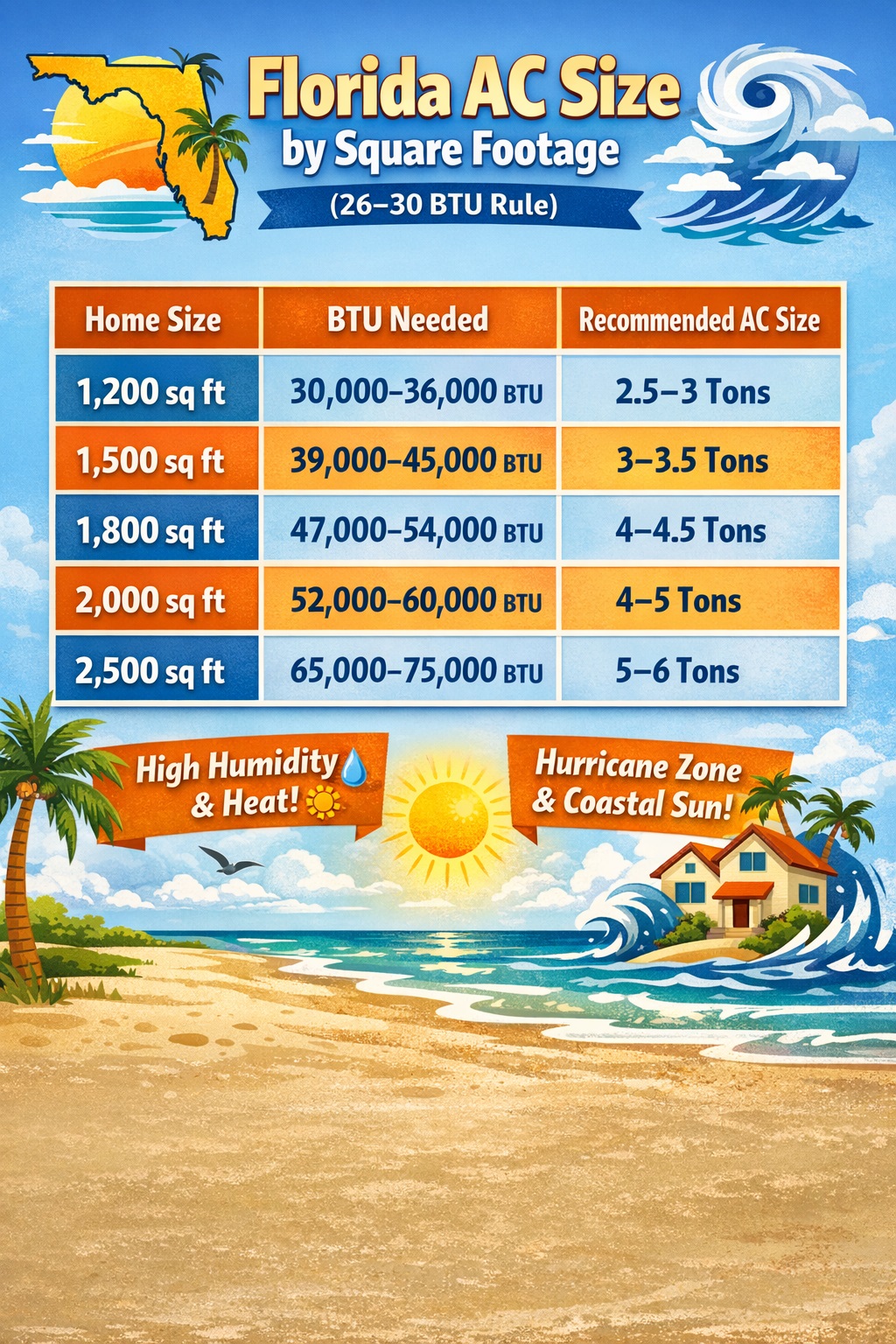
Florida preliminary AC size chart by square footage
| Home Size | Recommended BTU | Recommended Tons |
|---|---|---|
| 1,200 sq ft | 30,000–36,000 BTU | 2.5–3 tons |
| 1,500 sq ft | 39,000–45,000 BTU | 3–3.5 tons |
| 1,800 sq ft | 47,000–54,000 BTU | 4–4.5 tons |
| 2,000 sq ft | 52,000–60,000 BTU | 4–5 tons |
| 2,500 sq ft | 65,000–75,000 BTU | 5–6 tons |
For the full national framework, see Air Conditioner Sizing Guide and AC Size Chart.
What Size AC for 1500 Sq Ft House in Florida?
A 1,500 sq ft house in Florida typically requires between 37,500 and 45,000 BTU of cooling capacity. Most homes need a 3-ton to 3.5-ton air conditioner, although homes in South Florida often benefit from the upper end of the range because of year-round humidity and extended cooling seasons.
Humidity removal is just as important as temperature reduction. An oversized system may cool quickly but leave the house feeling damp.
To benchmark Florida, see What Size AC for 1500 Sq Ft House.
What Size AC for 2000 Sq Ft House in Florida?
Many homeowners ask what size AC for a 2000 sq ft house in Florida is needed. In most situations, a home of this size requires approximately 50,000 to 60,000 BTU of cooling output. That usually translates to a 4-ton to 5-ton air conditioner.
Because Florida combines high temperatures with high humidity, cooling loads are often greater than similarly sized homes in many other states.
For Florida, also compare What Size AC for 2000 Sq Ft House.
What Size AC for 2500 Sq Ft House in Florida?
A 2,500 sq ft Florida home generally requires between 62,500 and 75,000 BTU of cooling capacity. Most homes fall into the 5-ton to 6-ton range depending on insulation quality, ceiling height, solar exposure, and humidity levels.
In coastal areas, moisture control often becomes a major factor when selecting equipment.
For Florida, also compare What Size AC for 2500 Sq Ft House.
What Size AC for 3000 Sq Ft House in Florida?
Large Florida homes around 3,000 square feet frequently require between 75,000 and 90,000 BTU of cooling output. Depending on the floor plan, homeowners may benefit from HVAC zoning systems or variable-speed equipment for better humidity control and comfort.
Proper sizing is critical because oversized systems often create moisture problems in humid climates.
Learn more here: What Size AC for 3000 Sq Ft House.
How Florida compares with other states
One reason homeowners get confused is that the same square footage can need very different AC sizes depending on the state.
For example, a 2,000 sq ft home might need:
- Michigan: around 3 tons
- Texas: around 3.5 to 4 tons
- Florida: often 4 to 5 tons
That difference is mostly driven by humidity and year-round cooling demand.
For comparison, see What Size AC Do I Need in Texas?.
Should you oversize in Florida?
This is one of the most common mistakes in humid climates.
Many homeowners think:
“Florida is brutally hot, so bigger must be better.”
But oversizing can create serious problems, especially where humidity is high. An oversized AC may:
- cool too quickly
- shut off before removing enough moisture
- leave the air feeling sticky or clammy
- increase mold and mildew risk over time
That is why in humid climates, a correctly sized system that runs longer can often feel better than a larger one that cools faster.
For more on that, read Oversized AC Symptoms and AC Short Cycling Explained.
What happens if you undersize in Florida?
Florida can be just as unforgiving on the other side. A system that is too small may:
- run constantly
- struggle on 95°F to 100°F days
- fail to control indoor humidity well enough
- wear out faster from long runtimes
For the warning signs, read Undersized AC Symptoms and Is My AC Too Small?.
Two-story homes in Florida often need more than just extra tonnage
In many two-story homes, the upstairs stays warmer and more humid than the downstairs. That happens because heat rises, upper floors trap moisture, and airflow between floors is often uneven.
For homes above about 2,000 sq ft, it often makes sense to consider:
- dual-zone systems
- two separate systems
- variable-speed compressors
That can solve comfort problems more effectively than simply installing one oversized single-stage unit.
You can compare against the broader national chart here: AC Size Chart.
What SEER rating makes sense in Florida?
Because Florida systems run so much of the year, efficiency matters a lot.
A practical recommendation is:
- minimum: SEER 16
- better range: SEER 17–19
- best comfort option in many homes: variable-speed compressor
Higher-efficiency systems cost more up front, but in Florida’s long cooling season they often make more sense than they would in cooler states.
For cost context, read AC Installation Cost Per Square Foot and How Much Does a 5 Ton AC Unit Cost?.
Ceiling height still matters in Florida
Standard estimates assume 8-foot ceilings. If your Florida home has higher ceilings, the cooling load goes up because there is more air volume to condition.
- 9–10 ft ceilings: add about 10–15% capacity
- Vaulted ceilings: add about 15–25%
This is especially important in open Florida layouts with large living areas and tall ceilings.
The most accurate way to size an AC in Florida
Online formulas and rules of thumb are useful for getting into the right range, but Florida is one of the worst places to guess.
The best method is a Manual J load calculation. That looks at:
- window SHGC values
- insulation quality
- duct leakage
- orientation
- local weather data
- air infiltration
Because Florida humidity is so demanding, a professional load calculation is especially valuable here.
For the full framework, read Air Conditioner Sizing Guide.
How Much Does a New AC Cost?
After determining the right AC size for Florida's hot and humid climate, the next question is usually cost. See our detailed 3-ton AC unit cost guide for equipment, installation, and labor pricing.
Bottom line
If you are asking what size AC do I need in Florida, treat 26 to 30 BTU per square foot as preliminary planning guidance; final equipment selection requires a load calculation that accounts for the building envelope, solar exposure, humidity, duct conditions, orientation, and local climate.
For preliminary planning:
- 1,500 sq ft → about 3 to 3.5 tons
- 2,000 sq ft → about 4 to 5 tons
- 2,500 sq ft → about 5 to 6 tons
The goal is not to install the biggest possible unit. In Florida, the best system is the one that controls humidity, runtime, airflow, and temperature all at the same time.
City-Specific AC Sizing Guides
Florida homes face different combinations of coastal exposure, inland heat, humidity, and building characteristics. These city guides add local context, while a room-by-room load calculation remains the basis for final equipment selection.
- Boca Raton AC sizing guide
- What size AC does a Cape Coral home need?
- AC sizing considerations for Clearwater
- Choosing an AC size in Coral Springs
- Davie AC sizing guide
- What size AC does a Deltona home need?
- AC sizing considerations for Fort Lauderdale
- Choosing an AC size in Fort Myers
- Gainesville AC sizing guide
- What size AC does a Hialeah home need?
- AC sizing considerations for Hollywood
- Choosing an AC size in Jacksonville
- Lakeland AC sizing guide
- What size AC does a Miami home need?
- AC sizing considerations for Miami Gardens
- Choosing an AC size in Miramar
- North Port AC sizing guide
- What size AC does a Palm Bay home need?
- AC sizing considerations for Palm Coast
- Choosing an AC size in Pembroke Pines
- Plantation AC sizing guide
- What size AC does a Pompano Beach home need?
- AC sizing considerations for Port St. Lucie
- Choosing an AC size in St. Petersburg
- Sunrise AC sizing guide
- What size AC does a Tallahassee home need?
- AC sizing considerations for West Palm Beach
- Choosing an AC size in Orlando
- Tampa AC sizing guide
Sources and verification
The technical statements in What Size AC Do I Need in Florida? (BTU & Tonnage Guide – 2026) were cross-checked against the primary references below. Final sizing, airflow, electrical, combustion, and refrigerant decisions must also follow the exact equipment instructions and applicable local code.