SEER Rating Explained (SEER2 Update – 2026 Guide)
SEER vs SEER2 Explained (2026 Guide): Which Efficiency Rating Should You Actually Buy?
If you're shopping for a new air conditioner, you've probably seen labels such as SEER 14, SEER 16, or SEER2 15.2. Many homeowners assume a bigger number simply means a better air conditioner, but that isn't how HVAC efficiency actually works.
SEER does not measure how much cooling an air conditioner produces. It measures how efficiently that cooling is delivered over an entire cooling season. Two systems can produce exactly the same amount of cooling while using very different amounts of electricity.
Beginning with modern equipment, manufacturers now use SEER2, an updated testing standard that better reflects real-world operating conditions. That means comparing an old SEER rating directly with a new SEER2 rating can be misleading unless you understand the difference.
In this guide you'll learn:
- What SEER actually measures
- How SEER2 differs from older SEER ratings
- Whether SEER 14, 16 or 18 is worth buying
- How efficiency affects electricity bills
- When paying more for higher SEER actually saves money
- How to choose the right efficiency for your climate
Quick Answer
SEER (Seasonal Energy Efficiency Ratio) measures how efficiently an air conditioner converts electricity into cooling during an entire cooling season. Higher SEER ratings generally use less electricity while providing the same cooling capacity.
As of 2026, manufacturers use the newer SEER2 testing standard. Although SEER2 numbers often appear lower than older SEER ratings, the equipment itself is not necessarily less efficient—the testing procedure simply became more realistic.
| Efficiency Level | Typical Rating | Best For |
|---|---|---|
| Basic | SEER2 13.4–14 | Mild climates |
| Standard | SEER2 15–16 | Most homeowners |
| High Efficiency | SEER2 17–18 | Hot climates |
| Premium | SEER2 19+ | Heavy annual AC usage |
What Does SEER Actually Measure?
SEER stands for Seasonal Energy Efficiency Ratio.
Rather than measuring cooling power, SEER measures how efficiently an air conditioner uses electricity over an entire cooling season.
The calculation compares two values:
Total cooling produced (BTU)
divided by
Total electrical energy consumed (Watt-hours)
The result is an efficiency rating.
A higher SEER rating means the air conditioner produces more cooling for every unit of electricity consumed.
Think of it like fuel economy for a car.
- Horsepower tells you how powerful the engine is.
- Miles per gallon tells you how efficiently it uses fuel.
An air conditioner works the same way.
- Tonnage tells you how much cooling the system can produce.
- SEER tells you how efficiently it produces that cooling.
If you are unfamiliar with cooling capacity, read our What Is a Ton in HVAC? guide before comparing efficiency ratings.
SEER Does NOT Measure Cooling Capacity
This is probably the biggest misunderstanding homeowners have.
Many people assume that:
Higher SEER = Colder Air
That is incorrect.
Both of these systems may cool exactly the same home:
| System | Cooling Capacity | Efficiency |
|---|---|---|
| 3 Ton SEER2 14 | 36,000 BTU | Basic |
| 3 Ton SEER2 18 | 36,000 BTU | High |
Both produce approximately 36,000 BTU of cooling.
The difference is that the higher-SEER unit usually requires less electricity to produce the same cooling output.
Before spending more on a higher efficiency model, first make sure the system is properly sized.
Our Air Conditioner Sizing Guide explains why correct sizing usually matters more than simply buying a higher SEER rating.
SEER vs SEER2: What Changed?
Beginning with modern HVAC regulations, manufacturers transitioned from the original SEER testing procedure to the updated SEER2 standard.
The equipment itself did not suddenly become less efficient.
The testing method became more demanding.
SEER2 introduces higher external static pressure during laboratory testing, making the results more representative of real residential duct systems.
Because of this change, many modern systems display lower numbers despite offering nearly identical real-world performance.
For example:
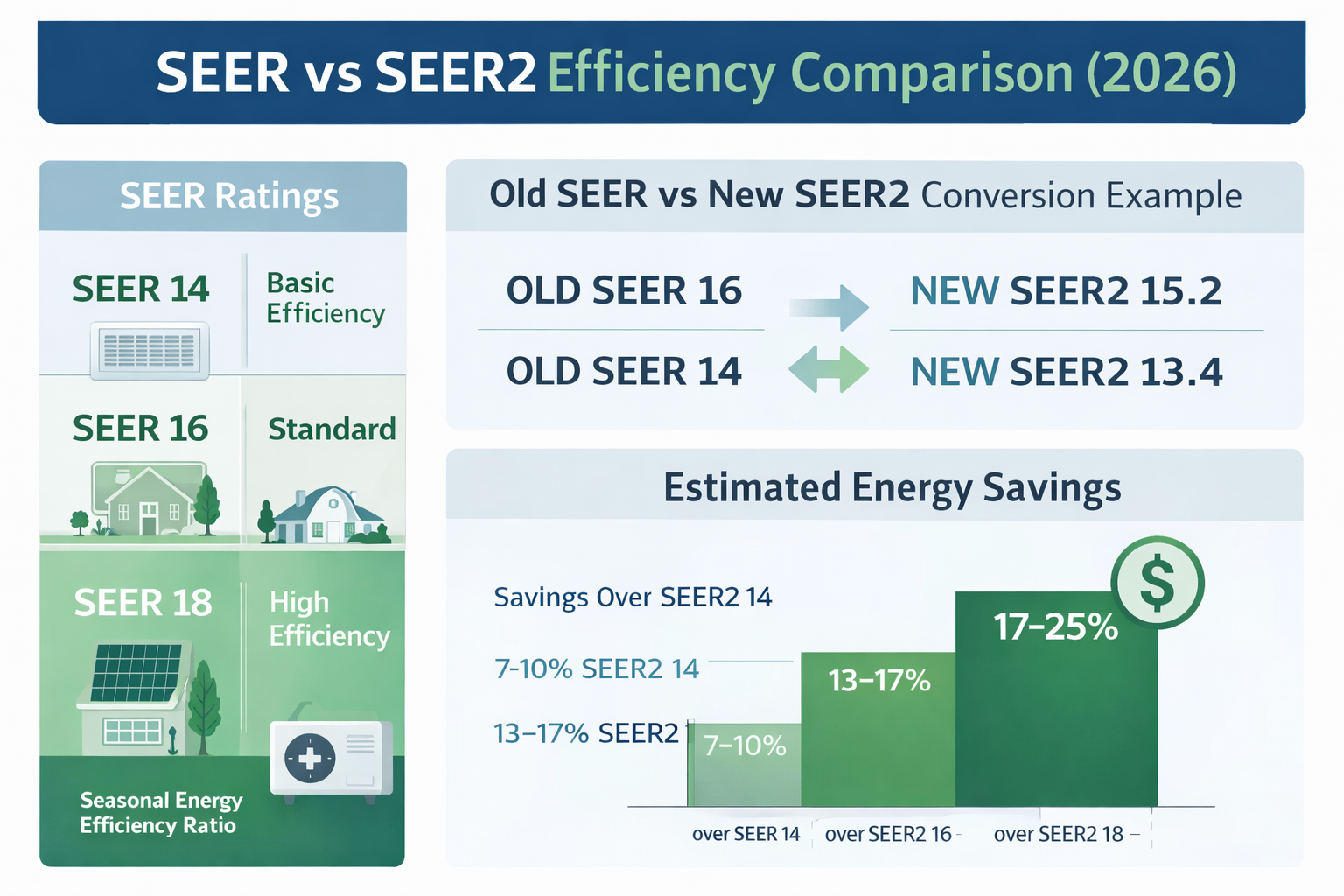
| Old Rating | Equivalent Modern Rating |
|---|---|
| SEER 14 | SEER2 13.4 |
| SEER 16 | SEER2 15.2 |
| SEER 18 | Approximately SEER2 17 |
This is why comparing an older brochure advertising SEER 16 directly against a modern unit labeled SEER2 15.2 can be misleading.
Whenever possible, compare:
- SEER with SEER
- SEER2 with SEER2
Mixing the two standards often causes unnecessary confusion.
Why SEER2 Is Actually Better
The purpose of SEER2 was not to make equipment appear less efficient.
The goal was to create testing conditions that more closely resemble how air conditioners operate inside real homes.
Older laboratory testing assumed lower airflow resistance than many installed systems actually experience.
SEER2 accounts for:
- more realistic duct pressure
- real installation airflow conditions
- modern testing requirements
- updated federal efficiency standards
For homeowners, this means today's efficiency ratings provide a better estimate of real operating performance than older SEER labels.
Federal and Regional SEER2 Minimums in 2026
Federal efficiency standards changed when SEER2 became the official testing method. For split-system central air conditioners with certified cooling capacity below 45,000 Btu/h, the federal minimum is SEER2 13.4 nationwide. The regional federal minimum is SEER2 14.3 in the Southeast and Southwest. Systems at or above 45,000 Btu/h have different regional minimums, so both equipment class and installation location matter.
| Classification | SEER2 value | Meaning |
|---|---|---|
| Northern states | 13.4 | Federal minimum for split-system ACs below 45,000 Btu/h |
| Southeastern states | 14.3 | Regional federal minimum for split-system ACs below 45,000 Btu/h |
| Southwestern states | 14.3 | Regional federal minimum for split-system ACs below 45,000 Btu/h |
| ENERGY STAR | 15.2 | Qualification level in DOE's December 2024 examples; not a federal legal minimum |
Local building codes and manufacturer availability may also influence which equipment is commonly installed in your area.
If you're estimating equipment for a specific state, compare our location guides such as Texas, Florida, California, and New York.
SEER14 vs SEER16 vs SEER18
Many homeowners don't actually need the highest efficiency available. The best choice depends on how often the system runs, local electricity prices, and how long you expect to stay in the home.
| Rating | Efficiency | Recommended For | Typical Value |
|---|---|---|---|
| SEER2 14 | Basic | Mild climates | Lowest purchase price |
| SEER2 15–16 | Standard | Most homeowners | Best balance of price and efficiency |
| SEER2 17–18 | High Efficiency | Hot climates | Lower operating cost |
| SEER2 19+ | Premium | Heavy annual AC usage | Maximum efficiency |
For many homes, the middle range often provides the strongest balance between purchase price and long-term operating cost.
Estimated Annual Electricity Savings
Higher efficiency does not make the house colder. Instead, it reduces the electricity required to produce the same amount of cooling.
Actual savings depend on:
- annual cooling hours
- electricity prices
- system sizing
- installation quality
- duct performance
Typical annual savings compared with a basic SEER2 14 system may look like this.
| Efficiency | Typical Energy Savings* |
|---|---|
| SEER2 14 | Baseline |
| SEER2 16 | Approximately 7–10% |
| SEER2 18 | Approximately 13–17% |
| SEER2 20+ | Approximately 17–25% |
*Actual savings vary depending on installation quality, climate, runtime, utility rates, and system sizing.
When Is Higher SEER Worth the Extra Cost?
Paying more for a higher-efficiency system makes sense only when the long-term electricity savings justify the higher purchase price.
Higher SEER ratings generally provide the greatest value if:
- you live in a hot climate
- the AC runs for several months every year
- electricity prices are high
- you expect to stay in the home for many years
- summer humidity is consistently high
In these situations, the additional purchase cost may gradually be recovered through lower utility bills.
When Paying More for Higher SEER May NOT Make Sense
Higher efficiency is not automatically the best investment for every homeowner.
A premium SEER rating may provide limited financial benefit when:
- the cooling season is short
- electricity prices are relatively low
- the home is being sold soon
- the air conditioner operates only occasionally
- the existing duct system performs poorly
Improving insulation, sealing duct leaks, or choosing the correct equipment size often delivers greater comfort than simply purchasing the highest SEER available.
Before upgrading efficiency, verify that your equipment size is correct using our AC Size Calculator and BTU Guide.
SEER vs Tonnage
Another common misunderstanding is confusing efficiency with cooling capacity.
| Measurement | What It Means |
|---|---|
| SEER / SEER2 | How efficiently the AC uses electricity. |
| Tonnage | How much cooling the system can produce. |
For example, both of these systems produce roughly the same amount of cooling.
- 3 Ton SEER2 14
- 3 Ton SEER2 18
The higher-SEER model simply requires less electricity to produce that cooling.
If you are unsure what tonnage your home needs, read:
SEER vs Variable-Speed Air Conditioners
Many homeowners assume that buying a higher SEER rating automatically means buying a better air conditioner. In reality, the compressor technology often has just as much impact on comfort as the efficiency rating itself.
Modern air conditioners generally use one of three compressor designs:
| Compressor Type | Operation | Typical SEER Range |
|---|---|---|
| Single-Stage | Runs at full capacity whenever cooling is needed. | 13–15 SEER2 |
| Two-Stage | Can operate at both low and high capacity. | 15–18 SEER2 |
| Variable-Speed | Continuously adjusts output to match cooling demand. | 18–22+ SEER2 |
Variable-speed systems usually provide:
- better humidity control
- more stable indoor temperatures
- quieter operation
- improved efficiency during part-load operation
- longer operating cycles with fewer temperature swings
While these systems typically cost more upfront, many homeowners choose them for improved comfort rather than electricity savings alone.
Higher SEER Does Not Fix Installation Problems
One of the biggest misconceptions is that buying the most efficient air conditioner automatically solves comfort issues.
It doesn't.
Even the highest SEER2 equipment can perform poorly if the installation itself has problems.
A higher efficiency system cannot correct:
- undersized ductwork
- poor airflow
- incorrect refrigerant charge
- oversized equipment
- undersized equipment
- leaking ducts
- poor attic insulation
- improper thermostat placement
This is why professional contractors typically perform sizing calculations before recommending equipment.
If the system size is wrong, comfort problems may continue regardless of how efficient the equipment is.
Learn more:
Common SEER Myths
SEER ratings are often misunderstood. Here are some of the most common myths homeowners encounter.
| Myth | Reality |
|---|---|
| Higher SEER cools faster. | No. Cooling speed depends primarily on system sizing and airflow. |
| Higher SEER means a larger AC. | No. SEER measures efficiency, not cooling capacity. |
| Higher SEER fixes humidity problems. | Not necessarily. Proper sizing and staging matter much more. |
| The highest SEER always saves money. | Only if your cooling usage is high enough to recover the additional purchase cost. |
| SEER and SEER2 are the same. | No. SEER2 uses updated testing procedures that better reflect real operating conditions. |
How to Choose the Right SEER Rating
Instead of asking "What is the highest SEER I can afford?", ask "Which SEER rating makes the most sense for my home?"
A practical decision guide looks like this:
| Your Situation | Recommended SEER2 |
|---|---|
| Small home in a mild climate | 13.4–14 |
| Average family home | 15–16 |
| Hot southern climate | 16–18 |
| Very high annual AC usage | 18+ |
| Long-term homeowner with high electricity costs | 18–20+ |
Choosing the right efficiency is only one part of the equation. Before selecting equipment, confirm:
- the correct tonnage
- duct condition
- airflow requirements
- installation quality
- expected annual runtime
Those factors often have a greater impact on comfort than the efficiency rating alone.
Frequently Asked Questions
Is SEER2 better than SEER?
SEER2 is not necessarily more efficient than SEER. It is simply measured using updated testing procedures that better represent real residential operating conditions.
Is SEER 16 worth the extra money?
For many homeowners, yes. SEER2 15–16 often provides one of the best balances between purchase price, energy savings, and long-term operating cost.
Does a higher SEER air conditioner cool my home faster?
No. Cooling speed depends primarily on system capacity, airflow, insulation, and proper installation rather than efficiency rating.
Can I install a high-SEER unit with old ductwork?
Yes, but poor ductwork can reduce overall system performance. Before investing in premium equipment, have the duct system inspected to ensure it can deliver the expected airflow.
What SEER2 rating is best for hot climates?
Homes in regions with long cooling seasons often benefit from SEER2 ratings between 16 and 18 or higher, particularly where electricity costs are above average.
Should I choose a higher SEER or a larger AC?
Always choose the correct size first. An oversized system may reduce comfort even if it has a very high efficiency rating.
Bottom Line
SEER and SEER2 ratings measure how efficiently an air conditioner converts electricity into seasonal cooling—not how much cooling it produces.
A higher efficiency rating can reduce long-term electricity costs, but only when the equipment is properly sized and professionally installed.
For most homeowners, choosing the right air conditioner means balancing efficiency, installation quality, climate, and expected runtime rather than simply buying the highest SEER available.
Before making a final decision, calculate the correct system size using our AC Size Calculator, review the Air Conditioner Sizing Guide, and compare total installation costs with our Central AC Replacement Cost Guide. A properly sized and correctly installed system will usually deliver greater comfort and better long-term value than simply choosing the highest efficiency rating available.
Related technical guides
Use these internal references to extend the checks in SEER Rating Explained without changing the measurement boundary or substituting a nearby topic for the original question.
- For the calculation and equipment-selection context, read SEER vs SEER2: What’s the Difference?; nominal ratings must be checked against the building load and matched performance data.
Sources and verification
The technical statements in SEER Rating Explained (SEER2 Update – 2026 Guide) were cross-checked against the primary references below. Final sizing, airflow, electrical, combustion, and refrigerant decisions must also follow the exact equipment instructions and applicable local code.