AC Labor Cost Breakdown in 2026
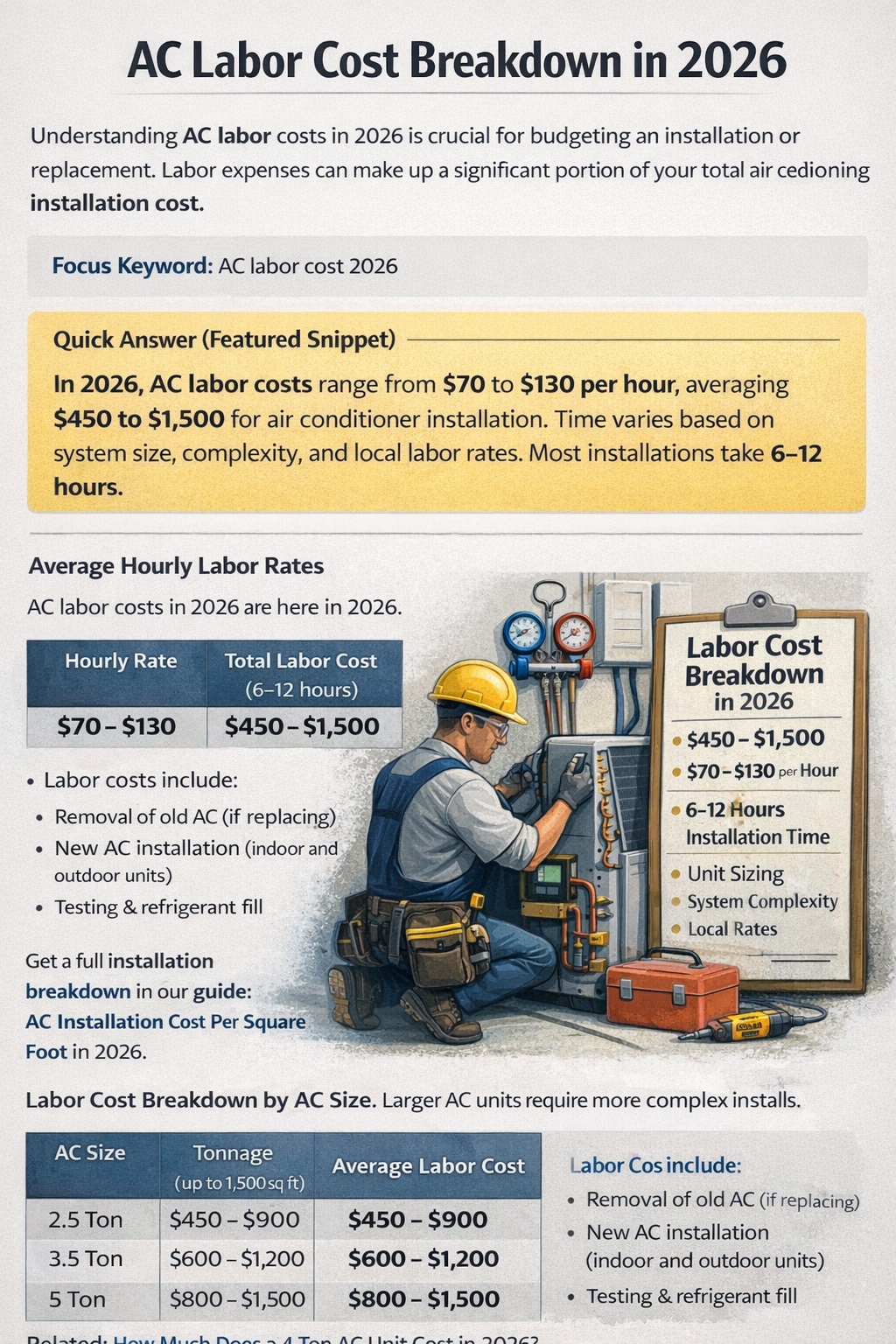
AC labor cost in 2026 usually ranges from $2,000 to $5,500, depending on system size, installation difficulty, crew size, duct condition, electrical readiness, and local labor rates.
Labor is one of the most important parts of an AC installation or replacement because it determines whether the system is installed safely, charged correctly, tested properly, and set up to deliver the comfort the equipment is designed to provide.
Quick Answer
Fixr's U.S. 2026 cost dataset, updated January 28, lists $500 to $2,500 for labor to install a standard central AC system and $75 to $250 per hour for labor. The source describes a standard central installation; it is a national planning reference, not a local contractor rate or a quote for every project.
Labor scope matters more than a headline number. Confirm whether the written proposal includes removal, refrigerant work, electrical connections, startup, airflow checks, permits, and any duct or access work.
What AC Labor Cost Actually Pays For
AC labor cost is not simply the price of someone placing a condenser outside. A proper air conditioner installation involves several skilled steps that affect safety, comfort, efficiency, and system life.
In most professional AC jobs, labor may include:
- removing the old AC system if this is a replacement
- setting the new outdoor condenser
- installing or reconnecting the evaporator coil
- connecting refrigerant lines
- brazing or reconnecting line-set components when needed
- pulling a vacuum before startup
- charging or verifying refrigerant level
- making basic electrical connections
- checking airflow and system operation
- testing the system after installation
This is why labor can represent a large part of the total AC project cost. A cheaper labor quote may look attractive at first, but if it skips startup testing, airflow checks, or proper refrigerant handling, the system may not perform correctly.
Typical HVAC Labor Cost Per Hour
Fixr's 2026 U.S. dataset lists $75 to $250 per hour for standard central AC installation labor. That range is not a local rate card: region, job complexity, access, season, and whether the contractor quotes a flat project price can materially change the number.
For a written proposal, compare the scope rather than multiplying an assumed crew size by an assumed number of hours.
AC Labor Cost by Project Type
The cited national source supports a standard central-AC installation labor range of $500 to $2,500, but it does not publish compatible national labor-only ranges for every replacement, complex installation, or new-duct scenario. Do not treat one local quote as a U.S. benchmark. Projects that add duct design, major electrical work, difficult access, or extensive refrigerant-line changes need a separately scoped local quote.
Why AC Labor Cost Is Different From Total Installation Cost
AC labor cost and total installation cost are related, but they are not the same thing. Labor is only the work required to install, connect, test, and start the system. Total installation cost may also include the outdoor condenser, indoor coil, refrigerant materials, thermostat, permits, duct repairs, electrical work, and other job-specific items.
This distinction matters because two quotes can look very different even when the labor quality is similar. One contractor may show labor separately, while another may bundle labor into the total system price.
For full project pricing by home size, compare this guide with AC Installation Cost Per Square Foot in 2026.
AC Labor Cost by System Size
The cited source does not provide a comparable national labor-only table by tonnage, so this guide does not assign a labor range to 2-, 3-, 4-, or 5-ton systems. Installation complexity, not tonnage alone, often drives labor. Confirm the correct equipment size before requesting like-for-like scopes.
Why Labor Quotes Can Vary So Much
Many homeowners are surprised when two contractors provide labor estimates that differ by several thousand dollars. In most cases, the difference is not simply hourly pay—it is the scope of work included in the proposal.
One contractor may include every installation step in a single labor charge, while another separates certain tasks into additional line items.
Labor prices commonly change because of:
- attic or crawlspace accessibility
- equipment location
- existing refrigerant line condition
- electrical readiness
- permit requirements
- startup and commissioning procedures
- crew size
- travel distance
- seasonal demand
This explains why the cheapest quote is not always the least expensive project once additional charges begin appearing after work starts.
What Labor Usually Includes
Although every contractor structures proposals differently, professional labor commonly includes the following work.
- removing the existing system when applicable
- positioning the outdoor condenser
- installing or reconnecting the evaporator coil
- connecting refrigerant piping
- vacuum testing before startup
- charging or verifying refrigerant
- electrical wiring connections
- system startup
- basic airflow verification
- performance testing
These procedures help ensure that the equipment operates safely and efficiently from the first day.
What Labor Usually Does NOT Include
Many homeowners assume every installation quote covers every possible expense. In reality, several project components are often billed separately because they depend entirely on the existing home.
Common exclusions include:
- complete duct replacement
- major duct redesign
- electrical panel upgrades
- structural framing work
- new concrete equipment pads
- major refrigerant line relocation
- drywall repair
- painting and finish work
If your electrical service is outdated, review AC Electrical Panel Upgrade Cost in 2026 before comparing installation bids.
Likewise, homes with aging or damaged duct systems may require additional work beyond the standard labor charge. You can estimate those costs separately in our Ductwork Replacement Cost guide.
Replacement Labor vs New Installation Labor
There is an important difference between replacing an existing air conditioner and installing central air in a home for the first time.
Replacing an Existing AC
When ductwork, equipment location, refrigerant routing, and electrical service already exist, labor is generally more predictable. Technicians can remove the old equipment and install the replacement using much of the existing infrastructure, provided it remains in good condition.
This is why replacement labor typically stays within the lower end of the normal labor range.
Installing Central Air for the First Time
Homes without an existing central cooling system often require considerably more labor because technicians may need to design airflow paths, install supply and return ducts, determine equipment placement, and coordinate multiple trades.
Those projects frequently require additional planning before installation even begins.
If you are budgeting the entire project instead of labor alone, compare this guide with Central AC Replacement Cost in 2026, which explains how labor fits into total installation pricing.
Regional Labor Differences
HVAC labor rates vary significantly across the United States. Contractors operating in areas with higher wages, stricter permitting requirements, or heavy seasonal demand generally charge more than companies serving lower-cost regions.
Higher labor rates are commonly found in:
- major metropolitan areas
- regions with high living costs
- areas requiring extensive permitting and inspections
- locations experiencing strong summer demand
Lower labor rates are more common in:
- smaller cities
- many rural communities
- regions with lower operating costs
If you're estimating a complete installation, remember that labor is only one part of the project. Equipment size also affects overall cost. Before approving any proposal, confirm the proper cooling capacity using our How Many BTU Do I Need? guide or the Air Conditioner Sizing Guide.
How to Compare HVAC Labor Quotes
When comparing AC labor quotes, do not look only at the final labor number. A lower quote may exclude important installation steps, while a higher quote may include testing, permit coordination, and warranty support.
Before choosing a contractor, ask these questions:
- Is labor listed separately or bundled into the total price?
- Does the quote include removal of the old system?
- Are refrigerant line work and vacuum testing included?
- Is startup testing included?
- Are airflow checks included?
- Are permit coordination and inspection time included?
- What happens if duct or electrical issues are found?
- Is labor warranty included?
A clear labor quote should explain what work is included, what is excluded, and what could increase the price after the job begins.
How to Reduce AC Labor Cost
You usually cannot remove labor cost from an AC project, but you can reduce avoidable labor surprises by preparing the home before installation day.
- Get at least three written quotes.
- Replace during the off-season when possible.
- Confirm electrical capacity before installation.
- Inspect ductwork before choosing equipment size.
- Avoid unnecessary equipment relocation.
- Choose the correct AC size before approving the quote.
Many expensive labor add-ons happen because sizing, duct, or electrical problems are discovered too late. If the home may need a larger system, compare related equipment guides such as How Much Does a 2 Ton AC Unit Cost in 2026?, How Much Does a 3 Ton AC Unit Cost in 2026?, How Much Does a 4 Ton AC Unit Cost in 2026?, and How Much Does a 5 Ton AC Unit Cost in 2026?.
Common AC Labor Cost Mistakes
The biggest mistake is comparing labor quotes without comparing the scope of work. Two contractors may use the same equipment size but include very different labor details.
Common mistakes include:
- choosing the lowest labor quote without checking what is included
- assuming permit work is included
- ignoring duct condition before installation
- approving a larger system without checking airflow needs
- forgetting electrical upgrades may be separate
- not asking about startup testing
- not confirming labor warranty terms
A low labor price is not always bad, and a high labor price is not always unfair. The important question is whether the quote includes the work needed for a safe, code-compliant, properly tested installation.
Why Correct AC Sizing Can Lower Labor Waste
Incorrect AC sizing can increase labor cost because the installer may need to solve problems created by the wrong equipment choice. An oversized system may require duct changes, airflow adjustments, or electrical work that could have been avoided with better planning.
A properly sized system is usually easier to install correctly because the equipment, ductwork, airflow, and electrical requirements are more likely to match the home.
Before approving a system size, compare your estimate with the Air Conditioner Sizing Guide, AC Size Chart, and AC Size Calculator.
AC Labor Cost FAQ
How much does AC labor cost in 2026? Fixr's U.S. 2026 dataset lists $500 to $2,500 for labor to install a standard central AC system. The applicable amount depends on the local scope and is not a quote.
How much do HVAC technicians charge per hour? The same source lists $75 to $250 per hour for installation labor. Local rates can be outside that planning range.
Why is AC installation labor so expensive? AC labor includes skilled refrigerant work, electrical connections, airflow setup, equipment handling, startup testing, and code-compliant installation. Poor labor can reduce comfort and shorten system life.
Is labor included in AC replacement cost? Usually yes, but not always in the same way. Some contractors show labor as a separate line item, while others bundle it into the total replacement price. Always ask what is included before comparing quotes.
Does ductwork increase AC labor cost? Yes. Duct repair, duct replacement, or a duct redesign can add labor and should be stated separately in the proposal.
Can I negotiate AC labor cost? You can compare written scopes, timing, warranties, and included work. A lower number is useful only when the scope is comparable.
Is the cheapest AC labor quote a bad choice? Not necessarily. Check whether it includes the required installation, testing, permitting, and warranty work before deciding.
Final AC Labor Cost Summary
For national planning, Fixr's January 2026 data lists $500 to $2,500 for standard central-AC installation labor and $75 to $250 per hour. Those figures do not establish a local rate or a labor-only price for every project. The best comparison is a written, like-for-like scope that states what is included, excluded, tested, and warranted.
Sources and verification
The technical statements in AC Labor Cost Breakdown in 2026 were cross-checked against the primary references below. Final sizing, airflow, electrical, combustion, and refrigerant decisions must also follow the exact equipment instructions and applicable local code.