Category: AC Problems & Symptoms

Troubleshoot common air conditioner problems, warning signs, and comfort issues. Learn what causes short cycling, nonstop runtime, weak cooling, humidity problems, freezing, loud operation, and other AC symptoms — plus what to check before calling a technician.

  • Undersized AC Symptoms: 7 Signs Your Air Conditioner Is Too Small

    undersized AC symptoms air conditioner running constantly

    Undersized AC Symptoms: 7 Signs Your Air Conditioner Is Too Small

    Quick Answer: An undersized air conditioner does not have enough cooling capacity to keep up with your home’s heat load. The most common signs include constant runtime, trouble reaching the thermostat setting, weak cooling in the hottest part of the day, uneven room temperatures, and rising utility bills. A system that is too small may run almost nonstop and still leave the house uncomfortable.

    That is what makes undersizing so frustrating: the AC seems to be working all the time, but comfort never quite catches up.

    What an undersized AC usually feels like

    When an air conditioner is properly sized, it should cool the home in balanced cycles and maintain a stable indoor temperature without running endlessly. When the unit is too small, it struggles to remove heat as quickly as the house gains it.

    Instead of short bursts of cooling followed by rest, the system may stay on for very long periods and still fail to fully satisfy the thermostat. That is the opposite of what happens with an oversized unit, which cools too fast and shuts off too early. For that comparison, see Oversized AC Symptoms.

    1. Your AC seems to run all day

    The most obvious sign of an undersized air conditioner is nonstop or near-nonstop operation. If the system rarely shuts off during warm weather, there may not be enough capacity to handle the space.

    Some runtime increase is normal on very hot days, but if the AC runs constantly even when conditions are only moderately warm, undersizing becomes much more likely.

    If that is the symptom you notice most, also read Why Is My AC Running Constantly?.

    2. The thermostat setting is never really reached

    A classic example is setting the thermostat to 72°F while the indoor temperature sits at 76°F or 77°F for hours. The AC is running, but the house never fully gets where you want it.

    This usually becomes more obvious in the late afternoon, when outdoor heat, sun exposure, and indoor heat gain all peak together.

    3. Cooling gets noticeably worse during peak heat

    An undersized system can sometimes seem “fine” in mild weather, then fall behind badly once outdoor temperatures climb. That is because the system may be close to adequate under lighter conditions, but not strong enough when the real summer load shows up.

    If you want the basic capacity concepts behind this, start with What Is BTU in Air Conditioning? and What Is a Ton in HVAC?.

    4. Energy bills keep rising

    Many people assume a smaller AC should automatically cost less to run. In practice, an undersized unit can end up using a lot of electricity because it stays on for such long stretches.

    Even though the equipment itself is smaller, long runtimes add up. A system that never gets a break may cost more than expected, especially in hot climates or poorly insulated homes.

    5. Certain rooms stay hotter than the rest

    Undersized systems often reveal themselves through hot spots. The AC may cool the main living area reasonably well, but rooms farther away remain warm or uncomfortable.

    Common examples include:

    • upstairs bedrooms that stay hot
    • back rooms that never cool properly
    • spaces with large windows heating up quickly

    If the issue is especially noticeable on upper floors, see Why Is My Upstairs Always Hot? once that post is live.

    6. The system is under constant strain

    When an AC runs near maximum capacity for long periods, internal parts are exposed to more sustained stress. The compressor, fan motor, and electrical components all work harder when the unit has to stay on for hours without enough recovery time.

    That does not mean every constantly running AC is undersized, but if the system is clean and working correctly, persistent overload can point to a sizing mismatch.

    7. Equipment wear happens faster than it should

    An undersized air conditioner may not short cycle like an oversized one, but it still wears down faster in a different way. Instead of repeated startups, the problem is long-term strain from operating near its limits too often.

    Over time, that can lead to:

    • more frequent maintenance needs
    • shorter compressor life
    • higher repair costs
    • reduced overall system lifespan

    If you want to compare this with startup-related strain, read AC Short Cycling Explained.

    Why an AC ends up undersized in the first place

    Undersizing usually starts with a bad assumption during equipment selection. That can happen when a system is chosen from square footage alone without considering how the house actually gains heat.

    Common reasons include:

    • incorrect square footage estimates
    • home additions without HVAC upgrades
    • poor insulation assumptions
    • more occupants or appliances than before
    • ignoring windows, ceilings, and sun exposure

    That is why sizing should never be based only on guesswork. For a broader overview, see Air Conditioner Sizing Guide, AC Size Chart, and AC Size Calculator.

    How to tell if the problem is sizing and not something else

    Ask yourself these questions:

    • Does the AC run for extremely long periods in summer?
    • Does the indoor temperature stay above the thermostat setting?
    • Do bills rise even though comfort stays poor?
    • Does the house cool much better at night than during the day?

    If several of those are true at the same time, the system may be too small. If you want a more direct diagnostic angle, read Is My AC Too Small?.

    Can you improve an undersized AC without replacing it?

    Sometimes you can reduce the symptoms even if you cannot completely solve the core sizing issue right away. Helpful upgrades may include:

    • improving insulation
    • sealing air leaks
    • reducing attic heat gain
    • cleaning coils and filters
    • improving airflow where possible

    Those steps can help the system perform better, but if the unit is significantly undersized for the load, the permanent fix may be replacing it with properly sized equipment.

    Frequently asked questions

    Is it worse to have an undersized or oversized AC?

    Both are bad in different ways. Undersized systems tend to run too long and wear down from continuous strain, while oversized systems often short cycle and control humidity poorly.

    Will an undersized AC wear out faster?

    Yes, it can. Running near full capacity for long periods puts added stress on major components and can shorten system life.

    How long should an AC normally run in summer?

    In many homes, normal cycles are around 15 to 20 minutes depending on heat, humidity, and insulation. If the system almost never shuts off, that can be a warning sign.

    Bottom line

    Undersized AC symptoms usually show up as long runtimes, weak cooling during peak heat, rooms that never feel balanced, and energy bills that keep climbing. The system may appear hardworking, but that does not mean it is correctly matched to the home.

    If your air conditioner runs for hours, struggles to hit the set temperature, and still leaves parts of the house warm, the equipment may simply be too small for the load.

    Helpful next reads: Is My AC Too Small?, Why Is My AC Running Constantly?, What Is BTU in Air Conditioning?, What Is a Ton in HVAC?, and Air Conditioner Sizing Guide.
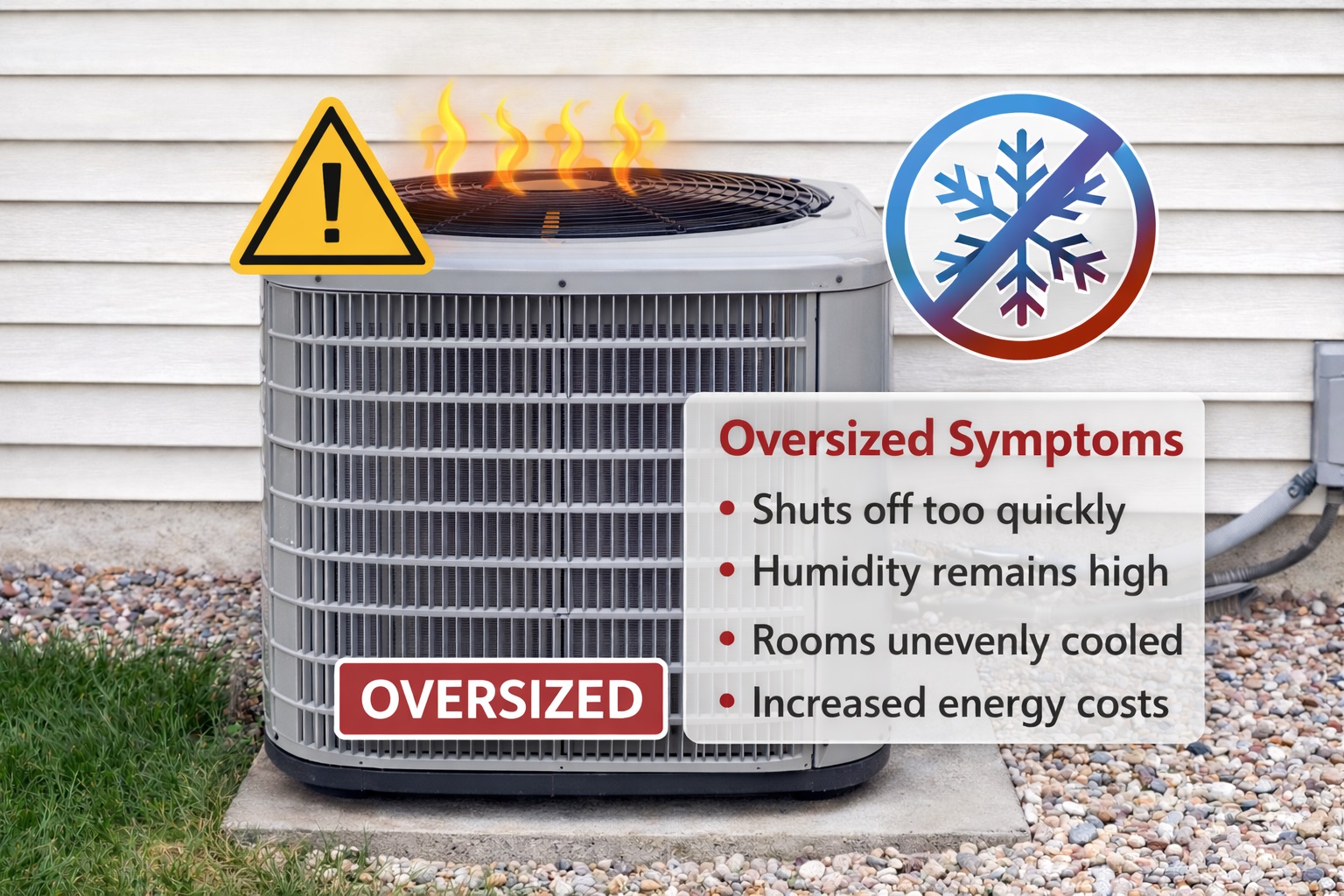
  • Oversized AC Symptoms: 7 Signs Your Air Conditioner Is Too Big

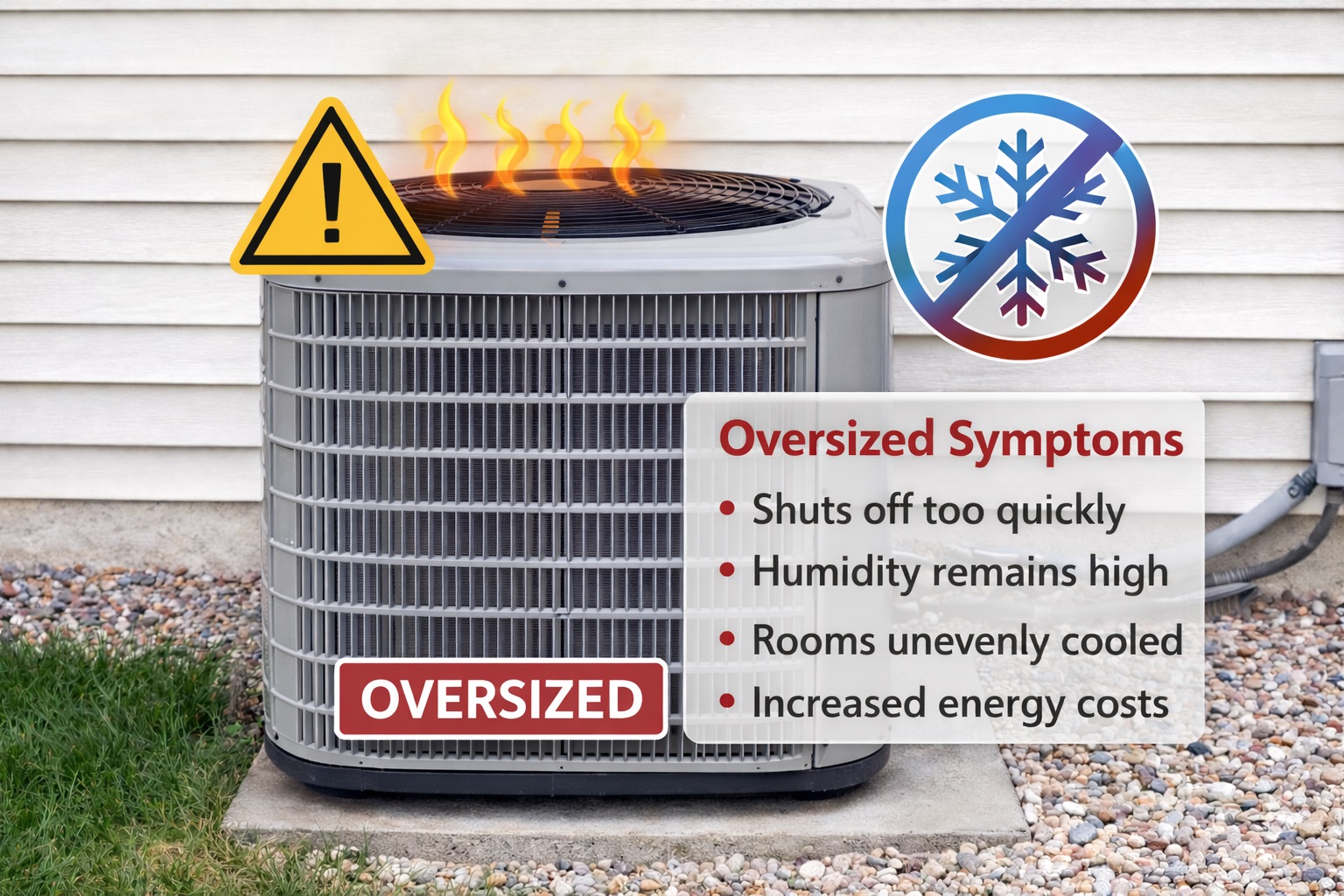
    oversized AC symptoms outdoor air conditioner unit shutting off too quickly

    Oversized AC Symptoms: 7 Signs Your Air Conditioner Is Too Big

    Quick Answer: An oversized air conditioner cools your home too fast, shuts off too early, and then starts again soon after. That pattern can lead to short cycling, poor humidity removal, uneven temperatures, higher electric bills, and extra wear on major components. A bigger AC may sound more powerful, but it often creates worse comfort.

    Many homeowners expect an oversized system to cool better. In reality, air conditioners work best when they run in balanced cycles long enough to remove both heat and moisture from the air.

    Why an oversized AC causes problems

    An air conditioner is not supposed to blast the house cold in just a few minutes and stop. It is supposed to run steadily, gradually bring the temperature down, and control humidity at the same time.

    When the system is too large for the home, the thermostat is satisfied too quickly. That sounds efficient, but it often means the unit never gets enough runtime to do the full job properly.

    If you want the basic sizing concepts first, start with What Is BTU in Air Conditioning?, What Is a Ton in HVAC?, and the full Air Conditioner Sizing Guide.

    1. Short cycling is happening all day

    The clearest sign of an oversized AC is short cycling. The system turns on, runs briefly, shuts off, and then comes back on again much sooner than it should.

    If your AC is regularly running for less than about 8 to 10 minutes per cycle, oversizing becomes a real possibility. This repeated start-stop pattern is hard on the compressor and electrical parts.

    For a deeper explanation, read AC Short Cycling Explained and How Long Should AC Run Per Cycle?.

    2. The house feels cool but still humid

    A properly sized AC does more than lower temperature. It also removes moisture. Oversized units often shut down before the evaporator coil has enough time to pull out sufficient humidity.

    That can leave you with:

    • sticky or clammy indoor air
    • musty smells
    • condensation on windows
    • rooms that feel cold but uncomfortable

    If that sounds familiar, also read Why Is My House Humid Even With the AC On?.

    3. Some rooms get too cold while others stay warm

    An oversized system can dump cold air into parts of the home quickly without allowing enough time for balanced distribution. Rooms near the thermostat or supply vents may cool fast, while farther rooms remain warmer than they should.

    This is one reason people get confused and assume the problem is ductwork alone. Sometimes the unit is simply too large and never runs long enough to deliver steady comfort through the whole house.

    4. Electric bills go up instead of down

    A larger AC does not automatically save money. In fact, oversized systems often cost more to run because compressor startup is one of the most energy-intensive moments in the cycle.

    If the unit starts over and over again, total energy use can rise even though each individual runtime is short.

    If you are already noticing operation-related cost issues, see Why Is My AC Running Constantly? for comparison with undersizing and other runtime problems.

    5. Parts wear out faster than expected

    Frequent cycling increases stress on components such as the:

    • compressor
    • capacitor
    • contactor
    • electrical relays

    Over time, that constant starting and stopping can shorten equipment life. Homeowners often think the system is “strong” because it cools fast, but mechanically it may be working in a very inefficient pattern.

    6. The system sounds louder than it should

    Oversized equipment often creates more noticeable bursts of operation. You may hear sudden airflow, loud startup noise, repeated clicking, or compressor surges throughout the day.

    Loud operation by itself does not prove oversizing, but when it appears together with short cycles and humidity problems, it becomes a stronger clue.

    7. Comfort still feels bad despite fast cooling

    This is where many people finally realize something is wrong. The home reaches the set temperature quickly, but comfort never feels stable. That happens because temperature alone is not the same as comfort.

    Real comfort depends on:

    • steady runtime
    • humidity control
    • balanced airflow
    • consistent room temperatures

    An oversized AC may win the race to the thermostat, but still lose on comfort.

    Why oversized systems get installed in the first place

    Oversizing usually happens because the equipment was selected using shortcuts instead of real load calculations. Common reasons include:

    • rule-of-thumb sizing based only on square footage
    • assuming “bigger is better”
    • not accounting for insulation or window exposure
    • ignoring ceiling height and home layout

    That is why accurate sizing matters so much. For a broader sizing reference, see AC Size Chart and AC Size Calculator.

    How to tell whether your AC is actually too big

    If several of these signs happen at the same time, oversizing becomes more likely:

    • cooling cycles are unusually short
    • humidity remains high indoors
    • some rooms feel much colder than others
    • your bills are climbing without a clear reason
    • the system starts and stops repeatedly

    If you want a more direct diagnostic guide, read Is My AC Too Big for My House?.

    Can an oversized AC be fixed without replacing it?

    Sometimes small improvements can reduce the symptoms. Thermostat adjustments, duct balancing, airflow changes, or better control settings may help a little.

    But if the equipment is significantly oversized, those changes usually do not solve the core problem. In those cases, the long-term fix may be replacing the unit with one that actually matches the load of the home.

    Frequently asked questions

    Is a slightly oversized AC always bad?

    A small oversizing margin is often manageable. Major oversizing is where comfort and efficiency problems start becoming obvious.

    Can an oversized AC cause mold or moisture problems?

    Yes. Poor dehumidification can leave excess moisture in the air, which may increase the risk of mold and mildew over time.

    How long should an AC cycle last if it is sized correctly?

    In many homes, normal runtimes are around 10 to 20 minutes depending on outdoor conditions, humidity, and insulation quality.

    Bottom line

    Oversized AC symptoms are easy to misread because the house may cool quickly at first. But fast cooling does not mean proper cooling. If your system short cycles, leaves the air humid, creates uneven temperatures, and drives up operating costs, the unit may be too large for the home.

    The goal is not to install the most powerful system possible. The goal is to install one that runs long enough to cool evenly, remove moisture, and operate efficiently.

    Helpful next reads: AC Short Cycling Explained, Is My AC Too Big for My House?, What Is a Ton in HVAC?, What Is BTU in Air Conditioning?, and Air Conditioner Sizing Guide.

  • AC Short Cycling Explained

    ac short cycling outdoor air conditioner unit

    Quick Answer: AC short cycling means your air conditioner turns on and off too often without completing a normal cooling cycle. Instead of running long enough to cool the home and remove humidity, it may shut off after only a few minutes and restart again soon after. This wastes energy, increases wear, and can shorten the life of the system.

    As a general rule, if your AC repeatedly runs for less than about 8 minutes per cycle, short cycling may be the problem.

    What short cycling looks like in real life

    Many homeowners first notice short cycling because the system feels “busy” all day without actually keeping the home comfortable. The thermostat calls for cooling, the AC starts, runs briefly, shuts off, and then turns back on again before the indoor temperature has really stabilized.

    A healthy system usually runs in steadier cycles. If you are not sure what normal looks like, read How Long Should AC Run Per Cycle?.

    Why AC short cycling is a problem

    Short cycling is not just annoying. It puts the system into one of the least efficient operating patterns possible. Air conditioners work best when they can run long enough to cool the space gradually and remove moisture at the same time.

    When that does not happen, several problems show up:

    • higher energy use from repeated compressor starts
    • poor humidity removal
    • more noticeable temperature swings
    • extra stress on components like the compressor and capacitor

    If your home feels cool but still damp, that may be connected to short cycling. See Why Is My House Humid Even With the AC On?.

    What causes an air conditioner to short cycle?

    There is no single cause. Short cycling can come from sizing problems, airflow restrictions, controls, or refrigerant issues. Some are simple to fix. Others need a technician.

    An oversized AC unit

    This is one of the most common causes. If the air conditioner is too large for the space, it may cool the air around the thermostat too quickly and shut down before the rest of the house is properly conditioned.

    That is why correct sizing matters so much. If you think your unit may be too large, read Oversized AC Symptoms and Is My AC Too Big for My House?.

    A dirty air filter or airflow restriction

    Restricted airflow can raise system stress and cause the AC to behave irregularly. A clogged filter, blocked return, or dirty coil can all contribute to short and inefficient cycles.

    Airflow matters more than most homeowners realize. A good companion read is How Many CFM Per Ton?.

    Low refrigerant

    Low refrigerant can create pressure problems that interfere with normal cooling operation. This is not a DIY repair and should be checked by a licensed HVAC technician.

    Thermostat placement problems

    If the thermostat is near a supply vent, in direct sun, or poorly calibrated, it can misread room conditions and shut the system off too early.

    Electrical component problems

    Weak capacitors, failing contactors, or relay issues can also cause abnormal starts and stops. These problems usually get worse over time rather than better.

    How long should an AC cycle normally run?

    In many homes, a normal AC cycle lasts around 10 to 20 minutes, depending on outdoor temperature, humidity, insulation, and system size. On milder days, runtimes may be shorter. On very hot days, the system may stay on longer.

    If the unit repeatedly shuts off after only a few minutes, that is when short cycling becomes much more likely.

    Can incorrect AC sizing cause short cycling?

    Yes. In fact, sizing errors are one of the biggest reasons this happens. An oversized unit cools too quickly, which sounds good at first, but often leads to poor dehumidification and frequent restart cycles.

    If you want to understand the basics behind AC capacity, start with What Is a Ton in HVAC? and What Is BTU in Air Conditioning?. For the bigger picture, see Air Conditioner Sizing Guide.

    How to fix AC short cycling

    The right fix depends on the actual cause, but these are the first places to look:

    • replace a dirty air filter
    • check that vents and returns are open and unobstructed
    • verify thermostat settings and location
    • have refrigerant levels checked
    • confirm that the unit is properly sized for the home

    If the system was oversized from the start, the long-term fix may be replacing it with a correctly sized unit rather than continuing to live with poor performance.

    When short cycling usually means “call a pro”

    You should have the system inspected if:

    • it short cycles several times per hour
    • the breaker trips
    • cooling performance drops noticeably
    • you hear unusual noises during startup or shutdown
    • the home feels humid even while the AC is running

    If your AC runs constantly instead of short cycling, that points to a different problem. In that case, read Why Is My AC Running Constantly? or Is My AC Too Small?.

    Frequently asked questions

    Is AC short cycling dangerous?

    Not usually in the immediate sense, but it can damage the compressor over time and lead to more expensive repairs if ignored.

    Can short cycling raise my electric bill?

    Yes. Starting the compressor repeatedly uses more electricity than allowing the system to run in balanced cooling cycles.

    Does an oversized AC cause short cycling?

    Very often, yes. Oversizing is one of the most common causes of short cycling in residential systems.

    Bottom line

    AC short cycling happens when the system turns on and off too often without finishing a proper cooling cycle. That pattern reduces efficiency, hurts comfort, and increases wear on major components.

    The most common causes include oversizing, dirty filters, thermostat problems, low refrigerant, and electrical faults. Catching the issue early can prevent bigger repair costs later.

    If your AC repeatedly shuts off after just a few minutes, do not ignore it. In many cases, the sooner you diagnose the reason, the easier and cheaper the fix will be.

    Helpful next reads: Oversized AC Symptoms, How Long Should AC Run Per Cycle?, What Is a Ton in HVAC?, Air Conditioner Sizing Guide, and What Is BTU in Air Conditioning?.