Is my AC too big for my house? Yes, it can be. An oversized air conditioner may cool the thermostat area quickly, but that does not mean it is cooling the home correctly. In many cases, a unit that is too large shuts off before it removes enough humidity, which leads to comfort problems, short cycling, and higher long-term operating costs.
That is why bigger is not always better in HVAC. A system that looks powerful on paper can still make the house feel less comfortable.
Quick Answer
Yes, an AC can absolutely be too big for a house. An oversized air conditioner often cools too quickly, shuts off before completing a proper cycle, reduces humidity control, causes short cycling, increases energy use, and puts extra stress on the system.
In HVAC, the goal is not maximum tonnage. The goal is balanced runtime, airflow, and moisture removal.
What happens when an AC is too big?
Air conditioners are supposed to run long enough to do three things well:
- remove heat
- remove humidity
- keep indoor temperature stable
When a system is too large, it can satisfy the thermostat too fast. That sounds efficient, but it often means the cycle ends before the air has been properly dried and distributed through the whole house.
This is where many homeowners get confused. The house may cool quickly, but overall comfort still feels wrong.
1. Your AC short cycles
Short cycling is one of the clearest warning signs of an oversized system.
If your AC:
- turns on
- runs for only 5 to 8 minutes
- shuts off
- starts again soon after
there is a good chance oversizing is part of the problem.
Short cycling increases wear on the compressor and usually reduces efficiency. For a full breakdown, read AC Short Cycling Explained.
2. The house feels cool but still humid
This is one of the most common complaints with oversized AC systems. The temperature may drop quickly, but the indoor air still feels sticky, clammy, or slightly damp.
That happens because proper dehumidification usually needs longer runtime. If the cycle ends too fast, moisture stays behind.
If this sounds familiar, also read Why Is My House Humid Even With the AC On?.
3. You notice uneven temperatures
Oversized systems often blast cold air fast near vents or near the thermostat, but that does not always mean the whole house is cooling evenly.
You may notice:
- cold spots in some rooms
- warm areas farther from the unit
- more noticeable temperature swings
This happens because comfort depends on balanced airflow and stable runtime, not just how fast cold air comes out at the start of a cycle.
4. Energy bills start rising
Many homeowners expect a larger AC to cool faster and therefore cost less to run. In practice, oversized systems often waste energy because they start and stop too often.
Compressor startup is one of the highest-energy moments in the cooling cycle. Frequent restarts can raise electricity use even if each cycle is short.
5. The system sounds too aggressive
If you constantly hear loud startup noise, sudden bursts of airflow, or abrupt shutoffs, that can be another clue the AC is oversized for the house or for the duct design.
Noise alone does not prove oversizing, but when it appears together with short cycling and humidity issues, it becomes a stronger warning sign.
6. Airflow balance feels off
Ductwork designed for a smaller system can struggle when paired with oversized equipment. That may create:
- high static pressure
- loud vents
- reduced efficiency
- room-to-room comfort imbalance
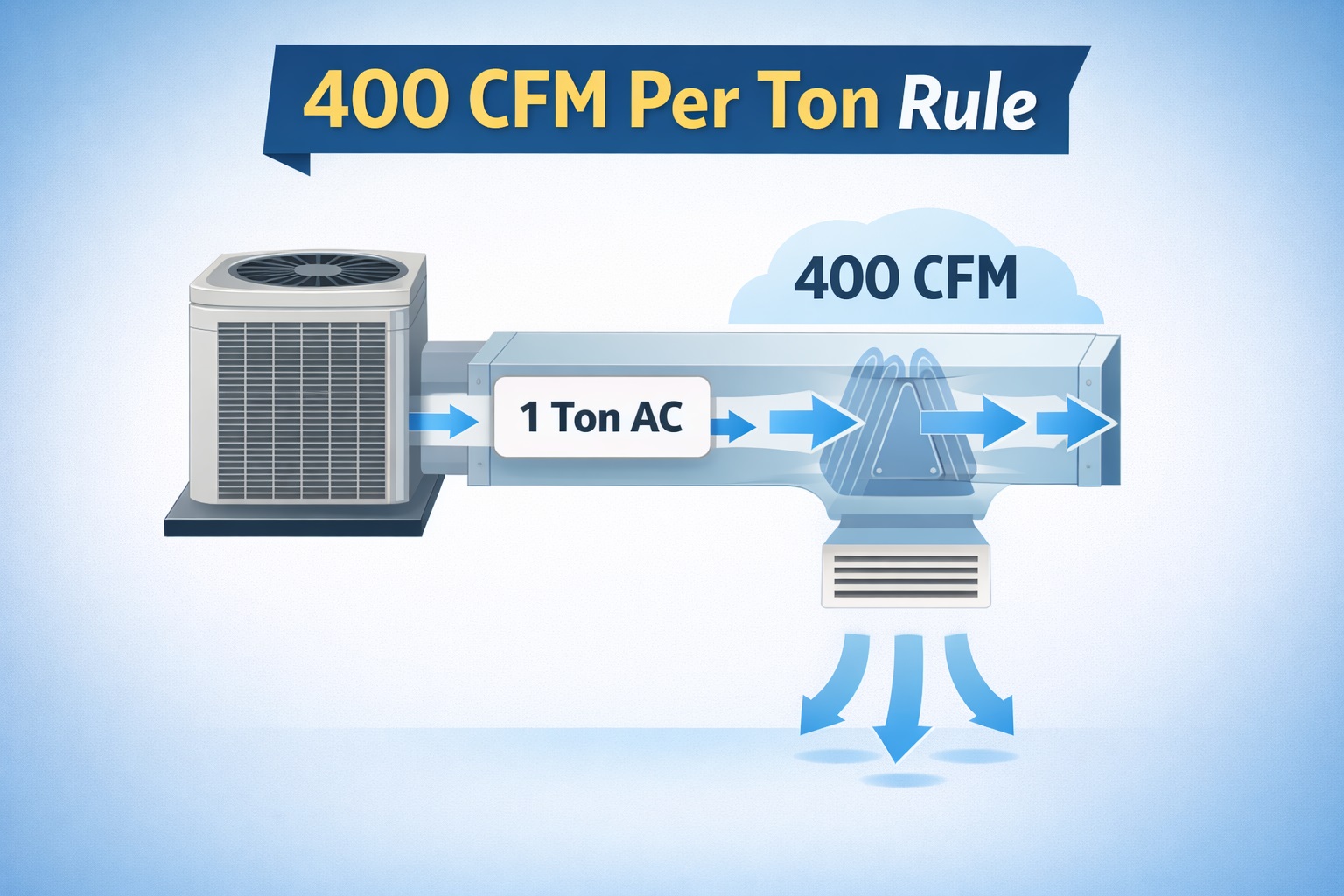
For more on airflow, read How Many CFM Per Ton?.
7. You see moisture or mold-related issues
In humid climates, oversizing can increase the risk of:
- condensation
- musty smells
- mold or mildew growth
This is especially common in places like Florida, Texas, and other warm coastal or humid regions where moisture control matters just as much as temperature control.
Why oversizing happens so often
Most oversized systems are not installed because someone wanted to cause a problem. They are installed because of shortcuts.
Common reasons include:
- contractors rounding up “just to be safe”
- wrong square footage assumptions
- reusing the old unit size without recalculating
- ignoring insulation or window upgrades
That is why proper sizing should be based on a real load calculation, not guesswork. For the full framework, see Air Conditioner Sizing Guide.
Oversized vs undersized AC
These two problems are easy to confuse, but the behavior is different.
| Problem | Typical Behavior |
|---|---|
| Oversized AC | Short cycles, humidity problems, uneven comfort |
| Undersized AC | Runs constantly, struggles to reach set temperature |
If your system never seems to shut off instead, read Why Is My AC Running Constantly? and Undersized AC Symptoms.
Can better technology fix an oversized AC?
Sometimes newer equipment can reduce the symptoms. Two-stage and variable-speed systems can run at lower output most of the time, which improves humidity control and reduces temperature swings.
That said, technology does not fully fix severe oversizing. If the system is far too large for the home, the mismatch still remains.
For more on system efficiency and staging, read SEER Rating Explained.
What should you do if your AC is too big?
1. Confirm the problem with a load calculation
The best first step is to request a Manual J load calculation. This checks whether the system size actually matches the home.
2. Check the duct system
Bad duct design can make oversizing symptoms worse. Even if the equipment is only slightly too large, airflow issues can magnify the problem.
3. Consider zoning or staging
In some homes, zoning or better compressor staging can reduce the comfort issues without immediately replacing the entire system.
4. Evaluate replacement if the mismatch is severe
If the unit is significantly oversized and the comfort problems are persistent, replacing it with correctly sized equipment may be the best long-term solution.
Final Answer
Yes, your AC can definitely be too big for your house. Oversizing often causes:
- short cycling
- poor humidity control
- higher energy bills
- reduced system lifespan
The best air conditioner is not the biggest one. It is the one that runs long enough to cool evenly, control humidity, and match the real load of the home.