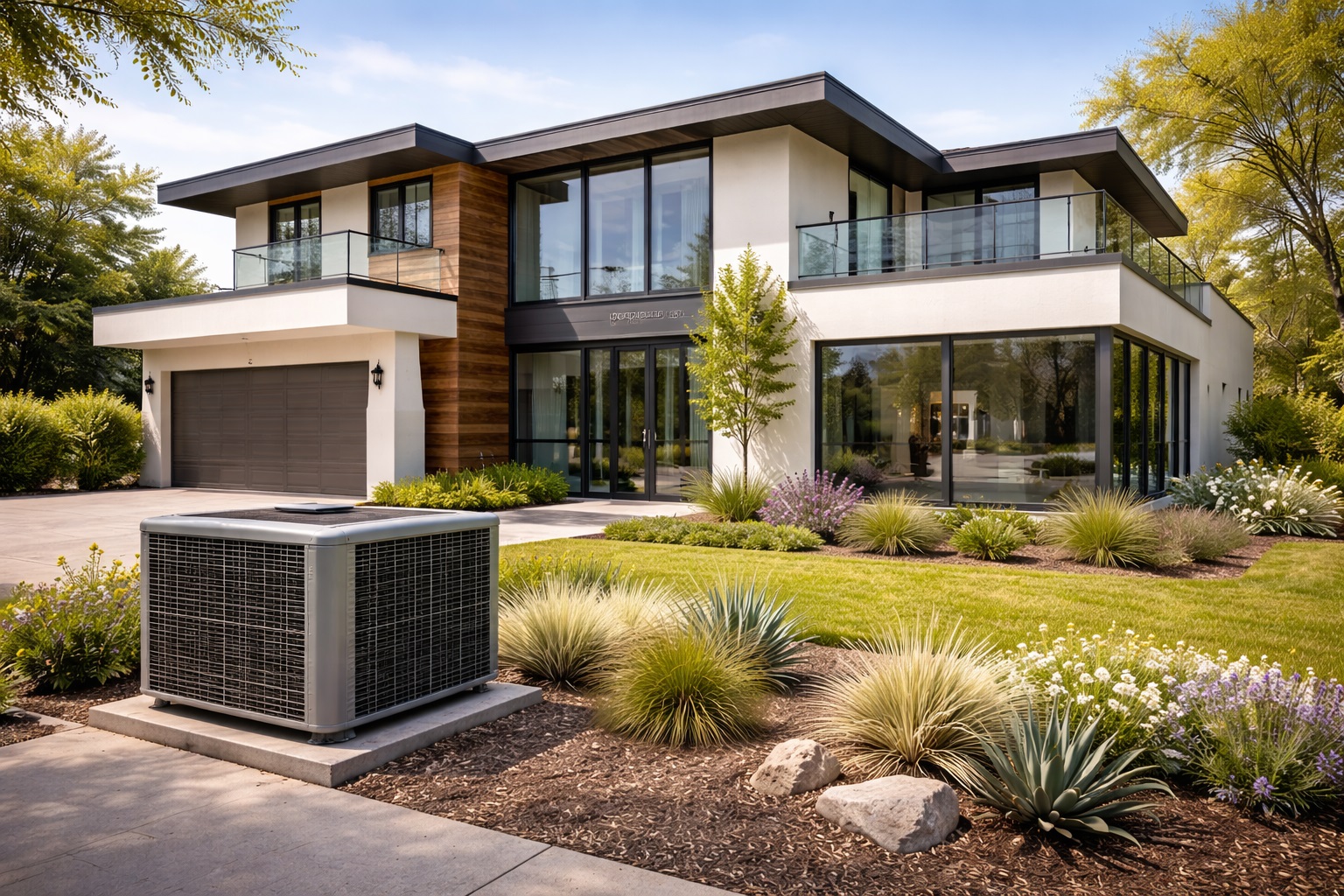
What Size AC for 2000 Sq Ft House? (3 Ton vs 3.5 Ton Decision Guide)
For a 2000 sq ft house, the right AC size is usually 36,000 to 42,000 BTU, which translates to about 3 to 3.5 tons. In many homes, the real question is not just whether the unit is larger or smaller. It is whether the house, ductwork, and climate actually support that extra half ton.
That is why a well-matched 3-ton system often performs better than a poorly matched 3.5-ton system. Bigger is not automatically safer at this size.
Why 2000 sq ft is such a common sizing trap
A 2000 sq ft home sits right in the middle of the most competitive AC sizing range. It is larger than homes that can clearly stay in 3-ton territory, but often not large enough to justify jumping up without checking the details.
This is where a lot of contractors and homeowners round up “just to be safe.” That sounds reasonable, but it can create humidity issues, poor airflow, and short cycling if the system is bigger than the home really needs.
If you want the core sizing concepts first, start with What Is BTU in Air Conditioning? and What Is a Ton in HVAC?.
3 ton vs 3.5 ton: what actually changes?
At first glance, the difference looks simple:
- 3 tons = 36,000 BTU per hour
- 3.5 tons = 42,000 BTU per hour
But that extra half ton changes more than just the cooling number. It also affects how much airflow the system needs, how the ducts perform, and how likely the unit is to short cycle.
A 3-ton system is often better suited to homes with moderate heat load, decent insulation, and average sun exposure. A 3.5-ton system is more often justified in hotter climates or homes with above-average heat gain.
The airflow issue most homeowners miss
The biggest hidden problem in this decision is duct capacity.
A basic HVAC rule is:
400 CFM per ton
- 3 tons needs about 1,200 CFM
- 3.5 tons needs about 1,400 CFM
That extra airflow is not a small detail. Many 2000 sq ft homes were originally built around a 3-ton design. If you install a 3.5-ton unit on ductwork that cannot move enough air, you may end up with:
- higher static pressure
- reduced efficiency
- more noise at vents
- weaker humidity control
- shorter equipment life
For more on airflow, read How Many CFM Per Ton?.
When 3 tons is usually the better choice
A 3-ton AC is often the smarter option when the home is reasonably efficient and the climate is not extreme. It tends to work best when:
- the home has standard 8-foot ceilings
- attic insulation is decent
- window exposure is average
- the climate is moderate rather than severe
- you want longer, steadier cooling cycles
In these conditions, a 3-ton unit often gives better balance, better moisture removal, and fewer oversizing risks.
When 3.5 tons may be justified
A 3.5-ton AC starts making more sense when the home takes on more heat than normal. That often happens in places with hotter summers, stronger sun exposure, or less efficient construction.
Leaning toward 3.5 tons is more reasonable if:
- you live in a hot climate like Texas or Florida
- the home has large west-facing windows
- the attic gets very hot in summer
- ceilings are higher than standard
- insulation is older or below average
For climate-specific examples, compare What Size AC Do I Need in Texas? and What Size AC Do I Need in Florida?.
What happens if you oversize a 2000 sq ft home?
When 3.5 tons is more system than the home really needs, the unit may cool too quickly and shut off before completing a proper cycle. That usually leads to comfort problems that homeowners do not expect.
Common oversizing symptoms include:
- short cycling
- sticky indoor air
- uneven room temperatures
- higher power bills
- extra strain on the compressor
If that sounds familiar, read Oversized AC Symptoms and AC Short Cycling Explained.
What happens if 3 tons is not enough?
The opposite mistake is undersizing. A 3-ton unit may struggle in a 2000 sq ft house if the heat load is high enough. In that case, you may notice:
- long runtimes during hot afternoons
- the thermostat not quite reaching set temperature
- hot rooms near the end of the day
- the system running almost nonstop during heat waves
For that side of the problem, read Undersized AC Symptoms and Is My AC Too Small?.
Why a two-stage 3-ton unit can outperform a single-stage 3.5-ton unit
This is one of the smartest solutions for borderline homes.
A two-stage 3-ton system can often deliver better comfort than a single-stage 3.5-ton system because it runs longer at lower output. That improves:
- humidity control
- temperature stability
- comfort consistency
- runtime balance
In many 2000 sq ft homes, that approach solves the “borderline size” problem without jumping to a bigger unit too early.
Ceilings, insulation, and sun exposure can swing the answer
Two homes with the same square footage can end up needing different AC sizes. A standard 2000 sq ft estimate usually assumes:
- 8-foot ceilings
- average insulation
- normal window area
- typical sun exposure
If your house has vaulted ceilings, poor attic insulation, or large west-facing glass, the load can rise enough to justify the larger option. But the duct system still has to support it.
How nearby house-size guides compare
It can help to compare the homes just above and below this range. A 2000 sq ft house sits between smaller mid-size homes and larger suburban layouts, so nearby examples are useful.
- What Size AC for 1800 Sq Ft House?
- What Size AC for 2200 Sq Ft House?
- What Size AC for 2500 Sq Ft House?
You can also compare your estimate against the broader AC Size Chart and AC Size Calculator.
Should you always get a Manual J calculation?
Yes, especially if you are right on the line between 3 and 3.5 tons. Rule-of-thumb estimates are helpful, but a Manual J calculation looks at the real heat load of the home, including:
- insulation values
- window heat gain
- orientation
- air leakage
- duct losses
That is the best way to avoid paying for too much capacity or living with too little.
For the full sizing framework, read Air Conditioner Sizing Guide.
Bottom line
For most 2000 sq ft homes, the right AC size falls between 3 and 3.5 tons. In moderate climates, 3 tons is often enough. In hotter climates or homes with higher heat gain, 3.5 tons may be the better fit.
The most important detail is not just tonnage. It is whether the ductwork, airflow, insulation, and home layout can support that choice. In many 2000 sq ft homes, getting the airflow right matters more than adding another half ton.
Helpful next reads: AC Size Chart, Air Conditioner Sizing Guide, How Many CFM Per Ton?, Oversized AC Symptoms, and Undersized AC Symptoms.