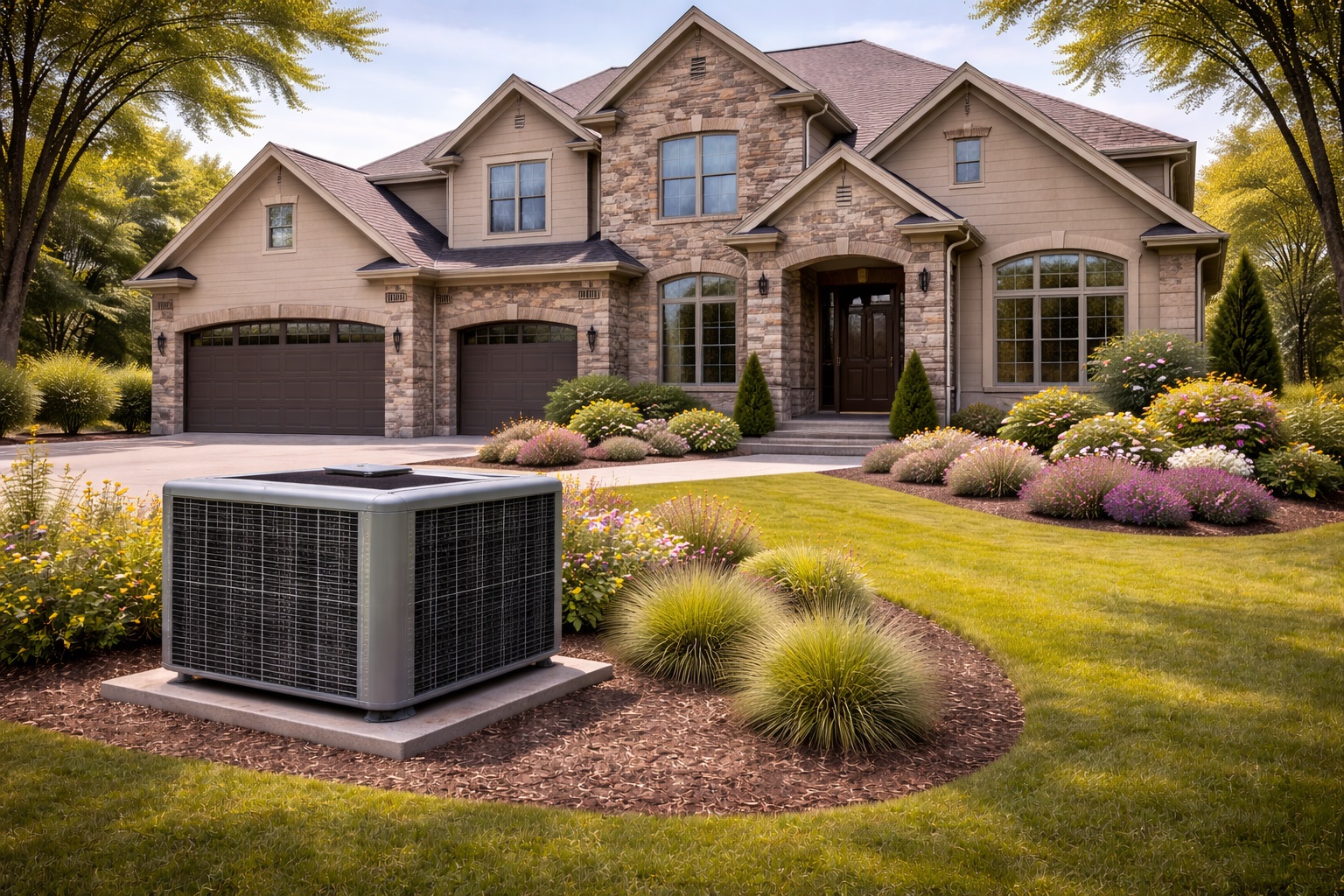
For a 3000 sq ft house, the typical cooling range is about 60,000 to 72,000 BTU, which equals roughly 5 to 6 tons of AC capacity. In many cases, that puts the home right on the border where equipment size matters a lot—but airflow, zoning, and floor-to-floor balance matter just as much.
That is why a larger single system is not always the best answer. In some 3000 sq ft homes, two smaller systems or a better zoning strategy deliver more comfort than one oversized unit.
Why 3000 sq ft homes are harder to size correctly
Once a home reaches this size, square footage stops telling the full story. Many 3000 sq ft houses also include features that raise cooling complexity, such as:
- two-story layouts
- open-concept living areas
- tall ceilings or vaulted spaces
- large window areas
- long duct runs
That means the right answer depends not only on tonnage, but also on air volume, heat gain, and how well the system can move air through the home.
If you want the basics first, start with What Is BTU in Air Conditioning? and What Is a Ton in HVAC?.
How many BTU do you need for 3000 sq ft?
A common estimate is:
20 to 25 BTU per square foot
That gives a rough range like this:
- 3,000 × 20 = 60,000 BTU
- 3,000 × 24 = 72,000 BTU
That is why most 3000 sq ft homes land in the 5 to 6 ton range. But this is only a starting estimate, not a final answer.
For broader sizing context, compare the AC Size Chart, What Size AC for 2500 Sq Ft House?, and Air Conditioner Sizing Guide.
Is 5 tons enough for a 3000 sq ft house?
Yes, in many homes 5 tons is enough—especially if the house is reasonably efficient and located in a moderate climate.
A 5-ton system usually makes more sense when:
- the climate is moderate rather than extreme
- insulation is strong
- window exposure is average
- ceiling heights are close to standard
- ductwork is well designed
In those conditions, a 5-ton unit often provides better runtime balance and lower oversizing risk than a 6-ton system.
When 6 tons becomes more realistic
A 6-ton AC starts making more sense when the home gains heat much faster than average. That often happens in hot southern climates, homes with heavy solar exposure, or layouts with unusually high air volume.
Leaning toward 6 tons is more reasonable if:
- you live in a very hot climate like Texas, Florida, Arizona, or Nevada
- the home has tall or vaulted ceilings
- there are large west-facing windows
- attic heat gain is high
- the house has big open great-room spaces
Even then, larger capacity only helps if the duct system and return air design can support it properly.
Why bigger is not always better
Many homeowners assume the safest move is to choose the larger unit. In a 3000 sq ft home, that can backfire.
If the system is too large, it may:
- cool too quickly
- shut off before removing enough humidity
- short cycle
- create uneven temperatures between rooms or floors
- increase wear on major components
That is why a 6-ton system is not automatically “better” than a 5-ton system. In the wrong house, it can feel worse.
If you are worried about oversizing, read Oversized AC Symptoms and AC Short Cycling Explained.
The real problem in many 3000 sq ft homes: upstairs heat
In two-story homes, the upstairs often stays warmer even when the total system size looks correct on paper. That happens because heat rises, upper floors trap warm air, and return air paths are often weaker than they should be.
So if your upper floor stays hot, the issue is not always lack of tonnage. It may be:
- poor airflow distribution
- undersized return ducts
- bad balancing between floors
- insufficient zoning
In other words, a bigger unit alone may not solve an upstairs comfort problem.
One large unit vs two smaller systems
At 3000 sq ft, this becomes a very important design question.
One 5-ton or 6-ton system
A single large unit may work in simpler layouts, especially if the duct system is strong and the house is not fighting big upstairs/downstairs imbalances.
Pros:
- lower upfront equipment cost
- simpler installation
- one main thermostat and control setup
Cons:
- harder to balance multiple floors
- more risk of hot and cold spots
- more static pressure stress if ducts are marginal
Two smaller systems
In many larger two-story homes, two smaller units perform better than one large central system.
Common setups include:
- two 2.5-ton systems
- a 2.5-ton plus a 3-ton system
- a zoned system with dampers and properly designed controls
Advantages of dual systems:
- independent floor control
- better humidity balance
- reduced airflow strain per system
- more even cooling
Downside:
- higher upfront cost
- more components to maintain
For many 3000 sq ft two-story homes, dual systems are often the better comfort solution.
Airflow and duct design matter more than many people expect
A large house needs more than a big condenser outside. It also needs:
- enough return air
- proper supply duct sizing
- balanced airflow between floors
- reasonable static pressure
If those conditions are not there, even a correctly sized unit may struggle. In larger homes, many comfort problems are actually duct design problems, not tonnage problems.
For airflow basics, read How Many CFM Per Ton?.
Climate changes the answer a lot
A useful shorthand for 3000 sq ft homes looks like this:
- Moderate climates: 5 tons is often enough
- Hot and humid climates: 5.5 to 6 tons becomes more likely
- Desert climates: 6 tons is often justified
That is why the same square footage can point to different system sizes depending on where the house is located.
If the AC runs all day and still struggles, that may point to the opposite problem. In that case, read Undersized AC Symptoms and Is My AC Too Small?.
Ceiling height and open layouts can push the size upward
Standard rules usually assume 8-foot ceilings. If your 3000 sq ft home includes 10-foot ceilings, vaulted sections, or very open living spaces, the actual air volume rises quickly.
That extra air volume can justify moving from 5 tons toward 5.5 or 6 tons, especially when combined with strong window exposure or hot climate conditions.
But again, extra tonnage only helps if the home can distribute that airflow correctly.
Efficiency strategy matters in a large house
Larger homes use more electricity, so equipment efficiency matters more here than it does in small spaces.
For many 3000 sq ft homes, it makes sense to consider:
- at least SEER 15
- ideally SEER 16–18 in many cases
- two-stage or variable-speed compressors
Better staging and airflow control often improve comfort more than jumping one full ton in size.
For more on this, read SEER Rating Explained.
Should you always get a Manual J calculation?
Yes. At this size, rule-of-thumb estimates are much more likely to miss something important.
A Manual J load calculation considers:
- window heat gain
- insulation levels
- orientation
- duct leakage
- air infiltration
- local climate conditions
That is the best way to know whether the home truly needs 6 tons, or whether 5 tons with better zoning and airflow would actually perform better.
For the full foundation, read Air Conditioner Sizing Guide.
Bottom line
For a 3000 sq ft house, the right AC size is usually 5 to 6 tons, or about 60,000 to 72,000 BTU. In moderate climates with good insulation, 5 to 5.5 tons is often enough. In hotter climates, homes with high ceilings, or houses with heavy solar gain, 6 tons may be justified.
But in many 3000 sq ft homes—especially two-story layouts—the best answer is not simply the biggest unit. It is the system that delivers the best airflow, zoning, humidity control, and floor-to-floor balance.
Helpful next reads: AC Size Chart, Air Conditioner Sizing Guide, What Is BTU in Air Conditioning?, What Is a Ton in HVAC?, and Oversized AC Symptoms.