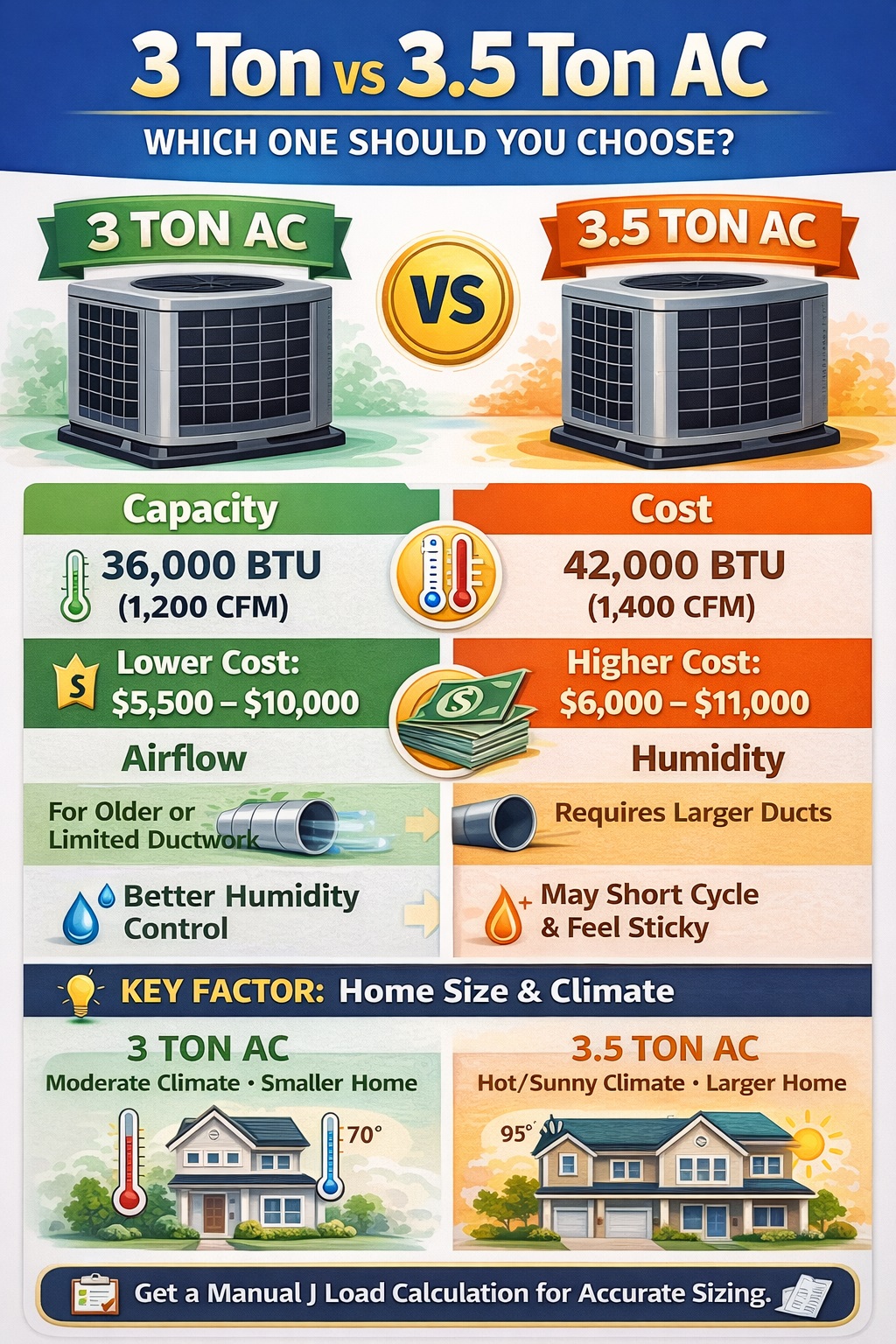
3 Ton vs 3.5 Ton AC – Which One Should You Choose?
A 3 ton AC delivers 36,000 BTU of cooling and usually needs about 1,200 CFM of airflow. A 3.5 ton AC delivers 42,000 BTU and typically needs around 1,400 CFM. On paper, that looks like a small jump. In real homes, that half-ton difference can change comfort, humidity control, duct performance, and total installation cost.
This is one of the most common HVAC sizing decisions because many homes sit right between these two sizes. The wrong choice can leave you with short cycling, weak airflow, or a system that never feels quite right.
Quick answer
If your home is well insulated, your climate is moderate, and your ductwork is average, a 3 ton AC is often the better choice. If the home is larger, hotter, or has higher sun exposure, a 3.5 ton AC may be justified. The deciding factors are usually airflow capacity, climate, insulation, and humidity performance, not just square footage alone.
Why half a ton matters more than it sounds
Many homeowners hear “3 ton vs 3.5 ton” and assume the difference is too small to matter. In practice, that extra half ton changes both cooling output and airflow demand.
- 3 ton = 36,000 BTU per hour
- 3.5 ton = 42,000 BTU per hour
That extra 6,000 BTU can be helpful in a high-load house, but it can also become a problem if the home or duct system cannot support it properly.
If you want the underlying sizing basics first, read What Is BTU in Air Conditioning? and What Is a Ton in HVAC?.
Where each size usually fits
As a rough estimate, these sizes often line up like this:
| System Size | Cooling Output | Typical Home Range |
|---|---|---|
| 3 Ton | 36,000 BTU | 1,800–2,200 sq ft |
| 3.5 Ton | 42,000 BTU | 2,000–2,500 sq ft |
Those are only broad starting points. Some 2,000 sq ft homes do great with 3 tons, while others legitimately need 3.5 tons. That is why borderline homes are where sizing mistakes happen most often.
For a home-size example, see What Size AC for 2000 Sq Ft House? and What Size AC for 2500 Sq Ft House?.
The airflow requirement is the hidden deciding factor
This is the part many homeowners never hear about when comparing sizes.
Air conditioners usually need about 400 CFM per ton. That means:
- 3 ton → about 1,200 CFM
- 3.5 ton → about 1,400 CFM
If your existing duct system was designed around 1,200 CFM, installing a 3.5 ton unit without checking the ducts can cause real problems:
- higher static pressure
- reduced efficiency
- more noise
- poorer airflow distribution
- shorter equipment life
That is why a 3.5 ton AC is not always a simple upgrade. Sometimes it becomes a ductwork problem, not just an equipment choice. For more on that, read How Many CFM Per Ton?.
When a 3 ton AC is the better choice
A 3 ton system is often the smarter option when the home has a moderate heat load and the goal is stable, efficient cooling rather than maximum blast capacity.
It usually makes more sense when:
- the home is closer to 1,800–2,100 sq ft
- insulation is decent
- ceilings are standard height
- the climate is moderate
- humidity control matters
- ductwork is older or limited
A properly matched 3 ton unit often runs longer and more evenly, which usually improves comfort. In many homes, that also means fewer oversizing risks.
When 3.5 ton is the more reasonable move
A 3.5 ton unit starts making more sense when the home takes on above-average heat. That may be due to climate, layout, insulation quality, or solar exposure.
It becomes easier to justify when:
- the home is closer to 2,200–2,500 sq ft
- you live in a hot southern or desert climate
- ceilings are 9 feet or higher
- the house has large west-facing windows
- attic heat gain is high
- the home struggles badly during late-afternoon heat
In those cases, 3.5 tons may be appropriate, but only if the airflow side checks out too.
For climate-based examples, compare What Size AC Do I Need in Texas? and What Size AC Do I Need in Florida?.
Why bigger can hurt humidity control
This is one of the biggest reasons people regret oversizing. A larger system may cool the thermostat area quickly and shut off before running long enough to remove enough moisture from the air.
That can lead to:
- short cycling
- sticky indoor air
- rooms that feel cold but not comfortable
- higher mold and mildew risk over time
So even if a 3.5 ton unit cools faster, it may still feel worse overall in the wrong house.
For more on this, read Oversized AC Symptoms and AC Short Cycling Explained.
What about energy use?
A 3.5 ton system uses more power when it runs at full output. But the total energy picture is more complicated than that. If a larger unit is correctly sized for a hotter home, it may run fewer total hours. If it is oversized, it may waste energy through repeated starts and poor runtime balance.
In other words, efficiency depends more on:
- proper sizing
- SEER rating
- duct performance
- installation quality
- actual home load
For more on equipment efficiency, read SEER Rating Explained.
Cost difference: is 3.5 ton much more expensive?
Usually, the equipment price difference between 3 ton and 3.5 ton is not huge on its own. In many cases, the step up is around:
- $300 to $800 more for equipment
- $500 to $1,000 more installed
The problem is that the real cost jump can come from the duct side. If the larger unit requires duct upgrades, airflow corrections, or other supporting changes, the total project cost can rise much more than expected.
For pricing context, see How Much Does a 3 Ton AC Unit Cost in 2026?.
Two-stage vs single-stage: the smarter borderline solution
Borderline homes do not always need more tonnage. Sometimes they need better equipment behavior.
A two-stage 3 ton system often performs better than a single-stage 3.5 ton unit because it can:
- run longer at lower output
- remove more humidity
- reduce temperature swings
- improve comfort consistency
That makes two-stage equipment a strong option when the house sits right on the line between both sizes.
Manual J is the only real way to settle the question
Rules of thumb help narrow the range, but they do not finish the job. The only reliable way to choose between 3 tons and 3.5 tons is a proper Manual J load calculation.
That process takes into account:
- insulation values
- window heat gain
- orientation
- air leakage
- duct losses
- occupancy and internal loads
If you want the full sizing framework, read Air Conditioner Sizing Guide and compare with the AC Size Chart.
Bottom line
There is no automatic winner in the 3 ton vs 3.5 ton AC comparison. A 3 ton unit is often the better fit in moderate climates and homes with average heat load. A 3.5 ton unit may be necessary in hotter climates, larger layouts, or homes with above-average solar gain.
The best choice comes down to balancing cooling capacity, airflow, humidity control, and duct support. That half ton may look small on paper, but in real HVAC performance, it can make a big difference.