What Size AC for 1400 Sq Ft House? (Oversizing Risk Guide – 2026)
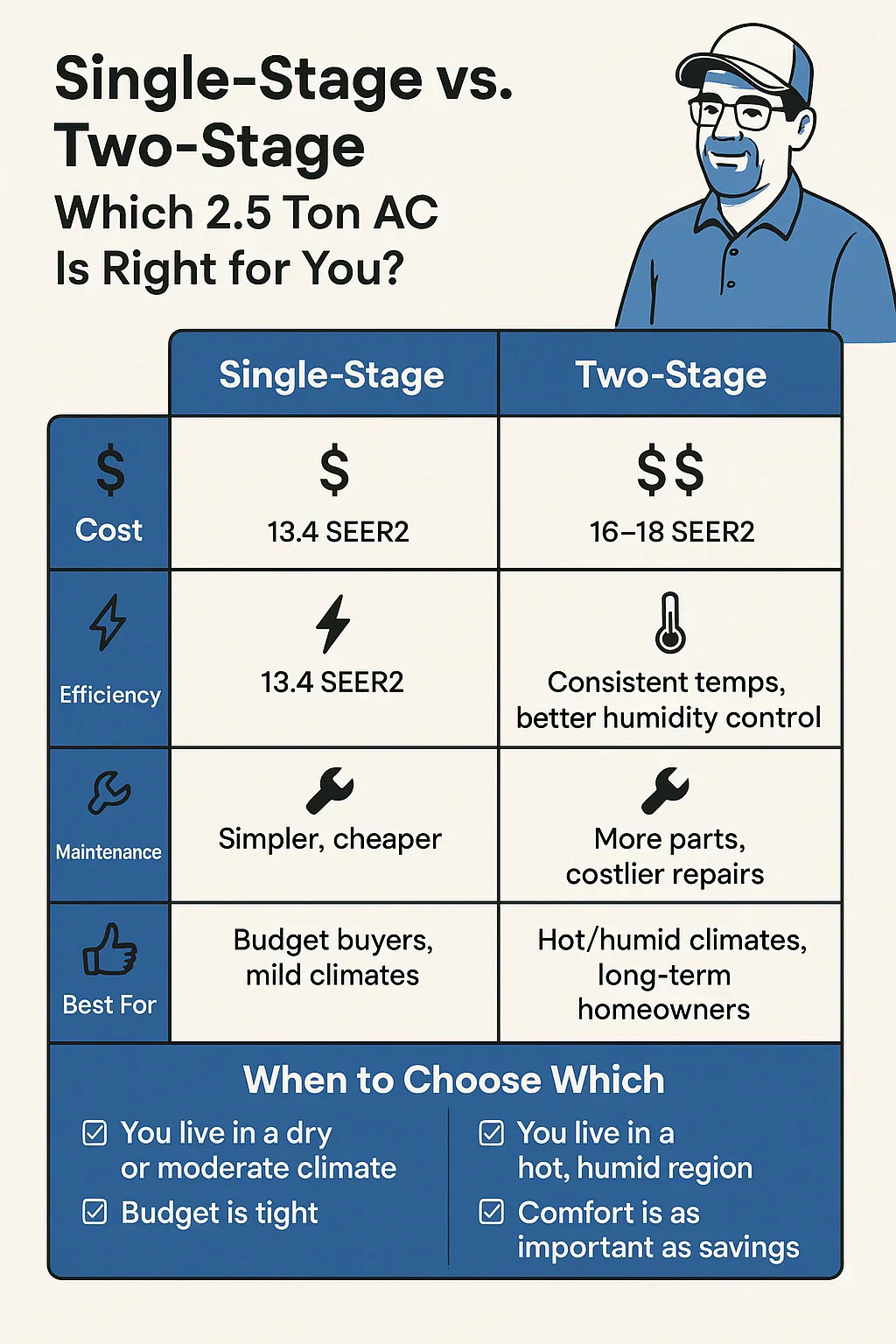
As preliminary planning guidance, a 1,400 sq ft house may fall near 24,000 to 30,000 BTU, or roughly 2 to 2.5 tons; final equipment selection requires a load calculation. At this size, the biggest mistake is often not buying too little AC. It is buying too much.
That is why many 1,400 sq ft homes end up feeling cold for a moment, then damp, uneven, and uncomfortable later. The system may look powerful on paper, but the runtime is too short to control humidity properly.
Quick Answer
For preliminary planning, a 1,400 sq ft home may fall in this AC size range:
- 24,000–30,000 BTU
- 2 to 2.5 tons
In many moderate climates, 2 tons is enough. In hotter climates or homes with more sun exposure, 2.5 tons may be the better fit. A 3-ton system is often too large for this house size unless a real load calculation proves otherwise.
Why 1,400 sq ft homes get oversized so often
This house size sits in an awkward spot. It is close enough to 1,500 sq ft that some contractors or homeowners assume the same tonnage should work without looking more closely.
That shortcut creates problems because 1,400 sq ft homes often cool faster than expected. Once the unit is too large, the system may satisfy the thermostat quickly and shut off before doing the full job.
If you want the basic capacity concepts first, read What Is BTU in Air Conditioning? and What Is a Ton in HVAC?.
When 2 tons is usually the right choice
A 2-ton AC provides about 24,000 BTU of cooling and usually needs around 800 CFM of airflow. For many 1,400 sq ft homes, that is enough to cool properly without creating unnecessary oversizing risk.
It is often the better fit when:
- the climate is moderate
- the home is reasonably well insulated
- ceilings are close to 8 feet
- sun exposure is fairly normal
- the layout is not unusually open
In those conditions, 2 tons usually allows longer cooling cycles, more stable humidity control, and smoother comfort from room to room.
When 2.5 tons makes sense
A 2.5-ton system delivers about 30,000 BTU and needs roughly 1,000 CFM of airflow. That extra capacity can make sense, but only when the home truly has a higher cooling load.
Leaning toward 2.5 tons is more reasonable when:
- you live in a hot climate
- the house has large west-facing windows
- the attic gets very hot in summer
- ceilings are higher than standard
- the home has poor shading or weak insulation
That does not mean 2.5 tons is automatically better. It means the house may have enough heat gain to justify it.
Why 3 tons is often too much
This is where many small and mid-size homes run into trouble. A 3-ton system can cool the space so quickly that the AC shuts off before it removes enough moisture from the air.
That usually leads to:
- short cycling
- clammy indoor air
- noticeable temperature swings
- higher wear on the compressor
- less efficient operation over time
If that sounds familiar, read AC Short Cycling Explained and Oversized AC Symptoms.
Humidity control matters more in smaller homes
Smaller homes cool faster. That sounds like an advantage, but it can become a problem when the AC is oversized. If the system reaches the thermostat setting too quickly, the cycle ends before enough moisture is removed.
That can leave behind:
- sticky air
- musty smells
- cold-but-uncomfortable rooms
- more noticeable mold or mildew risk over time
That is one reason a correctly sized 2-ton unit can feel better than a larger unit in a moderate climate.
If humidity is already a problem in the house, also read Why Is My House Humid Even With the AC On?.
Airflow can change the whole result
Even when the tonnage number looks right, the system still needs ductwork that can support the required airflow. About 400 CFM per ton is a common nominal reference, not a fixed requirement. Actual airflow depends on the equipment and blower setup, manufacturer data, sensible and latent goals, humidity, coil conditions, external static pressure, and the duct system.
For a nominal planning comparison, 2 tons is often associated with about 800 CFM and 2.5 tons with about 1,000 CFM. Confirm the target from the manufacturer's blower data and the installed duct system before changing equipment size.
If the existing duct system was built around 800 to 900 CFM, moving to 2.5 tons without an airflow check can create higher static pressure, louder vents, reduced efficiency, and comfort problems that feel like the system is too small. For more on that, read How Many CFM Per Ton? and Undersized AC Symptoms.
Climate-based recommendation for 1,400 sq ft
A practical way to think about this size is:
- Moderate climates: 2 tons is often enough
- Mixed climates: 2 to 2.5 tons depending on insulation and windows
- Hot and humid climates: 2.5 tons is often more realistic
That is why location matters so much. Two homes with the same floor area can need different sizes because their heat load is different.
For state-specific examples, compare What Size AC Do I Need in Texas? and What Size AC Do I Need in Florida?.
Ceiling height and layout still matter
Basic sizing charts usually assume:
- 8-foot ceilings
- average insulation
- a normal room layout
You may need to lean toward 2.5 tons if the house has:
- vaulted ceilings
- a large open living area
- big west-facing windows
- poor attic insulation
That is because air volume and sun load can push the cooling demand higher than square footage alone suggests.
How 1,400 sq ft compares with nearby house sizes
It helps to look at the homes just above and below this size range. That gives you a better sense of whether the house is closer to 2 tons or already pushing into 2.5-ton territory.
- What Size AC for 1500 Sq Ft House?
- What Size AC for 1600 Sq Ft House?
- AC Size Chart (BTU & Tonnage by Square Footage)
Should you still get a Manual J calculation?
Yes. This is exactly the kind of house size where a Manual J load calculation can prevent unnecessary upsizing.
Manual J evaluates:
- insulation values
- window heat gain
- orientation
- air leakage
- duct losses
For the full sizing framework, read Air Conditioner Sizing Guide.
Final Recommendation
For most 1,400 sq ft homes:
- 2 tons is a common preliminary starting point in moderate climates
- 2.5 tons is a common preliminary starting point in hotter or higher-heat-gain homes
- 3 tons requires a real load calculation before selection
At 1,400 sq ft, bigger is rarely better. The best system is the one that runs long enough to cool evenly, control humidity, and match the house without overshooting.
FAQ
Is 3 tons too big for 1,400 sq ft?
In many moderate climates, yes. It often creates short cycling and humidity problems.
How many BTU do I need for 1,400 sq ft?
Usually about 24,000 to 30,000 BTU, depending on climate, insulation, and ceiling height.
Is 2 tons enough for 1,400 sq ft?
Often yes, especially in well-insulated homes in moderate climates.
Sources and verification
The technical statements in What Size AC for 1400 Sq Ft House? (Oversizing Risk Guide – 2026) were cross-checked against the primary references below. Final sizing, airflow, electrical, combustion, and refrigerant decisions must also follow the exact equipment instructions and applicable local code.