What Size AC for 1500 Sq Ft House? (2.5 Ton vs 3 Ton Guide)
What Size AC for 1500 Sq Ft House? (2.5 Ton vs 3 Ton Guide)
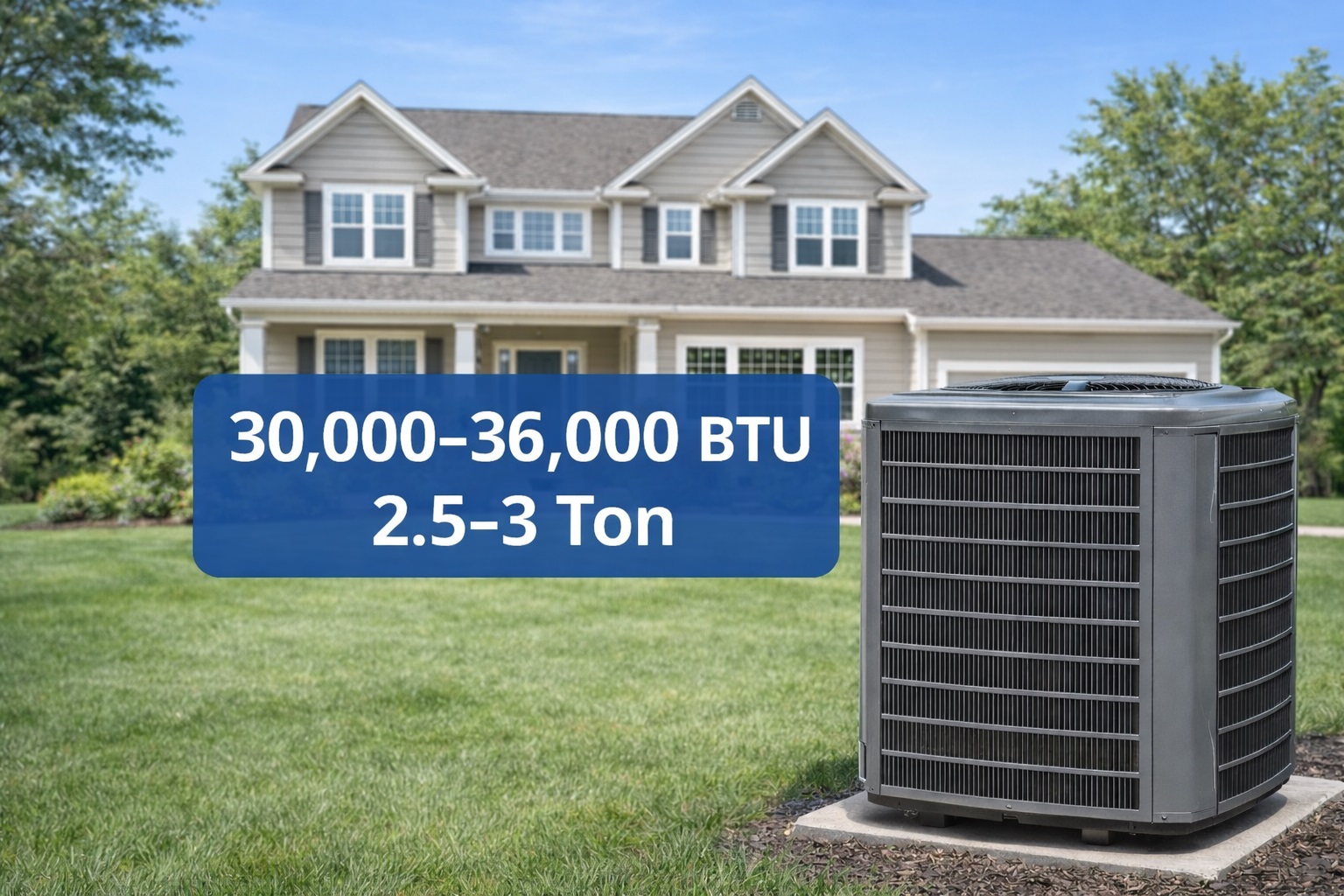
For a 1500 sq ft house, 30,000 to 36,000 BTU/h (about 2.5 to 3 tons) is a starting estimate, not a final equipment selection. Climate, insulation, window and solar load, ceiling height, infiltration, and duct or system conditions can change the load, so final sizing should follow a proper Manual J load calculation.
This size range is tricky because 1500 sq ft sits right in the middle. It is large enough that a system can fall behind if it is too small, but not so large that going bigger is automatically safer.
Why 1500 sq ft is one of the easiest homes to mis-size
At 1500 sq ft, you are in the zone where rule-of-thumb sizing starts becoming less reliable. A small change in insulation, sun exposure, ceiling height, or climate can push the answer from 2.5 tons to 3 tons.
That is why so many homeowners get stuck between the two. A 2-ton system is usually too small for a typical 1500 sq ft house, while a 3.5-ton system is usually too large. The real comparison is normally 2.5 ton vs 3 ton.
For the definitions used in a 1500 sq ft home, read What Is BTU in Air Conditioning? and What Is a Ton in HVAC?.
When 2.5 tons is the better choice
A 2.5-ton AC provides about 30,000 BTU of cooling. That is often the better option when the home is fairly efficient and the heat load is moderate rather than extreme.
It usually makes sense when:
- you live in a mild or moderate climate
- the insulation is in good shape
- ceilings are standard height
- the house does not get extreme west-facing sun
- you want longer, steadier cooling cycles
In those conditions, 2.5 tons can provide better balance, lower energy use, and more stable humidity control.
When 3 tons is the smarter move
A 3-ton AC delivers about 36,000 BTU per hour. That extra capacity can be the safer choice when the home gains heat faster than average or when outdoor conditions are consistently more demanding.
It often fits better if:
- you live in a hotter climate like Texas or Florida
- the house has older insulation
- the attic gets very hot in summer
- there are large windows or strong afternoon sun
- the house struggles to recover after peak daytime heat
For climate-specific examples, see What Size AC Do I Need in Texas? and What Size AC Do I Need in Florida?.
Why humidity changes the answer
Temperature is only part of the equation. In a 1500 sq ft home, comfort often depends just as much on humidity control as on raw cooling speed.
A unit that is slightly too large may cool the home quickly but still leave the indoor air damp because it shuts off before removing enough moisture. That is one reason a properly matched 2.5-ton unit can feel better than an oversized 3-ton unit in the wrong house.
If moisture is already a problem in your home, read Why Is My House Humid Even With the AC On? and Oversized AC Symptoms.
What if the AC is too large?
Going too big is one of the most common mistakes at this house size. Many homeowners assume the larger unit will cool faster and therefore perform better, but that usually creates a different set of problems.
If the 3-ton unit is more system than the home actually needs, you may notice:
- short cycling
- poor humidity removal
- uneven room temperatures
- extra wear on the compressor
- higher operating cost than expected
To understand that pattern better, read AC Short Cycling Explained and Is My AC Too Big for My House?.
What if the AC is too small?
A system that is too small creates the opposite problem. Instead of cooling too fast, it may run for very long periods and still fail to bring the house down to the thermostat setting during the hottest part of the day.
That often shows up as:
- long runtimes
- rooms that stay warm in late afternoon
- difficulty reaching the set temperature
- higher energy bills from nonstop operation
If that sounds familiar, read Undersized AC Symptoms and Is My AC Too Small?.
Airflow and ductwork matter more than many people realize
Even if the tonnage looks right on paper, the system still needs enough airflow to deliver that cooling properly. A common HVAC rule is:
400 CFM per ton
- 2.5 tons = about 1,000 CFM
- 3 tons = about 1,200 CFM
If the ductwork cannot handle that airflow, installing a larger unit may not solve the problem and can sometimes make comfort worse. Restricted airflow can even make a correctly sized unit look undersized.
For more on that, read How Many CFM Per Ton?.
How nearby house-size guides compare
One useful way to sense-check your result is to compare nearby square footage examples. A 1500 sq ft home should usually fall above very small-home sizing but below what larger mid-size homes need.
Related guides:
- What Size AC for 1400 Sq Ft House?
- What Size AC for 1600 Sq Ft House?
- What Size AC for 2000 Sq Ft House?
Does system type make a difference?
Yes. In some 1500 sq ft homes, a two-stage or variable-speed system can perform better than a basic single-stage unit of the same nominal tonnage. That is because it can run longer at lower output, which improves humidity removal and reduces temperature swings.
In other words, the right equipment design can matter almost as much as the raw tonnage number.
General rule for 1500 sq ft homes
If you want a simple way to think about it, use this:
- Choose 2.5 tons if the home is efficient and the climate is moderate
- Choose 3 tons if the climate is hot or the home has above-average heat gain
If you are still estimating, compare your house against the broader AC Size Chart and the AC Size Calculator.
Bottom line
For a 1500 sq ft house, the correct AC size is usually 2.5 to 3 tons. In many average homes, 2.5 tons is enough. In hotter climates or homes with more solar gain, 3 tons is often the better fit.
The best choice depends on climate, insulation, duct capacity, and humidity performance, not just square footage. If you are on the border between sizes, it is usually smarter to think about the home’s actual heat load than to assume bigger is safer.
Helpful next reads: AC Size Chart, Air Conditioner Sizing Guide, What Is BTU in Air Conditioning?, What Is a Ton in HVAC?, and How Many BTU Do I Need?.
Related technical guides
- If the conditioned floor area is near another bracket, compare What Size AC for 600 Sq Ft? before rounding the load or choosing the next nominal half-ton size.
Sources and verification
The technical statements in What Size AC for 1500 Sq Ft House? (2.5 Ton vs 3 Ton Guide) were cross-checked against the primary references below. Final sizing, airflow, electrical, combustion, and refrigerant decisions must also follow the exact equipment instructions and applicable local code.