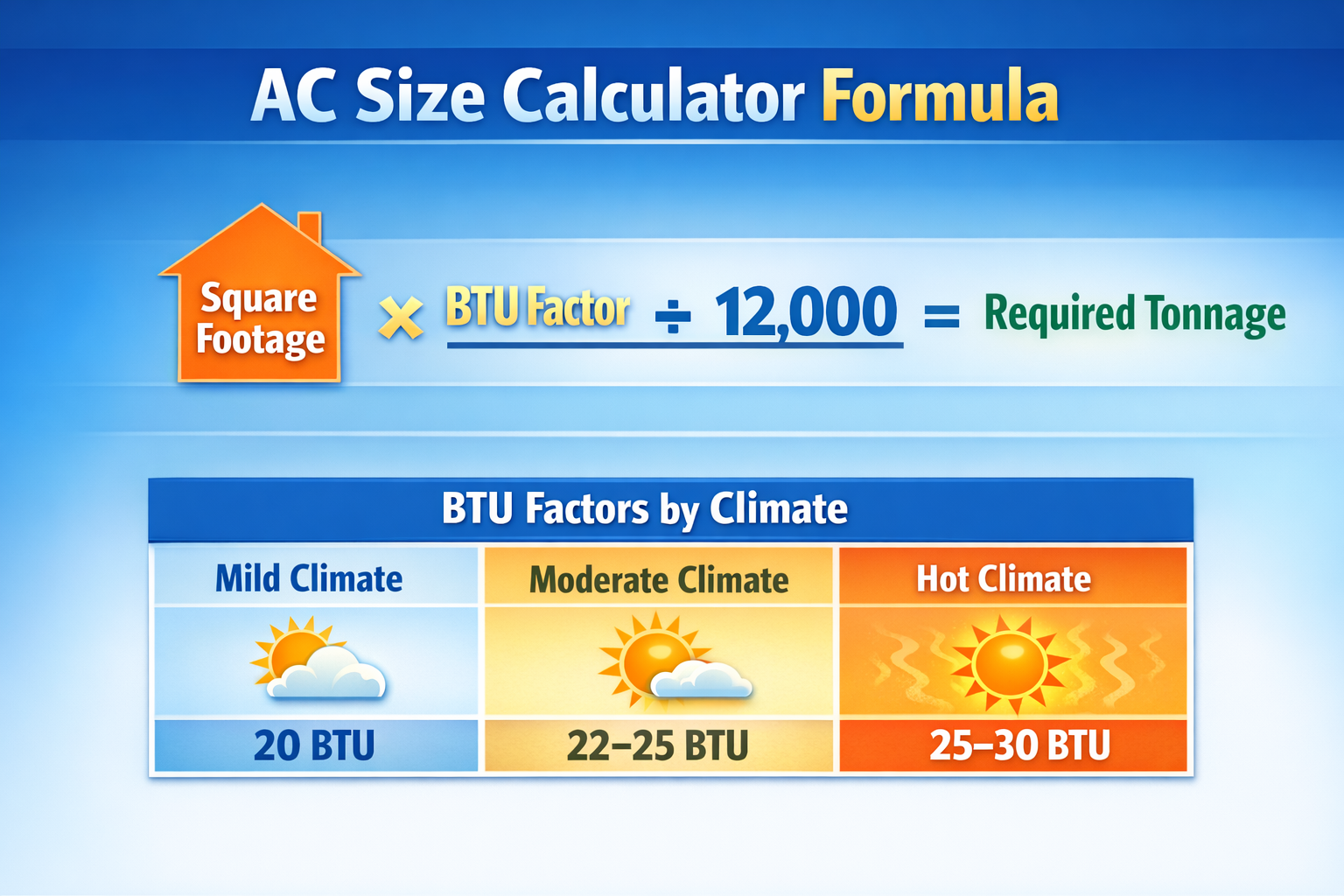
Most homes require 20–25 BTU per square foot. To calculate AC size, multiply your square footage by the appropriate BTU factor and divide by 12,000 to determine required tonnage.
AC Size Calculator (BTU & Tonnage Estimator for Any Home – 2026)
Choosing the correct air conditioner size is one of the biggest factors in indoor comfort, energy efficiency, and long-term HVAC performance. This AC size calculator helps you estimate BTU capacity, AC tonnage, climate adjustments, and the airflow your system will need.
If you are asking what size AC do I need, this page gives you a fast starting point before requesting contractor quotes or a full load calculation.
Quick AC Size Calculator
You can estimate AC size in two simple steps:
Step 1: Multiply your home’s square footage by the appropriate BTU factor:
- 20 BTU per sq ft for cool climates
- 22–25 BTU per sq ft for moderate climates
- 25–30 BTU per sq ft for hot and humid climates
Step 2: Divide the total BTU by 12,000 to estimate tonnage.
Example:
2,000 sq ft home in a hot climate:
2,000 × 28 BTU = 56,000 BTU
56,000 ÷ 12,000 = 4.6 tons
Recommended size: 4.5 to 5 tons
If you want the broader sizing framework behind this estimate, read Air Conditioner Sizing Guide.
AC Size Calculator Chart
| Home Size | Mild Climate | Moderate Climate | Hot Climate |
|---|---|---|---|
| 600 sq ft | 12,000 BTU | 14,000 BTU | 15,000–18,000 BTU |
| 1,000 sq ft | 20,000 BTU | 22,000–25,000 BTU | 25,000–30,000 BTU |
| 1,500 sq ft | 30,000 BTU | 33,000–36,000 BTU | 37,000–45,000 BTU |
| 2,000 sq ft | 36,000–40,000 BTU | 40,000–48,000 BTU | 50,000–60,000 BTU |
| 2,500 sq ft | 48,000 BTU | 50,000–60,000 BTU | 62,000–75,000 BTU |
| 3,000 sq ft | 60,000 BTU | 66,000–72,000 BTU | 75,000–90,000 BTU |
For detailed size-specific guides, see:
- What Size AC for 2000 Sq Ft House
- What Size AC for 2500 Sq Ft House
- What Size AC for 3000 Sq Ft House
How BTU Converts to Tonnage
In HVAC, 1 ton = 12,000 BTU per hour. That makes it easy to convert your estimated BTU load into system size.
- 24,000 BTU = 2 tons
- 36,000 BTU = 3 tons
- 48,000 BTU = 4 tons
- 60,000 BTU = 5 tons
If these terms are new to you, read What Is BTU in Air Conditioning? and What Is a Ton in HVAC?.
Climate Adjustment Guide
Climate has a major effect on AC sizing. Two homes with the same square footage can need very different systems depending on heat and humidity.
- Cool / Northern climates: 18–22 BTU per sq ft
- Moderate climates: 20–25 BTU per sq ft
- Hot & humid climates: 25–30 BTU per sq ft
Homes in high-humidity regions need extra cooling capacity because the system must remove both heat and moisture.
For climate-specific examples, compare What Size AC Do I Need in Texas?, What Size AC Do I Need in Florida?, and What Size AC Do I Need in California?.
Ceiling Height Adjustment
Most online size calculators assume standard 8-foot ceilings. If your home has more air volume than that, the estimate needs to be adjusted upward.
- 9–10 ft ceilings: add about 10–15% capacity
- Vaulted ceilings: add about 15–25%
That is why open great rooms, loft layouts, and tall ceilings often need more cooling than the square footage alone would suggest.
Airflow Requirement (CFM Calculator)
Correct airflow is just as important as correct tonnage. A common HVAC rule is:
400 CFM per ton
That means:
- 3 ton AC → about 1,200 CFM
- 4 ton AC → about 1,600 CFM
- 5 ton AC → about 2,000 CFM
If the duct system cannot handle that airflow, cooling performance drops and the blower has to work harder. For more on this, read How Many CFM Per Ton?.
What Happens If You Choose the Wrong Size?
An AC calculator is useful because incorrect sizing creates expensive problems on both sides.
If the AC is too big
An oversized air conditioner may:
- short cycle
- leave humidity behind
- create uneven room temperatures
- raise electricity bills
Learn more in Oversized AC Symptoms and AC Short Cycling Explained.
If the AC is too small
An undersized unit may:
- run almost continuously
- struggle in peak afternoon heat
- stress the compressor
- cost more over time than expected
For that side of the problem, read Undersized AC Symptoms and Is My AC Too Small?.
Manual J vs Online AC Calculator
This AC size calculator is a strong starting point, but it is still an estimate. HVAC professionals use a Manual J load calculation to choose the final system size.
Manual J considers:
- insulation levels
- window efficiency
- home orientation
- air leakage
- duct losses
- local climate data
If you are installing a new central air system, replacing equipment near the edge of a size range, or dealing with comfort issues already, a Manual J calculation is worth requesting.
When One Large Unit Isn’t the Best Answer
Homes above about 2,500 to 3,000 sq ft may perform better with:
- dual systems
- zoned HVAC setups
- two-stage or variable-speed compressors
That is especially true in two-story homes or floor plans with hot upstairs rooms. In those cases, layout and zoning can matter more than simply choosing the biggest available unit.
Bottom Line
Use this AC size calculator to get into the right range fast:
- multiply square footage by the right climate-based BTU factor
- divide by 12,000 for tonnage
- adjust for ceiling height and humidity
- confirm the final result with Manual J
Correct AC sizing improves indoor comfort, lowers energy waste, protects equipment life, and helps the system control humidity properly. If you are not sure where to start, begin with your home’s square footage, climate zone, and whether the house has standard or high ceilings.