Author: admin

  • Oversized AC Symptoms: 7 Signs Your Air Conditioner Is Too Big

    oversized AC symptoms outdoor air conditioner unit shutting off too quickly

    Oversized AC Symptoms: 7 Signs Your Air Conditioner Is Too Big

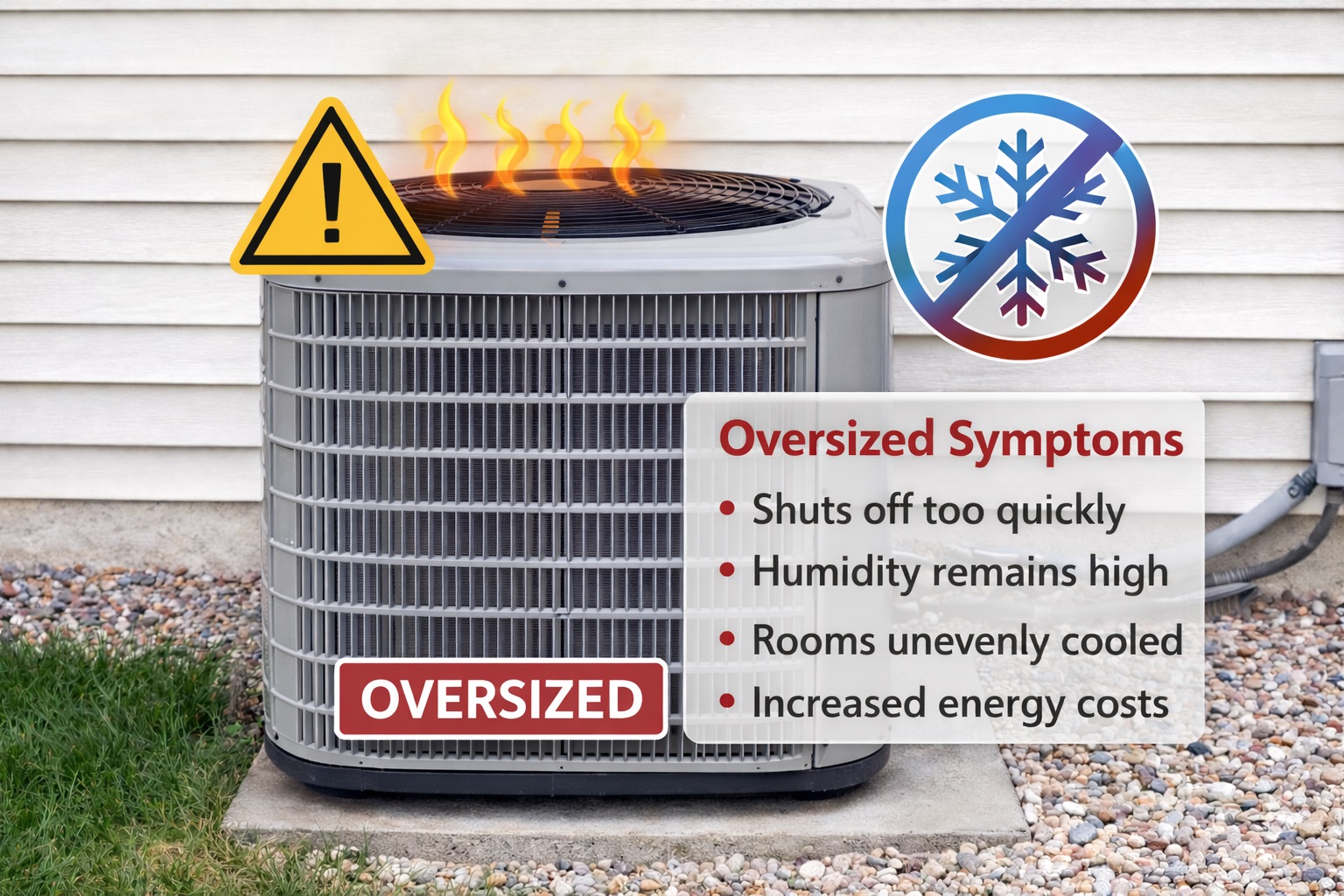
    Quick Answer: An oversized air conditioner cools your home too fast, shuts off too early, and then starts again soon after. That pattern can lead to short cycling, poor humidity removal, uneven temperatures, higher electric bills, and extra wear on major components. A bigger AC may sound more powerful, but it often creates worse comfort.

    Many homeowners expect an oversized system to cool better. In reality, air conditioners work best when they run in balanced cycles long enough to remove both heat and moisture from the air.

    Why an oversized AC causes problems

    An air conditioner is not supposed to blast the house cold in just a few minutes and stop. It is supposed to run steadily, gradually bring the temperature down, and control humidity at the same time.

    When the system is too large for the home, the thermostat is satisfied too quickly. That sounds efficient, but it often means the unit never gets enough runtime to do the full job properly.

    If you want the basic sizing concepts first, start with What Is BTU in Air Conditioning?, What Is a Ton in HVAC?, and the full Air Conditioner Sizing Guide.

    1. Short cycling is happening all day

    The clearest sign of an oversized AC is short cycling. The system turns on, runs briefly, shuts off, and then comes back on again much sooner than it should.

    If your AC is regularly running for less than about 8 to 10 minutes per cycle, oversizing becomes a real possibility. This repeated start-stop pattern is hard on the compressor and electrical parts.

    For a deeper explanation, read AC Short Cycling Explained and How Long Should AC Run Per Cycle?.

    2. The house feels cool but still humid

    A properly sized AC does more than lower temperature. It also removes moisture. Oversized units often shut down before the evaporator coil has enough time to pull out sufficient humidity.

    That can leave you with:

    • sticky or clammy indoor air
    • musty smells
    • condensation on windows
    • rooms that feel cold but uncomfortable

    If that sounds familiar, also read Why Is My House Humid Even With the AC On?.

    3. Some rooms get too cold while others stay warm

    An oversized system can dump cold air into parts of the home quickly without allowing enough time for balanced distribution. Rooms near the thermostat or supply vents may cool fast, while farther rooms remain warmer than they should.

    This is one reason people get confused and assume the problem is ductwork alone. Sometimes the unit is simply too large and never runs long enough to deliver steady comfort through the whole house.

    4. Electric bills go up instead of down

    A larger AC does not automatically save money. In fact, oversized systems often cost more to run because compressor startup is one of the most energy-intensive moments in the cycle.

    If the unit starts over and over again, total energy use can rise even though each individual runtime is short.

    If you are already noticing operation-related cost issues, see Why Is My AC Running Constantly? for comparison with undersizing and other runtime problems.

    5. Parts wear out faster than expected

    Frequent cycling increases stress on components such as the:

    • compressor
    • capacitor
    • contactor
    • electrical relays

    Over time, that constant starting and stopping can shorten equipment life. Homeowners often think the system is “strong” because it cools fast, but mechanically it may be working in a very inefficient pattern.

    6. The system sounds louder than it should

    Oversized equipment often creates more noticeable bursts of operation. You may hear sudden airflow, loud startup noise, repeated clicking, or compressor surges throughout the day.

    Loud operation by itself does not prove oversizing, but when it appears together with short cycles and humidity problems, it becomes a stronger clue.

    7. Comfort still feels bad despite fast cooling

    This is where many people finally realize something is wrong. The home reaches the set temperature quickly, but comfort never feels stable. That happens because temperature alone is not the same as comfort.

    Real comfort depends on:

    • steady runtime
    • humidity control
    • balanced airflow
    • consistent room temperatures

    An oversized AC may win the race to the thermostat, but still lose on comfort.

    Why oversized systems get installed in the first place

    Oversizing usually happens because the equipment was selected using shortcuts instead of real load calculations. Common reasons include:

    • rule-of-thumb sizing based only on square footage
    • assuming “bigger is better”
    • not accounting for insulation or window exposure
    • ignoring ceiling height and home layout

    That is why accurate sizing matters so much. For a broader sizing reference, see AC Size Chart and AC Size Calculator.

    How to tell whether your AC is actually too big

    If several of these signs happen at the same time, oversizing becomes more likely:

    • cooling cycles are unusually short
    • humidity remains high indoors
    • some rooms feel much colder than others
    • your bills are climbing without a clear reason
    • the system starts and stops repeatedly

    If you want a more direct diagnostic guide, read Is My AC Too Big for My House?.

    Can an oversized AC be fixed without replacing it?

    Sometimes small improvements can reduce the symptoms. Thermostat adjustments, duct balancing, airflow changes, or better control settings may help a little.

    But if the equipment is significantly oversized, those changes usually do not solve the core problem. In those cases, the long-term fix may be replacing the unit with one that actually matches the load of the home.

    Frequently asked questions

    Is a slightly oversized AC always bad?

    A small oversizing margin is often manageable. Major oversizing is where comfort and efficiency problems start becoming obvious.

    Can an oversized AC cause mold or moisture problems?

    Yes. Poor dehumidification can leave excess moisture in the air, which may increase the risk of mold and mildew over time.

    How long should an AC cycle last if it is sized correctly?

    In many homes, normal runtimes are around 10 to 20 minutes depending on outdoor conditions, humidity, and insulation quality.

    Bottom line

    Oversized AC symptoms are easy to misread because the house may cool quickly at first. But fast cooling does not mean proper cooling. If your system short cycles, leaves the air humid, creates uneven temperatures, and drives up operating costs, the unit may be too large for the home.

    The goal is not to install the most powerful system possible. The goal is to install one that runs long enough to cool evenly, remove moisture, and operate efficiently.

    Helpful next reads: AC Short Cycling Explained, Is My AC Too Big for My House?, What Is a Ton in HVAC?, What Is BTU in Air Conditioning?, and Air Conditioner Sizing Guide.
  • AC Short Cycling Explained

    ac short cycling outdoor air conditioner unit

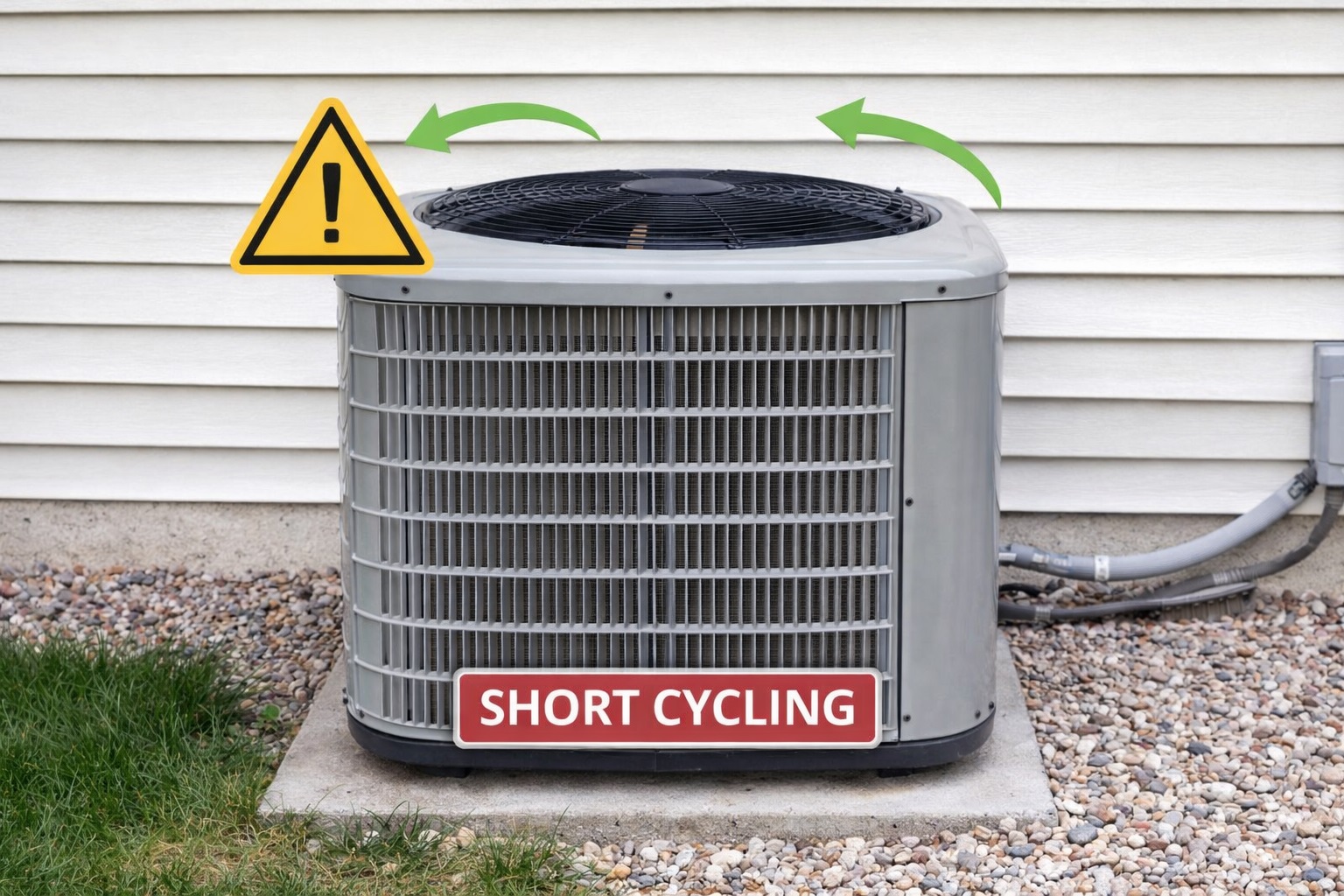
    Quick Answer: AC short cycling means your air conditioner turns on and off too often without completing a normal cooling cycle. Instead of running long enough to cool the home and remove humidity, it may shut off after only a few minutes and restart again soon after. This wastes energy, increases wear, and can shorten the life of the system.

    As a general rule, if your AC repeatedly runs for less than about 8 minutes per cycle, short cycling may be the problem.

    What short cycling looks like in real life

    Many homeowners first notice short cycling because the system feels “busy” all day without actually keeping the home comfortable. The thermostat calls for cooling, the AC starts, runs briefly, shuts off, and then turns back on again before the indoor temperature has really stabilized.

    A healthy system usually runs in steadier cycles. If you are not sure what normal looks like, read How Long Should AC Run Per Cycle?.

    Why AC short cycling is a problem

    Short cycling is not just annoying. It puts the system into one of the least efficient operating patterns possible. Air conditioners work best when they can run long enough to cool the space gradually and remove moisture at the same time.

    When that does not happen, several problems show up:

    • higher energy use from repeated compressor starts
    • poor humidity removal
    • more noticeable temperature swings
    • extra stress on components like the compressor and capacitor

    If your home feels cool but still damp, that may be connected to short cycling. See Why Is My House Humid Even With the AC On?.

    What causes an air conditioner to short cycle?

    There is no single cause. Short cycling can come from sizing problems, airflow restrictions, controls, or refrigerant issues. Some are simple to fix. Others need a technician.

    An oversized AC unit

    This is one of the most common causes. If the air conditioner is too large for the space, it may cool the air around the thermostat too quickly and shut down before the rest of the house is properly conditioned.

    That is why correct sizing matters so much. If you think your unit may be too large, read Oversized AC Symptoms and Is My AC Too Big for My House?.

    A dirty air filter or airflow restriction

    Restricted airflow can raise system stress and cause the AC to behave irregularly. A clogged filter, blocked return, or dirty coil can all contribute to short and inefficient cycles.

    Airflow matters more than most homeowners realize. A good companion read is How Many CFM Per Ton?.

    Low refrigerant

    Low refrigerant can create pressure problems that interfere with normal cooling operation. This is not a DIY repair and should be checked by a licensed HVAC technician.

    Thermostat placement problems

    If the thermostat is near a supply vent, in direct sun, or poorly calibrated, it can misread room conditions and shut the system off too early.

    Electrical component problems

    Weak capacitors, failing contactors, or relay issues can also cause abnormal starts and stops. These problems usually get worse over time rather than better.

    How long should an AC cycle normally run?

    In many homes, a normal AC cycle lasts around 10 to 20 minutes, depending on outdoor temperature, humidity, insulation, and system size. On milder days, runtimes may be shorter. On very hot days, the system may stay on longer.

    If the unit repeatedly shuts off after only a few minutes, that is when short cycling becomes much more likely.

    Can incorrect AC sizing cause short cycling?

    Yes. In fact, sizing errors are one of the biggest reasons this happens. An oversized unit cools too quickly, which sounds good at first, but often leads to poor dehumidification and frequent restart cycles.

    If you want to understand the basics behind AC capacity, start with What Is a Ton in HVAC? and What Is BTU in Air Conditioning?. For the bigger picture, see Air Conditioner Sizing Guide.

    How to fix AC short cycling

    The right fix depends on the actual cause, but these are the first places to look:

    • replace a dirty air filter
    • check that vents and returns are open and unobstructed
    • verify thermostat settings and location
    • have refrigerant levels checked
    • confirm that the unit is properly sized for the home

    If the system was oversized from the start, the long-term fix may be replacing it with a correctly sized unit rather than continuing to live with poor performance.

    When short cycling usually means “call a pro”

    You should have the system inspected if:

    • it short cycles several times per hour
    • the breaker trips
    • cooling performance drops noticeably
    • you hear unusual noises during startup or shutdown
    • the home feels humid even while the AC is running

    If your AC runs constantly instead of short cycling, that points to a different problem. In that case, read Why Is My AC Running Constantly? or Is My AC Too Small?.

    Frequently asked questions

    Is AC short cycling dangerous?

    Not usually in the immediate sense, but it can damage the compressor over time and lead to more expensive repairs if ignored.

    Can short cycling raise my electric bill?

    Yes. Starting the compressor repeatedly uses more electricity than allowing the system to run in balanced cooling cycles.

    Does an oversized AC cause short cycling?

    Very often, yes. Oversizing is one of the most common causes of short cycling in residential systems.

    Bottom line

    AC short cycling happens when the system turns on and off too often without finishing a proper cooling cycle. That pattern reduces efficiency, hurts comfort, and increases wear on major components.

    The most common causes include oversizing, dirty filters, thermostat problems, low refrigerant, and electrical faults. Catching the issue early can prevent bigger repair costs later.

    If your AC repeatedly shuts off after just a few minutes, do not ignore it. In many cases, the sooner you diagnose the reason, the easier and cheaper the fix will be.

    Helpful next reads: Oversized AC Symptoms, How Long Should AC Run Per Cycle?, What Is a Ton in HVAC?, Air Conditioner Sizing Guide, and What Is BTU in Air Conditioning?.

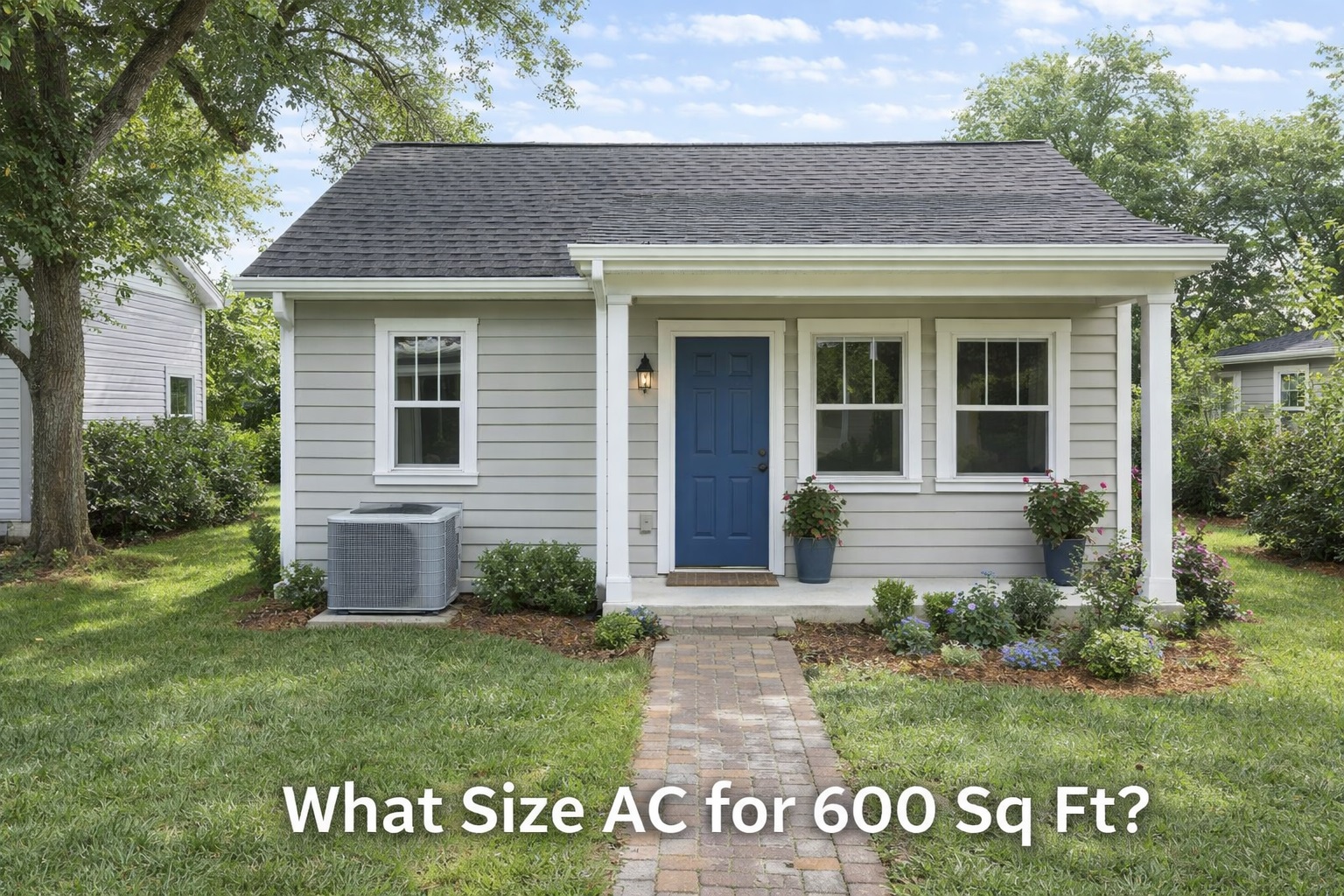
  • What Size AC for 600 Sq Ft? (Is 1 Ton Too Much?)

    what size AC for 600 sq ft small house exterior

    What Size AC for 600 Sq Ft? (Is 1 Ton Too Much?)

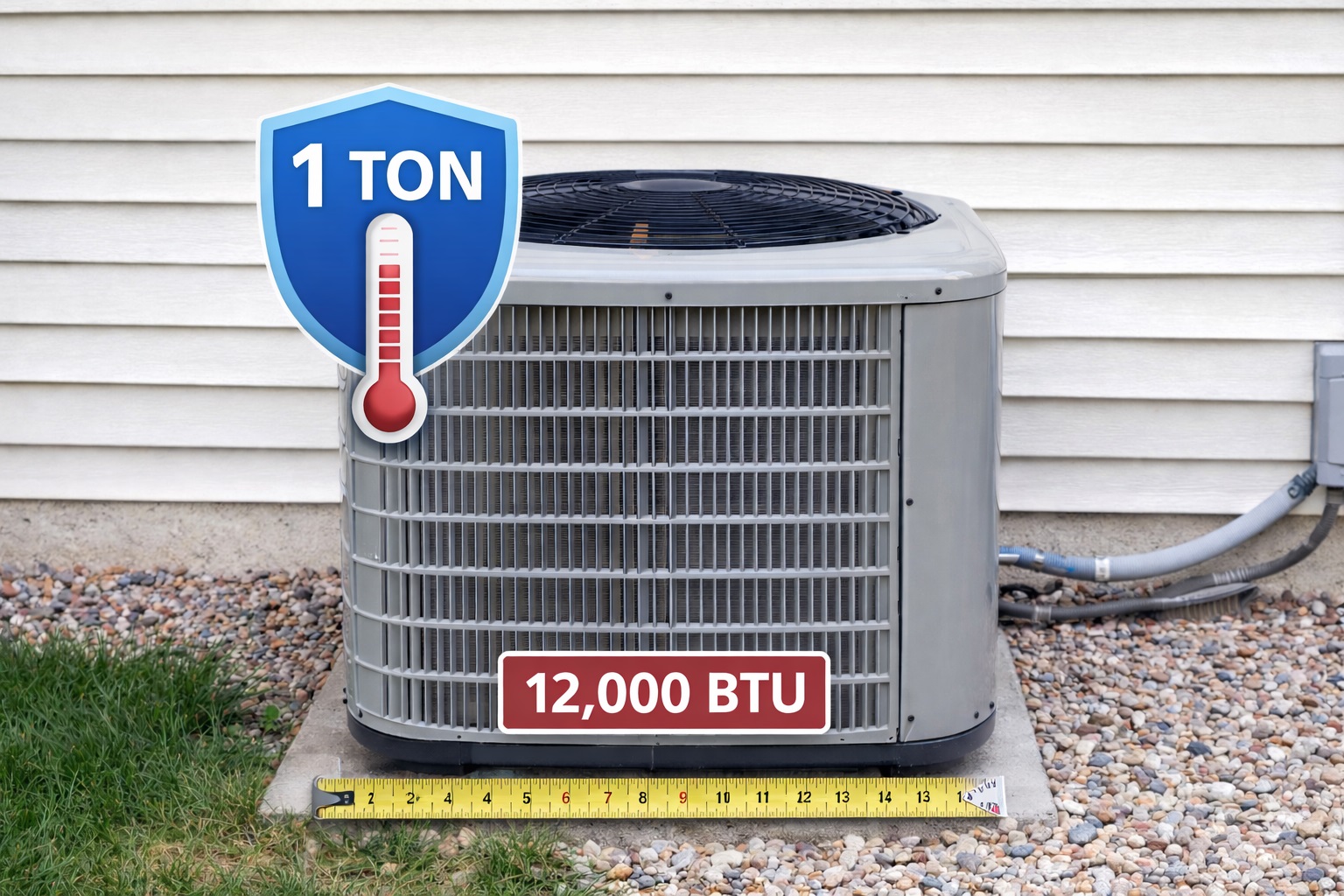
    For a 600 sq ft apartment, studio, or small home, the sweet spot is usually 12,000 to 15,000 BTU, which works out to about 1 to 1.25 tons of cooling capacity. In most average conditions, a 1-ton AC is enough. Going much larger than that can create more problems than it solves.

    That surprises a lot of homeowners, because the instinct is often to size up “just in case.” In smaller spaces, that approach can backfire fast.

    Why small spaces are easier to oversize

    A 600 sq ft apartment does not behave like a full-size house. The air volume is lower, the rooms cool faster, and the system has less space to condition before the thermostat is satisfied.

    That means small areas are actually more likely to suffer from oversizing than undersizing. If the unit is too powerful, it may cool the room quickly but shut off before removing enough humidity. That is one reason many people end up with a space that feels cold but still uncomfortable.

    If you want the basics behind AC capacity first, read What Is BTU in Air Conditioning? and What Is a Ton in HVAC?.

    What size AC is usually right for 600 sq ft?

    Most 600 sq ft spaces land in one of these two ranges:

    • 12,000 BTU (1 ton): best for average insulation, normal 8-foot ceilings, and moderate sun exposure
    • 15,000 BTU (1.25 ton): better for hotter climates, taller ceilings, or apartments with heavy afternoon sun

    For many people, 12,000 BTU is the correct answer. It is large enough to cool the space without being so large that the unit short cycles all day.

    When 12,000 BTU makes the most sense

    A 12,000 BTU unit is usually the better pick when the apartment is reasonably insulated and the layout is simple. It is especially appropriate if:

    • the ceilings are around 8 feet high
    • the unit is serving a typical one-bedroom or studio layout
    • the windows are not getting intense afternoon sun
    • the climate is moderate rather than extreme

    If you are in a northern or mild climate, going above this size often creates unnecessary oversizing risk.

    When stepping up to 15,000 BTU is reasonable

    There are cases where a 600 sq ft space needs more than the standard 1-ton rule. A 15,000 BTU system can make sense if the apartment has more heat gain than normal.

    That usually happens when:

    • you live in a hot state like Texas or Florida
    • the apartment has west-facing windows
    • the ceilings are higher than average
    • large glass doors or unshaded windows increase solar gain

    Regional climate matters more than many people think, which is why sizing in hot states often needs adjustment. See What Size AC Do I Need in Texas? and What Size AC Do I Need in Florida? for state-specific examples.

    Is 1 ton too much for 600 sq ft?

    No, not usually. In fact, a 1-ton unit is often the correct size for a 600 sq ft space. The real problem starts when people jump to something much larger, such as a 2-ton system.

    A 2-ton AC provides 24,000 BTU per hour, which is far too much for most 600 sq ft apartments. At that point, the system may satisfy the thermostat too quickly and cycle off before it has done a proper job controlling moisture and airflow.

    If you want to understand those warning signs better, read Oversized AC Symptoms and AC Short Cycling Explained.

    Why bigger can feel worse

    Many homeowners assume a larger AC will cool faster and therefore perform better. In real-world small-space cooling, that is often false.

    An oversized unit can lead to:

    • rapid on-and-off cycling
    • weak humidity removal
    • higher utility bills
    • uneven room comfort
    • more wear on components over time

    Proper AC sizing is about balanced runtime, not brute force. If your system already seems to run in strange cycles, it may help to read How Long Should AC Run Per Cycle? and Why Is My AC Running Constantly?.

    What kind of AC works best for 600 sq ft?

    The best choice is not always just about tonnage. System type matters too.

    Window AC

    A 12,000 BTU window unit is often the most affordable option for renters or anyone cooling a compact apartment. It is simple, widely available, and usually powerful enough for a typical 600 sq ft setup.

    Mini split

    A 1-ton mini split is often the best performance option. It is quiet, energy efficient, and especially good in open layouts or studio-style spaces where consistent comfort matters.

    Central AC

    Central AC is less common for 600 sq ft unless the unit is part of a larger building-wide setup. For most standalone small spaces, central air is often more system than you really need.

    Ceiling height, sunlight, and layout change the answer

    Square footage is only the starting point. Two apartments with the same floor area can need different AC sizes depending on their design.

    You may need more capacity if your 600 sq ft space has:

    • high or vaulted ceilings
    • an open-concept layout
    • large sliding glass doors
    • poor insulation
    • strong west or south sun exposure

    This is why square footage rules should be treated as guidelines, not guarantees. For a broader explanation, see Air Conditioner Sizing Guide and AC Size Chart.

    Airflow still matters, even in a small apartment

    Even if the BTU size is correct, cooling performance can still fall short when airflow is poor. A basic HVAC rule is:

    400 CFM per ton

    • 1 ton = about 400 CFM
    • 1.25 ton = about 500 CFM

    If airflow is restricted, the system may cool unevenly or operate inefficiently. You can learn more in How Many CFM Per Ton?.

    What if your unit still cannot keep up?

    If a properly sized system struggles in a 600 sq ft space, the issue is not always lack of tonnage. Sometimes the real problem is insulation, air leakage, sun exposure, or humidity load.

    Before automatically buying a larger unit, check whether the symptoms actually point to undersizing. See Undersized AC Symptoms and Is My AC Too Small?.

    Bottom line

    For most 600 sq ft apartments, 12,000 BTU or 1 ton is the right size. If the space is in a very hot climate, has tall ceilings, or gets strong sun, 15,000 BTU may be the better fit.

    What you usually want to avoid is jumping all the way to a 2-ton system. In a small space, that often creates short cycling, poor humidity control, and wasted energy.

    The best AC for 600 sq ft is not the biggest one. It is the one that matches the space, the climate, and the way the apartment actually gains heat.

    Related reading

  • What Is a Ton in HVAC?

    what is a ton in hvac outdoor central air conditioner unit

    Quick Answer

    A ton in HVAC is a unit of cooling capacity. One ton equals 12,000 BTU per hour. It measures how much heat an air conditioner can remove from a home in one hour.

    Understanding tonnage helps homeowners choose the correct AC size and avoid oversizing or undersizing problems.

    Where Did the Term “Ton” Come From?

    The term “ton” comes from early refrigeration systems.

    Before modern air conditioners existed, cooling was measured by how much heat was required to melt one ton of ice in 24 hours.

    That amount equals:

    • 288,000 BTU per day
    • Divided by 24 hours
    • = 12,000 BTU per hour

    That is why:

    1 ton = 12,000 BTU per hour.

    If you’re not familiar with BTU measurements, start here: What Is BTU in Air Conditioning?

    How Many BTU Are in One Ton?

    Here is the standard HVAC conversion chart:

    • 1 ton = 12,000 BTU
    • 2 tons = 24,000 BTU
    • 3 tons = 36,000 BTU
    • 4 tons = 48,000 BTU
    • 5 tons = 60,000 BTU

    This number represents cooling capacity, not physical weight.

    When an HVAC contractor says you need a 3-ton system, they mean a system capable of removing 36,000 BTU per hour.

    For a full sizing overview, see: Air Conditioner Sizing Guide.

    You can also use our AC Size Chart or try the AC Size Calculator for a quick estimate.

    Why HVAC Tonnage Matters

    Choosing the correct tonnage affects:

    • Cooling performance
    • Indoor humidity
    • Energy efficiency
    • Equipment lifespan

    If tonnage is too low:

    • The system runs constantly
    • It struggles during extreme heat
    • Energy bills increase

    If tonnage is too high:

    • The AC shuts off too quickly
    • It causes short cycling
    • Indoor humidity remains high

    To understand short cycling problems, read: AC Short Cycling Explained.

    If your system runs too often, you may also want to read Why Is My AC Running Constantly?.

    What Size AC Ton Do You Need?

    A common estimation method uses square footage.

    Typical rule:

    20–25 BTU per square foot

    Example:

    1,200 sq ft × 22 BTU = 26,400 BTU
    ≈ 2.2 tons

    In this case, a 2–2.5 ton unit would typically be considered.

    For more help with the math, see How Many BTU Do I Need?.

    For detailed breakdowns by home size, see:

    However, square footage alone is not enough.

    Proper sizing depends on:

    • Climate zone
    • Insulation level
    • Ceiling height
    • Window exposure
    • Number of occupants

    Common Residential AC Tonnage Sizes

    Most homes use systems between:

    • 1.5 tons (18,000 BTU)
    • 2 tons (24,000 BTU)
    • 2.5 tons (30,000 BTU)
    • 3 tons (36,000 BTU)
    • 4 tons (48,000 BTU)

    Larger homes may require 5 tons or more.

    2 Ton vs 3 Ton AC: What’s the Difference?

    A 2-ton AC removes 24,000 BTU per hour. A 3-ton AC removes 36,000 BTU per hour.

    The difference impacts:

    • Airflow requirements
    • Duct sizing
    • Compressor workload
    • Electricity consumption

    Choosing a larger unit “just to be safe” can reduce comfort and efficiency.

    Oversizing often leads to humidity issues and uneven cooling.

    For signs of an oversized system, see: Oversized AC Symptoms.

    To understand airflow better, also read How Many CFM Per Ton?.

    Does Higher Tonnage Mean Better Cooling?

    No.

    Bigger is not always better in HVAC.

    An oversized unit may:

    • Cool the home too quickly
    • Turn off prematurely
    • Reduce humidity control
    • Increase long-term wear

    An undersized system may:

    • Run continuously
    • Struggle during peak summer heat

    To learn more about undersizing problems, read: Undersized AC Symptoms.

    Balanced sizing ensures stable cooling cycles and proper moisture removal.

    If you are comparing system sizes directly, see 3 Ton vs 3.5 Ton AC and 3 Ton vs 4 Ton AC.

    Can You Calculate AC Tonnage Yourself?

    You can estimate using the BTU formula:

    Square footage × 20–25 BTU
    Then divide by 12,000 to convert to tons.

    However, for accurate results, HVAC professionals use Manual J load calculations.

    Manual J considers:

    • Climate
    • Insulation
    • Windows
    • Duct design
    • Home orientation

    This prevents expensive sizing mistakes.

    Frequently Asked Questions

    Is 2 tons enough for 1,000 sq ft?

    In many moderate climates, yes. However, insulation and climate must be considered.

    What happens if AC tonnage is too big?

    It may cause short cycling, higher humidity, and uneven temperatures.

    Is 3 tons too much for 1,500 sq ft?

    In mild climates, yes. In very hot regions, it may be appropriate depending on insulation.

    Final Thoughts

    Now you understand what a ton in HVAC means and why it matters.

    One ton equals 12,000 BTU per hour and represents cooling capacity, not weight.

    Correct tonnage ensures:

    • Comfortable indoor temperatures
    • Lower energy costs
    • Proper humidity control
    • Longer equipment lifespan

    Before selecting an air conditioner, always consider climate, insulation, and professional load calculations.

    Related Guides

  • What Is BTU in Air Conditioning?

    what is BTU in air conditioning outdoor AC unit

    What Is BTU in Air Conditioning? (Complete Beginner Guide)

    Quick Answer (Snippet Target)

    BTU (British Thermal Unit) is a unit of heat measurement. In air conditioning, BTU indicates how much heat an AC unit can remove from your home per hour. A higher BTU rating means greater cooling capacity.

    For example, a 12,000 BTU air conditioner removes 12,000 units of heat per hour.

    Understanding BTU helps you choose the correct air conditioner size and avoid common sizing mistakes.

    What Does BTU Mean in HVAC?

    BTU stands for British Thermal Unit.

    One BTU is the amount of energy required to raise the temperature of one pound of water by one degree Fahrenheit.

    In HVAC systems, BTU measures cooling capacity, heating output, and heat removal rate.

    Air conditioners do not create cold air. They remove heat from indoor air. BTU tells you how much heat your AC can remove every hour.

    If you want a complete overview of how BTU fits into system sizing, read our Air Conditioner Sizing Guide.

    BTU vs Tons: What’s the Difference?

    In central air systems, cooling capacity is often measured in tons instead of BTU.

    The conversion is simple:

    • 1 ton = 12,000 BTU per hour
    • 12,000 BTU = 1 ton
    • 24,000 BTU = 2 tons
    • 36,000 BTU = 3 tons
    • 48,000 BTU = 4 tons

    For a deeper explanation, see What Is a Ton in HVAC.

    How Many BTU Do You Need?

    A common rule of thumb is 20–25 BTU per square foot.

    For more accurate sizing, use our AC Size Calculator and BTU Calculation Guide.

    For specific home sizes:

    Factors That Affect BTU Requirements

    Climate Zone

    Hot and humid regions require more cooling power. See regional guides:

    Ceiling Height

    Higher ceilings increase air volume and require more BTU.

    Insulation

    Poor insulation increases heat gain and cooling demand.

    Windows

    Large windows increase solar heat gain.

    What Happens If BTU Is Too High?

    Oversized systems can cause short cycling and poor humidity removal.

    Learn more here: Oversized AC Symptoms

    What Happens If BTU Is Too Low?

    An undersized system may run constantly and fail to cool effectively.

    See full guide: Undersized AC Symptoms

    BTU vs Watts

    BTU measures cooling capacity, while watts measure electrical consumption.

    For efficiency details, see SEER Rating Explained.

    Most Accurate Way to Calculate BTU

    Professionals use Manual J load calculations to determine exact sizing.

    Final Thoughts

    BTU is the foundation of air conditioner sizing. Choosing the correct BTU improves comfort, reduces costs, and extends system life.

    Related Guides