Replacing a central air conditioner is one of the biggest HVAC expenses most homeowners face. In 2026, the price of a full replacement usually depends on four things more than anything else: system size, efficiency level, duct condition, and labor complexity.
That is why two homes with similar square footage can still receive very different quotes. The equipment matters, but airflow, installation difficulty, and supporting upgrades often change the final number just as much.
Quick Answer
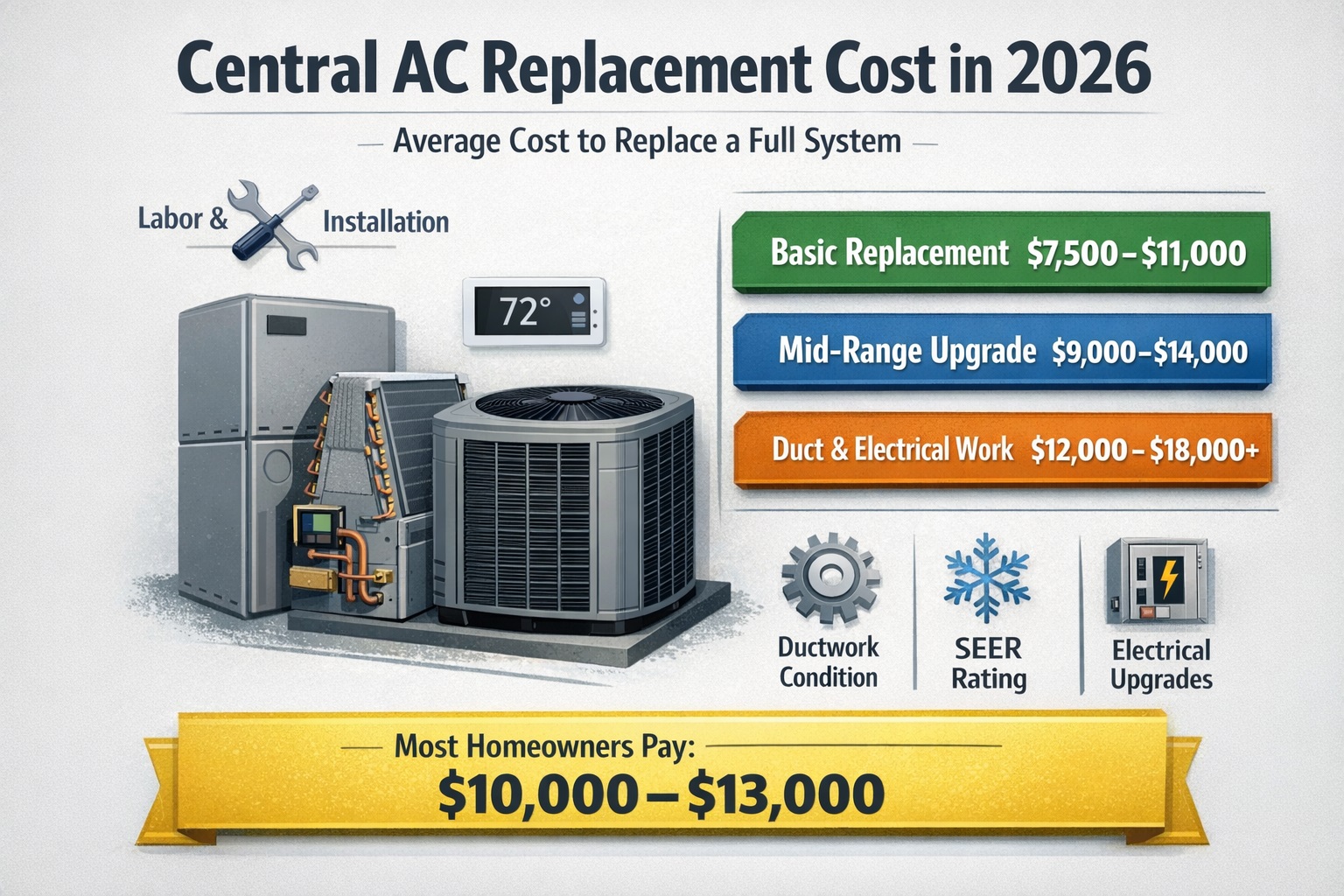
The average central AC replacement cost in 2026 usually falls between $7,500 and $15,000 for a full replacement. In many homes, the most common real-world total lands around $10,000 to $13,000.
If duct modifications, panel upgrades, or premium high-efficiency equipment are involved, the total can climb beyond $18,000.
What a central AC replacement usually includes
When contractors quote a full central AC replacement, they are usually talking about replacing the core cooling equipment while keeping the existing duct system in place—assuming the ducts are still usable.
A standard replacement often includes:
- outdoor condenser unit
- indoor evaporator coil
- refrigerant and charging work
- electrical disconnect and wiring adjustments
- startup, testing, and calibration
- labor and permit-related work
If the ducts also need resizing or replacement, the price moves into a different category. For the sizing side of that decision, read Air Conditioner Sizing Guide.
Central AC replacement cost by home size
| Home Size | Typical Cost Range |
|---|---|
| 1,500 sq ft | $7,500 – $10,500 |
| 2,000 sq ft | $8,500 – $12,000 |
| 2,500 sq ft | $10,000 – $14,000 |
| 3,000 sq ft | $12,000 – $18,000 |
Those ranges depend heavily on choosing the right tonnage. Related guides: What Size AC for 2000 Sq Ft House? and What Size AC for 3000 Sq Ft House?.
Where the money goes
Most replacement projects break down into three main buckets:
- equipment: about 50–60%
- labor: about 30–35%
- permits and materials: about 10–15%
In a $12,000 replacement, that might look roughly like this:
- equipment: about $6,500
- labor: about $3,800
- permits and materials: about $1,700
This is why a lower equipment price does not always mean a lower final bill.
Why quotes vary by thousands of dollars
Many homeowners are surprised when contractor estimates differ by $3,000 to $5,000 for what sounds like the same job. That usually happens because the quotes are not actually identical once you look closer.
Common reasons for large price differences include:
- brand choice
- single-stage vs two-stage vs variable-speed equipment
- line-set replacement vs reuse
- attic or crawlspace difficulty
- permit and inspection requirements
- regional labor pricing
That is why line-item detail matters more than the headline quote number.
Cost by system size
Tonnage changes replacement cost more than most homeowners realize. Bigger systems cost more for equipment, refrigerant handling, and sometimes airflow support too.
| System Size | Typical Installed Cost |
|---|---|
| 3 Ton | $7,500 – $10,500 |
| 4 Ton | $9,000 – $13,000 |
| 5 Ton | $11,000 – $16,000 |
If you need a refresher on tonnage, read What Is a Ton in HVAC?. For size-specific pricing, compare How Much Does a 4 Ton AC Unit Cost in 2026?.
How SEER affects replacement price
Efficiency level has a direct impact on cost. Higher-SEER equipment usually costs more up front, but can reduce long-term electricity bills—especially in hot climates with long cooling seasons.
| SEER Rating | Cost Impact |
|---|---|
| 14–15 SEER | Base price |
| 16–18 SEER | +$800 – $1,500 |
| 20+ SEER | +$2,000 – $4,000 |
For a deeper explanation, read SEER Rating Explained.
Hidden costs homeowners often miss
A replacement quote may look complete but still leave out items that turn into surprise add-ons later.
Common hidden costs include:
- duct sealing
- return-air resizing
- electrical panel upgrades
- smart thermostat upgrades
- drain line replacement
- refrigerant line replacement
Typical add-on ranges:
- electrical upgrades: $1,500 – $3,500
- duct modifications: $2,000 – $6,000
For related pricing, see AC Electrical Panel Upgrade Cost in 2026 and Ductwork Replacement Cost.
When replacement makes more sense than repair
Sometimes homeowners start out asking for a repair quote, then realize full replacement is the smarter long-term choice.
Replacement becomes easier to justify when:
- the system is 12 to 15+ years old
- the compressor has failed
- the system uses outdated refrigerant
- repair cost is already 30–40% of replacement value
If you are weighing a big repair first, compare with AC Compressor Replacement Cost in 2026.
How to avoid overpaying
The best way to protect your budget is to make sure the replacement is correctly sized and correctly scoped before comparing equipment brands.
Good rules to follow:
- get at least three quotes
- ask whether a Manual J load calculation was used
- avoid automatic upsizing
- ask about duct airflow capacity
- compare warranty terms, not just price
Many homeowners overpay by moving up in tonnage when the house does not actually need it. For the BTU side of that, see What Size AC Do I Need?.
Climate changes the replacement cost
Hot-climate states often push replacement pricing upward because they tend to require larger systems, higher-efficiency equipment, and longer labor demand during cooling season.
This is especially common in places like:
- Texas
- Florida
- Arizona
- California
That is one reason the same house can receive very different replacement quotes in different parts of the country.
2026 central AC replacement cost summary
| Scenario | Estimated Cost |
|---|---|
| Basic replacement | $7,500 – $11,000 |
| Mid-range upgrade | $9,000 – $14,000 |
| High-efficiency system | $11,000 – $16,000 |
| With duct and electrical work | $12,000 – $18,000+ |
In 2026, many homeowners end up spending around $10,000 to $13,000 for a full central AC replacement.
Final Thoughts
Central AC replacement cost is about much more than square footage. The final number depends on correct sizing, airflow support, duct condition, efficiency level, and how complicated the installation is.
Before approving a replacement, make sure you:
- verify the required tonnage
- confirm airflow and duct compatibility
- compare SEER options realistically
- review a complete contractor estimate line by line
A correctly sized and properly installed replacement system can improve comfort, lower energy waste, reduce humidity issues, and extend equipment life.