Category: HVAC Basics

Learn HVAC basics including BTU meaning, tonnage calculation, short cycling issues, oversized AC symptoms, and proper air conditioning principles.

  • SEER Rating Explained (SEER2 Update – 2026 Guide)

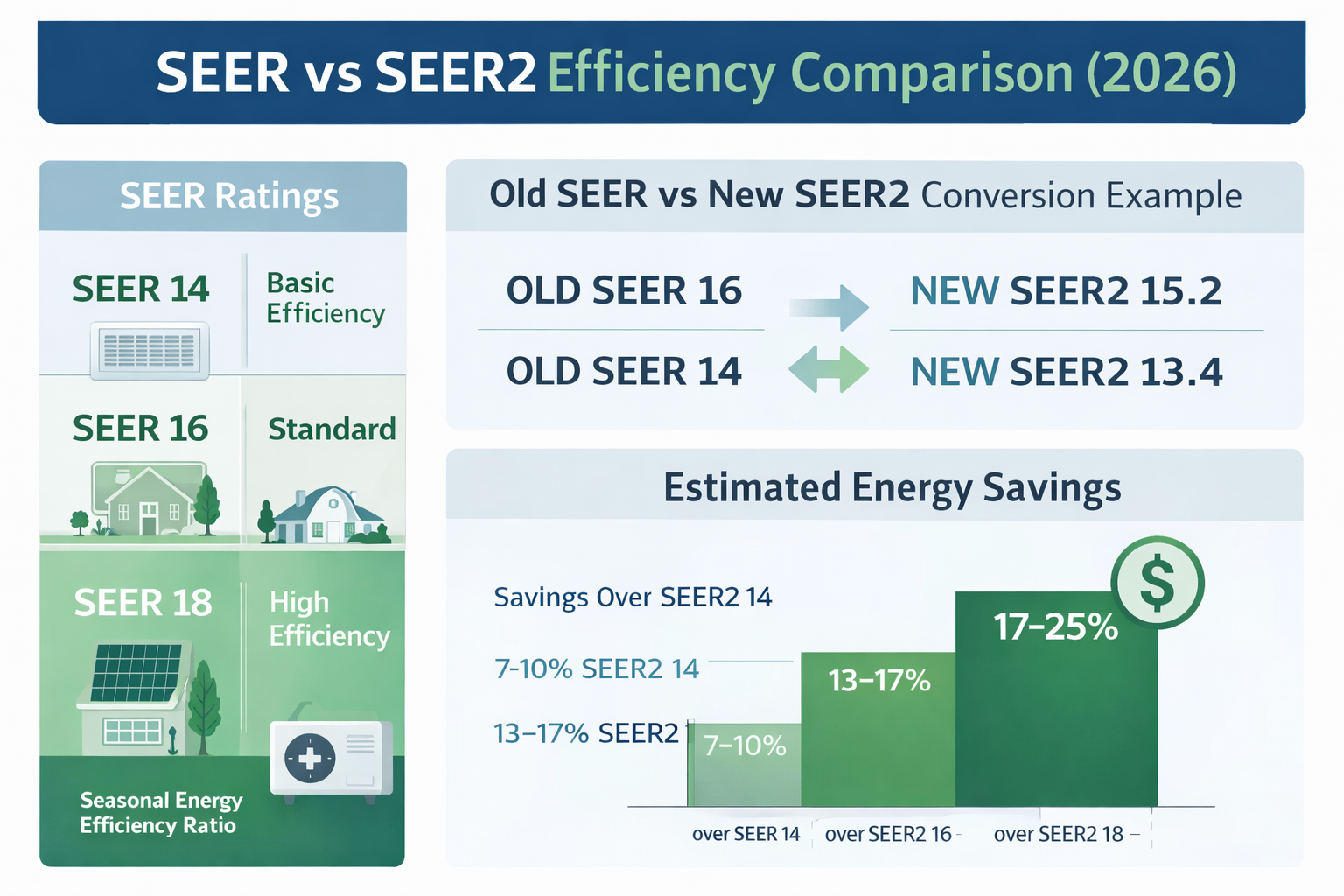
    SEER vs SEER2 efficiency comparison chart showing energy savings and rating differences

    SEER Rating Explained (SEER2 Update – 2026 Guide)

    If you are shopping for a new air conditioner, you have probably seen labels like SEER 14, SEER 16, or SEER2 17. Those numbers matter, but they do not mean what many homeowners think they mean.

    SEER measures efficiency, not raw cooling power. A higher SEER or SEER2 rating usually means the system uses less electricity to deliver the same amount of cooling over a season.

    Quick Answer

    SEER stands for Seasonal Energy Efficiency Ratio. It measures how efficiently an air conditioner cools your home over a full cooling season. A higher SEER rating means greater efficiency and lower electricity consumption. As of 2026, SEER2 is the updated testing standard used for modern HVAC equipment.

    What SEER actually measures

    At its core, SEER compares:

    Total cooling output (BTU)
    divided by
    Total electrical energy used (watt-hours)

    In simple terms, it answers this question:

    How much cooling does the AC provide for the electricity it consumes?

    That is why a higher SEER rating generally means lower operating cost. If you need a quick refresher on cooling output first, read What Is BTU in Air Conditioning?.

    SEER vs SEER2: what changed?

    The biggest recent update is that HVAC systems are now measured using SEER2 instead of the older SEER standard for modern compliance and comparisons.

    SEER2 uses updated test procedures that better reflect real-world external static pressure and field conditions. That means a unit may look like it has a lower number on paper, even if its real efficiency is basically the same as an older model rated under the previous system.

    Common examples:

    • Old SEER 16New SEER2 15.2
    • Old SEER 14New SEER2 13.4

    So when comparing systems, make sure you are comparing SEER to SEER or SEER2 to SEER2—not mixing the two.

    Why SEER2 matters in real life

    The reason this update matters is simple: homeowners often think a lower SEER2 number means newer equipment is less efficient. That is usually not true. In many cases, the number looks lower only because the testing method became stricter.

    That is why you should never compare an old marketing brochure listing “SEER 16” against a new system labeled “SEER2 15.2” and assume the new one is worse.

    Minimum SEER requirements in 2026

    Efficiency minimums vary by region because cooling demand is not the same everywhere. In hotter states, the minimum allowed efficiency is generally higher.

    As a practical rule:

    • Northern states: minimum SEER2 is often around 13.4–14.3
    • Southern and hotter states: minimum SEER2 is often around 14.3–15.2

    That is one reason efficiency planning matters more in places with long cooling seasons. Related sizing guides: What Size AC Do I Need in Texas?, What Size AC Do I Need in Florida?, and What Size AC Do I Need in California?.

    SEER rating comparison chart

    SEER / SEER2 RangeEfficiency LevelBest For
    13–14BasicMild climates
    15–16StandardMost homes
    17–18High EfficiencyHot climates / long cooling seasons
    19–22+PremiumHigh-use homes and expensive electricity markets

    Is higher SEER worth the extra money?

    Sometimes yes, sometimes no. The answer depends more on how often you run the AC than on the label alone.

    A higher-efficiency system usually makes more sense when:

    • you live in a hot climate
    • electricity rates are high
    • the AC runs for many months per year
    • you plan to stay in the home long enough to recover the upfront cost

    In very mild climates, the extra cost may take too long to pay back. In places with long cooling seasons, the savings can be much more meaningful.

    Example energy savings

    Imagine a 3-ton AC running about 1,500 hours per year. Comparing a lower-efficiency model with a higher-efficiency one can reduce annual electricity use noticeably.

    In many cases, moving from a lower baseline efficiency to a higher one can cut cooling energy use by roughly 15% to 25%, depending on the exact models, installation quality, and runtime.

    That makes a much bigger difference in places with expensive electricity or long summers. For installation budgeting, see AC Installation Cost Per Square Foot.

    SEER vs tonnage: they are not the same thing

    This is one of the most common homeowner misunderstandings.

    • SEER = efficiency
    • Tonnage = cooling capacity

    For example:

    • 3 ton AC = 36,000 BTU of cooling
    • SEER 16 = how efficiently that system uses electricity

    So a higher SEER unit is not necessarily a bigger AC. It is simply a more efficient one.

    For the basics behind tonnage, read What Is a Ton in HVAC?.

    When higher SEER will not solve your problem

    Many homeowners assume a high-SEER system automatically fixes poor comfort. It does not.

    A high-efficiency unit will not correct:

    • bad ductwork
    • poor airflow
    • incorrect AC sizing
    • leaky returns or supply ducts
    • major insulation problems

    If the unit is oversized or undersized, efficiency gains can disappear fast. That is why correct sizing matters first. See Air Conditioner Sizing Guide, Oversized AC Symptoms, and Undersized AC Symptoms.

    Single-stage vs two-stage vs variable-speed

    As efficiency increases, the system often includes more advanced compressor technology. That matters because comfort is not only about energy savings. It is also about how the system behaves while cooling.

    Higher-efficiency systems often include:

    • two-stage compressors
    • variable-speed compressors

    These can improve:

    • humidity control
    • comfort consistency
    • temperature stability
    • part-load efficiency

    In many homes, better staging provides more comfort than simply buying a bigger unit.

    How to choose the right SEER rating

    A simple planning rule looks like this:

    • Mild climate: SEER2 14–15 is often enough
    • Moderate climate: SEER2 15–16 is a common target
    • Hot climate: SEER2 16–18+ usually makes more sense
    • Long cooling season / high utility rates: higher SEER often has stronger payback

    The best choice depends on total installed cost, expected runtime, and how long you plan to stay in the home.

    Bottom line

    SEER rating tells you how efficiently an air conditioner uses electricity over a cooling season. A higher rating usually means lower operating cost, but it does not mean the AC is more powerful.

    Before choosing a system, make sure you:

    • confirm the AC is sized correctly
    • check the duct system and airflow
    • compare SEER2 ratings using the same standard
    • weigh energy savings against the installed price

    In hot climates and high-electricity-cost regions, a higher-SEER system can make a meaningful difference. But the best result comes when efficiency, sizing, and duct performance all work together.
  • What Is a Ton in HVAC?

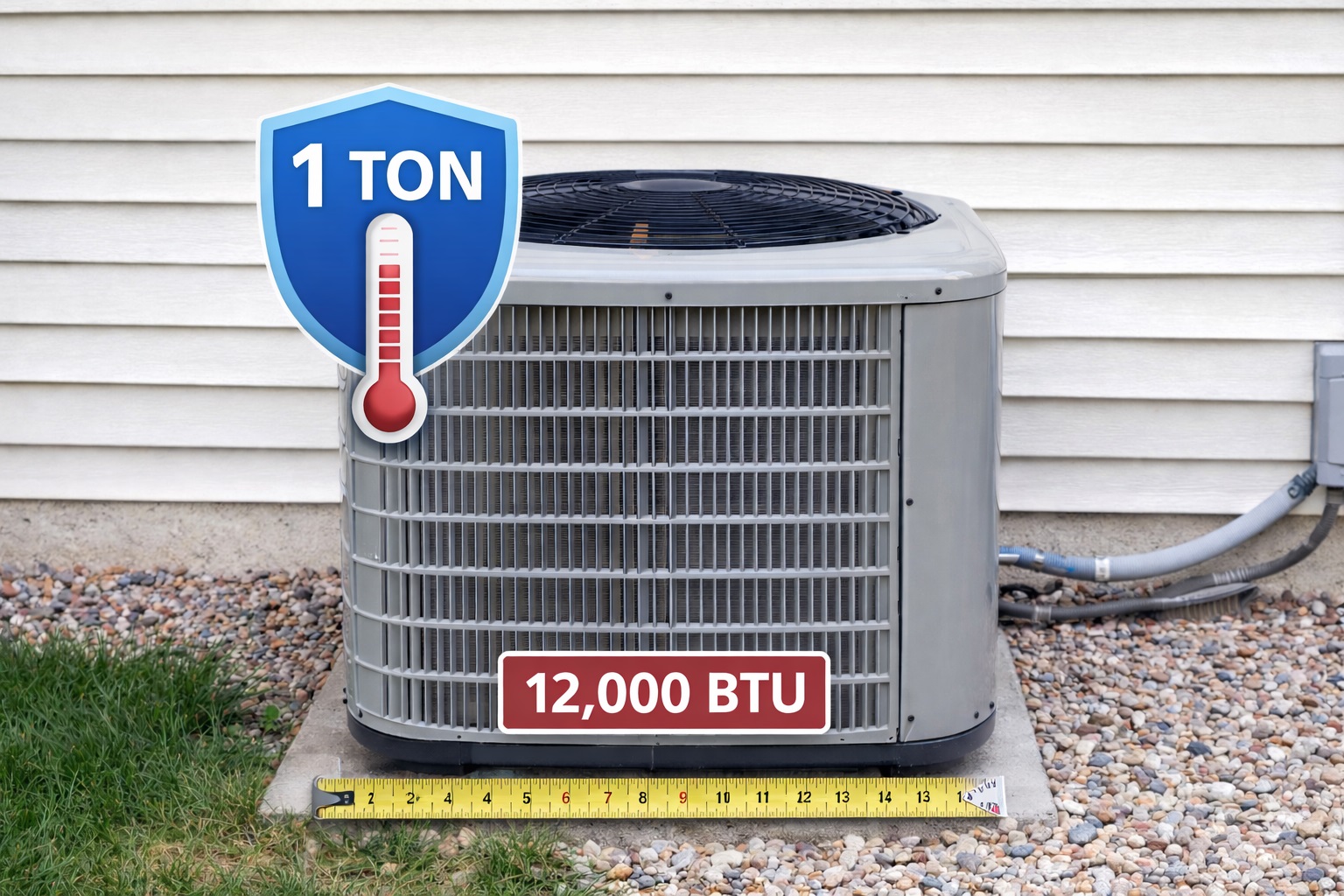
    what is a ton in hvac outdoor central air conditioner unit

    Quick Answer

    A ton in HVAC is a unit of cooling capacity. One ton equals 12,000 BTU per hour. It measures how much heat an air conditioner can remove from a home in one hour.

    Understanding tonnage helps homeowners choose the correct AC size and avoid oversizing or undersizing problems.

    Where Did the Term “Ton” Come From?

    The term “ton” comes from early refrigeration systems.

    Before modern air conditioners existed, cooling was measured by how much heat was required to melt one ton of ice in 24 hours.

    That amount equals:

    • 288,000 BTU per day
    • Divided by 24 hours
    • = 12,000 BTU per hour

    That is why:

    1 ton = 12,000 BTU per hour.

    If you’re not familiar with BTU measurements, start here: What Is BTU in Air Conditioning?

    How Many BTU Are in One Ton?

    Here is the standard HVAC conversion chart:

    • 1 ton = 12,000 BTU
    • 2 tons = 24,000 BTU
    • 3 tons = 36,000 BTU
    • 4 tons = 48,000 BTU
    • 5 tons = 60,000 BTU

    This number represents cooling capacity, not physical weight.

    When an HVAC contractor says you need a 3-ton system, they mean a system capable of removing 36,000 BTU per hour.

    For a full sizing overview, see: Air Conditioner Sizing Guide.

    You can also use our AC Size Chart or try the AC Size Calculator for a quick estimate.

    Why HVAC Tonnage Matters

    Choosing the correct tonnage affects:

    • Cooling performance
    • Indoor humidity
    • Energy efficiency
    • Equipment lifespan

    If tonnage is too low:

    • The system runs constantly
    • It struggles during extreme heat
    • Energy bills increase

    If tonnage is too high:

    • The AC shuts off too quickly
    • It causes short cycling
    • Indoor humidity remains high

    To understand short cycling problems, read: AC Short Cycling Explained.

    If your system runs too often, you may also want to read Why Is My AC Running Constantly?.

    What Size AC Ton Do You Need?

    A common estimation method uses square footage.

    Typical rule:

    20–25 BTU per square foot

    Example:

    1,200 sq ft × 22 BTU = 26,400 BTU
    ≈ 2.2 tons

    In this case, a 2–2.5 ton unit would typically be considered.

    For more help with the math, see How Many BTU Do I Need?.

    For detailed breakdowns by home size, see:

    However, square footage alone is not enough.

    Proper sizing depends on:

    • Climate zone
    • Insulation level
    • Ceiling height
    • Window exposure
    • Number of occupants

    Common Residential AC Tonnage Sizes

    Most homes use systems between:

    • 1.5 tons (18,000 BTU)
    • 2 tons (24,000 BTU)
    • 2.5 tons (30,000 BTU)
    • 3 tons (36,000 BTU)
    • 4 tons (48,000 BTU)

    Larger homes may require 5 tons or more.

    2 Ton vs 3 Ton AC: What’s the Difference?

    A 2-ton AC removes 24,000 BTU per hour. A 3-ton AC removes 36,000 BTU per hour.

    The difference impacts:

    • Airflow requirements
    • Duct sizing
    • Compressor workload
    • Electricity consumption

    Choosing a larger unit “just to be safe” can reduce comfort and efficiency.

    Oversizing often leads to humidity issues and uneven cooling.

    For signs of an oversized system, see: Oversized AC Symptoms.

    To understand airflow better, also read How Many CFM Per Ton?.

    Does Higher Tonnage Mean Better Cooling?

    No.

    Bigger is not always better in HVAC.

    An oversized unit may:

    • Cool the home too quickly
    • Turn off prematurely
    • Reduce humidity control
    • Increase long-term wear

    An undersized system may:

    • Run continuously
    • Struggle during peak summer heat

    To learn more about undersizing problems, read: Undersized AC Symptoms.

    Balanced sizing ensures stable cooling cycles and proper moisture removal.

    If you are comparing system sizes directly, see 3 Ton vs 3.5 Ton AC and 3 Ton vs 4 Ton AC.

    Can You Calculate AC Tonnage Yourself?

    You can estimate using the BTU formula:

    Square footage × 20–25 BTU
    Then divide by 12,000 to convert to tons.

    However, for accurate results, HVAC professionals use Manual J load calculations.

    Manual J considers:

    • Climate
    • Insulation
    • Windows
    • Duct design
    • Home orientation

    This prevents expensive sizing mistakes.

    Frequently Asked Questions

    Is 2 tons enough for 1,000 sq ft?

    In many moderate climates, yes. However, insulation and climate must be considered.

    What happens if AC tonnage is too big?

    It may cause short cycling, higher humidity, and uneven temperatures.

    Is 3 tons too much for 1,500 sq ft?

    In mild climates, yes. In very hot regions, it may be appropriate depending on insulation.

    Final Thoughts

    Now you understand what a ton in HVAC means and why it matters.

    One ton equals 12,000 BTU per hour and represents cooling capacity, not weight.

    Correct tonnage ensures:

    • Comfortable indoor temperatures
    • Lower energy costs
    • Proper humidity control
    • Longer equipment lifespan

    Before selecting an air conditioner, always consider climate, insulation, and professional load calculations.

    Related Guides

  • What Is BTU in Air Conditioning?

    what is BTU in air conditioning outdoor AC unit

    What Is BTU in Air Conditioning? (Complete Beginner Guide)

    Quick Answer (Snippet Target)

    BTU (British Thermal Unit) is a unit of heat measurement. In air conditioning, BTU indicates how much heat an AC unit can remove from your home per hour. A higher BTU rating means greater cooling capacity.

    For example, a 12,000 BTU air conditioner removes 12,000 units of heat per hour.

    Understanding BTU helps you choose the correct air conditioner size and avoid common sizing mistakes.

    What Does BTU Mean in HVAC?

    BTU stands for British Thermal Unit.

    One BTU is the amount of energy required to raise the temperature of one pound of water by one degree Fahrenheit.

    In HVAC systems, BTU measures cooling capacity, heating output, and heat removal rate.

    Air conditioners do not create cold air. They remove heat from indoor air. BTU tells you how much heat your AC can remove every hour.

    If you want a complete overview of how BTU fits into system sizing, read our Air Conditioner Sizing Guide.

    BTU vs Tons: What’s the Difference?

    In central air systems, cooling capacity is often measured in tons instead of BTU.

    The conversion is simple:

    • 1 ton = 12,000 BTU per hour
    • 12,000 BTU = 1 ton
    • 24,000 BTU = 2 tons
    • 36,000 BTU = 3 tons
    • 48,000 BTU = 4 tons

    For a deeper explanation, see What Is a Ton in HVAC.

    How Many BTU Do You Need?

    A common rule of thumb is 20–25 BTU per square foot.

    For more accurate sizing, use our AC Size Calculator and BTU Calculation Guide.

    For specific home sizes:

    Factors That Affect BTU Requirements

    Climate Zone

    Hot and humid regions require more cooling power. See regional guides:

    Ceiling Height

    Higher ceilings increase air volume and require more BTU.

    Insulation

    Poor insulation increases heat gain and cooling demand.

    Windows

    Large windows increase solar heat gain.

    What Happens If BTU Is Too High?

    Oversized systems can cause short cycling and poor humidity removal.

    Learn more here: Oversized AC Symptoms

    What Happens If BTU Is Too Low?

    An undersized system may run constantly and fail to cool effectively.

    See full guide: Undersized AC Symptoms

    BTU vs Watts

    BTU measures cooling capacity, while watts measure electrical consumption.

    For efficiency details, see SEER Rating Explained.

    Most Accurate Way to Calculate BTU

    Professionals use Manual J load calculations to determine exact sizing.

    Final Thoughts

    BTU is the foundation of air conditioner sizing. Choosing the correct BTU improves comfort, reduces costs, and extends system life.

    Related Guides