Quick Answer
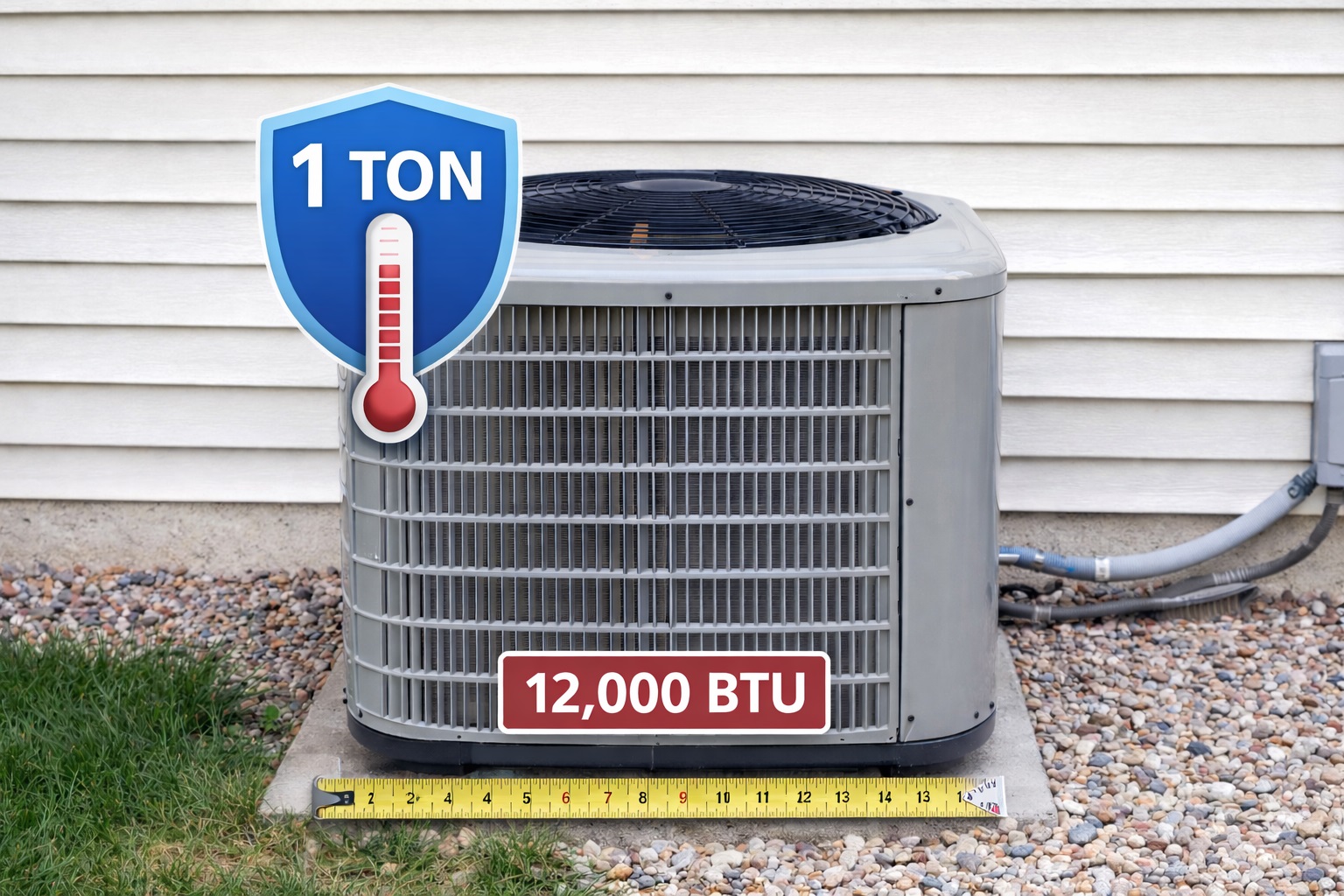
A ton in HVAC is a unit of cooling capacity. One ton equals 12,000 BTU per hour. It measures how much heat an air conditioner can remove from a home in one hour.
Understanding tonnage helps homeowners choose the correct AC size and avoid oversizing or undersizing problems.
Where Did the Term “Ton” Come From?
The term “ton” comes from early refrigeration systems.
Before modern air conditioners existed, cooling was measured by how much heat was required to melt one ton of ice in 24 hours.
That amount equals:
- 288,000 BTU per day
- Divided by 24 hours
- = 12,000 BTU per hour
That is why:
1 ton = 12,000 BTU per hour.
If you’re not familiar with BTU measurements, start here: What Is BTU in Air Conditioning?
How Many BTU Are in One Ton?
Here is the standard HVAC conversion chart:
- 1 ton = 12,000 BTU
- 2 tons = 24,000 BTU
- 3 tons = 36,000 BTU
- 4 tons = 48,000 BTU
- 5 tons = 60,000 BTU
This number represents cooling capacity, not physical weight.
When an HVAC contractor says you need a 3-ton system, they mean a system capable of removing 36,000 BTU per hour.
For a full sizing overview, see: Air Conditioner Sizing Guide.
You can also use our AC Size Chart or try the AC Size Calculator for a quick estimate.
Why HVAC Tonnage Matters
Choosing the correct tonnage affects:
- Cooling performance
- Indoor humidity
- Energy efficiency
- Equipment lifespan
If tonnage is too low:
- The system runs constantly
- It struggles during extreme heat
- Energy bills increase
If tonnage is too high:
- The AC shuts off too quickly
- It causes short cycling
- Indoor humidity remains high
To understand short cycling problems, read: AC Short Cycling Explained.
If your system runs too often, you may also want to read Why Is My AC Running Constantly?.
What Size AC Ton Do You Need?
A common estimation method uses square footage.
Typical rule:
20–25 BTU per square foot
Example:
1,200 sq ft × 22 BTU = 26,400 BTU
≈ 2.2 tons
In this case, a 2–2.5 ton unit would typically be considered.
For more help with the math, see How Many BTU Do I Need?.
For detailed breakdowns by home size, see:
- What Size AC for 2000 Sq Ft House?
- What Size AC for 2500 Sq Ft House?
- What Size AC for 3000 Sq Ft House?
However, square footage alone is not enough.
Proper sizing depends on:
- Climate zone
- Insulation level
- Ceiling height
- Window exposure
- Number of occupants
Common Residential AC Tonnage Sizes
Most homes use systems between:
- 1.5 tons (18,000 BTU)
- 2 tons (24,000 BTU)
- 2.5 tons (30,000 BTU)
- 3 tons (36,000 BTU)
- 4 tons (48,000 BTU)
Larger homes may require 5 tons or more.
2 Ton vs 3 Ton AC: What’s the Difference?
A 2-ton AC removes 24,000 BTU per hour. A 3-ton AC removes 36,000 BTU per hour.
The difference impacts:
- Airflow requirements
- Duct sizing
- Compressor workload
- Electricity consumption
Choosing a larger unit “just to be safe” can reduce comfort and efficiency.
Oversizing often leads to humidity issues and uneven cooling.
For signs of an oversized system, see: Oversized AC Symptoms.
To understand airflow better, also read How Many CFM Per Ton?.
Does Higher Tonnage Mean Better Cooling?
No.
Bigger is not always better in HVAC.
An oversized unit may:
- Cool the home too quickly
- Turn off prematurely
- Reduce humidity control
- Increase long-term wear
An undersized system may:
- Run continuously
- Struggle during peak summer heat
To learn more about undersizing problems, read: Undersized AC Symptoms.
Balanced sizing ensures stable cooling cycles and proper moisture removal.
If you are comparing system sizes directly, see 3 Ton vs 3.5 Ton AC and 3 Ton vs 4 Ton AC.
Can You Calculate AC Tonnage Yourself?
You can estimate using the BTU formula:
Square footage × 20–25 BTU
Then divide by 12,000 to convert to tons.
However, for accurate results, HVAC professionals use Manual J load calculations.
Manual J considers:
- Climate
- Insulation
- Windows
- Duct design
- Home orientation
This prevents expensive sizing mistakes.
Frequently Asked Questions
Is 2 tons enough for 1,000 sq ft?
In many moderate climates, yes. However, insulation and climate must be considered.
What happens if AC tonnage is too big?
It may cause short cycling, higher humidity, and uneven temperatures.
Is 3 tons too much for 1,500 sq ft?
In mild climates, yes. In very hot regions, it may be appropriate depending on insulation.
Final Thoughts
Now you understand what a ton in HVAC means and why it matters.
One ton equals 12,000 BTU per hour and represents cooling capacity, not weight.
Correct tonnage ensures:
- Comfortable indoor temperatures
- Lower energy costs
- Proper humidity control
- Longer equipment lifespan
Before selecting an air conditioner, always consider climate, insulation, and professional load calculations.
Leave a Reply