Author: admin

  • Is My AC Too Big for My House? (Oversizing Warning Signs – 2026 Guide)

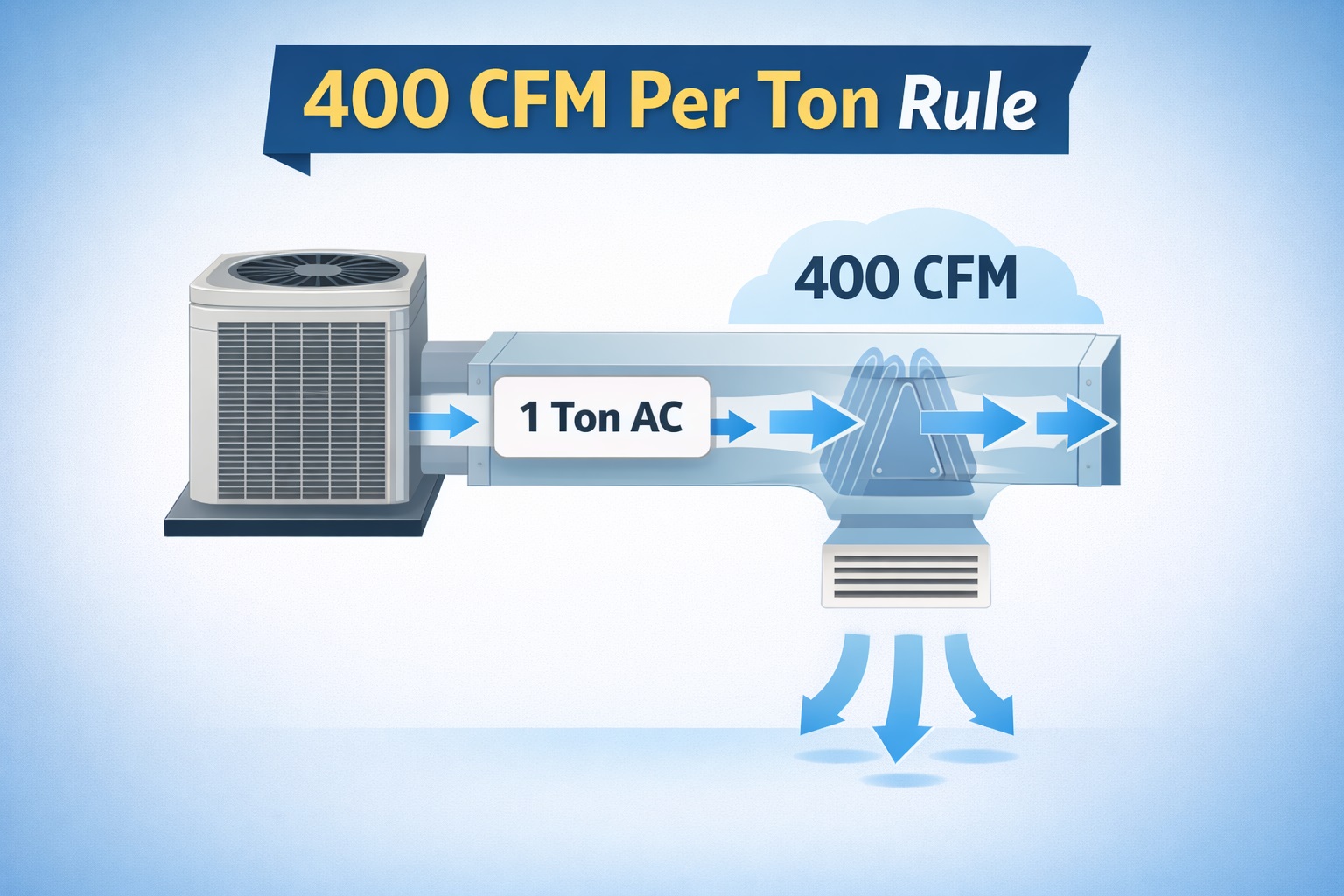
    400 CFM per ton airflow rule diagram showing a 1 ton AC system requiring 400 CFM of air movement.

    Is my AC too big for my house? Yes, it can be. An oversized air conditioner may cool the thermostat area quickly, but that does not mean it is cooling the home correctly. In many cases, a unit that is too large shuts off before it removes enough humidity, which leads to comfort problems, short cycling, and higher long-term operating costs.

    That is why bigger is not always better in HVAC. A system that looks powerful on paper can still make the house feel less comfortable.

    Quick Answer

    Yes, an AC can absolutely be too big for a house. An oversized air conditioner often cools too quickly, shuts off before completing a proper cycle, reduces humidity control, causes short cycling, increases energy use, and puts extra stress on the system.

    In HVAC, the goal is not maximum tonnage. The goal is balanced runtime, airflow, and moisture removal.

    What happens when an AC is too big?

    Air conditioners are supposed to run long enough to do three things well:

    • remove heat
    • remove humidity
    • keep indoor temperature stable

    When a system is too large, it can satisfy the thermostat too fast. That sounds efficient, but it often means the cycle ends before the air has been properly dried and distributed through the whole house.

    This is where many homeowners get confused. The house may cool quickly, but overall comfort still feels wrong.

    1. Your AC short cycles

    Short cycling is one of the clearest warning signs of an oversized system.

    If your AC:

    • turns on
    • runs for only 5 to 8 minutes
    • shuts off
    • starts again soon after

    there is a good chance oversizing is part of the problem.

    Short cycling increases wear on the compressor and usually reduces efficiency. For a full breakdown, read AC Short Cycling Explained.

    2. The house feels cool but still humid

    This is one of the most common complaints with oversized AC systems. The temperature may drop quickly, but the indoor air still feels sticky, clammy, or slightly damp.

    That happens because proper dehumidification usually needs longer runtime. If the cycle ends too fast, moisture stays behind.

    If this sounds familiar, also read Why Is My House Humid Even With the AC On?.

    3. You notice uneven temperatures

    Oversized systems often blast cold air fast near vents or near the thermostat, but that does not always mean the whole house is cooling evenly.

    You may notice:

    • cold spots in some rooms
    • warm areas farther from the unit
    • more noticeable temperature swings

    This happens because comfort depends on balanced airflow and stable runtime, not just how fast cold air comes out at the start of a cycle.

    4. Energy bills start rising

    Many homeowners expect a larger AC to cool faster and therefore cost less to run. In practice, oversized systems often waste energy because they start and stop too often.

    Compressor startup is one of the highest-energy moments in the cooling cycle. Frequent restarts can raise electricity use even if each cycle is short.

    5. The system sounds too aggressive

    If you constantly hear loud startup noise, sudden bursts of airflow, or abrupt shutoffs, that can be another clue the AC is oversized for the house or for the duct design.

    Noise alone does not prove oversizing, but when it appears together with short cycling and humidity issues, it becomes a stronger warning sign.

    6. Airflow balance feels off

    Ductwork designed for a smaller system can struggle when paired with oversized equipment. That may create:

    • high static pressure
    • loud vents
    • reduced efficiency
    • room-to-room comfort imbalance

    For more on airflow, read How Many CFM Per Ton?.

    7. You see moisture or mold-related issues

    In humid climates, oversizing can increase the risk of:

    • condensation
    • musty smells
    • mold or mildew growth

    This is especially common in places like Florida, Texas, and other warm coastal or humid regions where moisture control matters just as much as temperature control.

    Why oversizing happens so often

    Most oversized systems are not installed because someone wanted to cause a problem. They are installed because of shortcuts.

    Common reasons include:

    • contractors rounding up “just to be safe”
    • wrong square footage assumptions
    • reusing the old unit size without recalculating
    • ignoring insulation or window upgrades

    That is why proper sizing should be based on a real load calculation, not guesswork. For the full framework, see Air Conditioner Sizing Guide.

    Oversized vs undersized AC

    These two problems are easy to confuse, but the behavior is different.

    ProblemTypical Behavior
    Oversized ACShort cycles, humidity problems, uneven comfort
    Undersized ACRuns constantly, struggles to reach set temperature

    If your system never seems to shut off instead, read Why Is My AC Running Constantly? and Undersized AC Symptoms.

    Can better technology fix an oversized AC?

    Sometimes newer equipment can reduce the symptoms. Two-stage and variable-speed systems can run at lower output most of the time, which improves humidity control and reduces temperature swings.

    That said, technology does not fully fix severe oversizing. If the system is far too large for the home, the mismatch still remains.

    For more on system efficiency and staging, read SEER Rating Explained.

    What should you do if your AC is too big?

    1. Confirm the problem with a load calculation

    The best first step is to request a Manual J load calculation. This checks whether the system size actually matches the home.

    2. Check the duct system

    Bad duct design can make oversizing symptoms worse. Even if the equipment is only slightly too large, airflow issues can magnify the problem.

    3. Consider zoning or staging

    In some homes, zoning or better compressor staging can reduce the comfort issues without immediately replacing the entire system.

    4. Evaluate replacement if the mismatch is severe

    If the unit is significantly oversized and the comfort problems are persistent, replacing it with correctly sized equipment may be the best long-term solution.

    Final Answer

    Yes, your AC can definitely be too big for your house. Oversizing often causes:

    • short cycling
    • poor humidity control
    • higher energy bills
    • reduced system lifespan

    The best air conditioner is not the biggest one. It is the one that runs long enough to cool evenly, control humidity, and match the real load of the home.
  • Why Is My AC Running Constantly? (Causes & Fixes – 2026 Guide)

    Why is my AC running constantly? In many homes, the answer comes down to heat load, airflow, insulation, or AC sizing. During extreme summer weather, long runtimes can be completely normal. But if the system runs nonstop in mild weather, struggles to reach the thermostat setting, or drives up your electric bill, there is usually an underlying problem.

    The key is figuring out whether the system is working hard because conditions are severe—or because something is wrong.

    Quick Answer

    An AC running constantly is most often caused by one of these issues:

    • extreme outdoor heat
    • an undersized AC unit
    • poor insulation or air leaks
    • dirty air filter
    • dirty condenser coil
    • low refrigerant
    • thermostat problems

    In very hot climates, long runtimes can be normal. In mild weather, nonstop operation usually points to airflow, insulation, or sizing problems.

    1. Extreme outdoor heat can make long runtimes normal

    When outdoor temperatures climb into the 95°F to 105°F range—or higher—many AC systems will run for most of the afternoon. That does not automatically mean the system is failing.

    This is especially common in places like:

    • Texas
    • Florida
    • Arizona

    If the outside temperature is near 100°F, the AC may run almost continuously just to hold the indoor temperature steady. In those conditions, long cycles are often expected.

    For climate-specific examples, read What Size AC Do I Need in Texas? and What Size AC Do I Need in Florida?.

    2. The AC may be undersized

    If the system runs constantly even when outdoor temperatures are only moderately hot, the unit may not have enough cooling capacity for the house.

    Common signs of an undersized AC include:

    • the house never reaches the thermostat setting
    • the AC runs for 40+ minutes at a time
    • cooling falls behind in late afternoon heat
    • the home feels better at night than during the day

    An undersized unit simply cannot remove heat as fast as the home is gaining it.

    Related guides: Undersized AC Symptoms and Air Conditioner Sizing Guide.

    3. Poor insulation or air leaks may be the real cause

    Sometimes the AC is sized correctly, but the house is losing cooled air too quickly. In that case, the unit keeps running because the home cannot hold the temperature it just created.

    Common causes include:

    • old attic insulation
    • drafty windows
    • poorly sealed doors
    • air leaks in the building envelope
    • leaky ductwork

    This is one of the most overlooked reasons an AC seems to run nonstop.

    4. Dirty air filter

    A clogged air filter restricts airflow, which reduces how much cooling the system can deliver. The AC may still run, but it has to run longer to do the same job.

    When airflow drops:

    • cooling capacity decreases
    • the evaporator coil gets colder than it should
    • the system may run longer than normal

    Replace the filter every 1 to 3 months, depending on the home and filter type.

    For airflow-related symptoms, also read AC Running But Not Cooling.

    5. Dirty or blocked outdoor condenser coil

    The outdoor unit has to reject heat. If it is covered in dirt, grass, leaves, or debris, the system cannot get rid of heat efficiently, so it runs longer trying to keep up.

    That usually leads to:

    • weaker cooling
    • higher energy use
    • longer runtime

    Keep the outdoor unit clear and clean, and make sure airflow around it is not blocked.

    6. Refrigerant problems can reduce cooling capacity

    If refrigerant is low, the system cannot absorb and move heat properly. The AC may continue running, but the cooling effect drops, so the house never fully catches up.

    Possible signs include:

    • AC runs constantly
    • cooling feels weak
    • ice forms on refrigerant lines
    • electric bills rise

    Low refrigerant is not a DIY fix. It usually means a leak or sealed-system problem that requires a licensed HVAC technician.

    7. Thermostat issues can keep the AC running

    A thermostat can cause nonstop operation if it is reading the home incorrectly or is placed in a bad location.

    Common thermostat-related issues:

    • installed near a hot window
    • installed near kitchen heat
    • poor calibration
    • older mechanical thermostat problems

    If the thermostat thinks the house is warmer than it really is, it will keep calling for cooling.

    When constant running is actually a good sign

    Some modern systems are designed to run longer than older equipment. Variable-speed and high-efficiency systems often operate for long periods at lower output on purpose.

    That helps improve:

    • humidity control
    • temperature stability
    • overall efficiency

    So if your system is variable-speed, longer runtime is not automatically a problem. It may actually be normal behavior.

    For more on this, read SEER Rating Explained.

    Constant running is not the same as short cycling

    These two problems often get confused, but they are very different.

    ProblemBehavior
    Constant RunningLong or nonstop operation
    Short CyclingRapid on/off operation every few minutes

    If your system is turning on and off rapidly instead of running long, read AC Short Cycling Explained.

    Watch for energy bill warning signs

    If your AC runs constantly and you also notice these symptoms, there is a good chance the system has an airflow, insulation, or sizing issue:

    • electric bills rising sharply
    • indoor humidity staying high
    • uneven room temperatures
    • weak airflow from vents

    In some homes, the problem can even come from the opposite sizing mistake. Oversized systems can create comfort imbalance and poor humidity control too. See Oversized AC Symptoms.

    How to fix an AC that runs constantly

    Start with the simplest steps before assuming the system needs major repair.

    1. Replace the air filter
    2. Check thermostat settings and placement
    3. Clear debris around the outdoor unit
    4. Look for insulation or air leakage problems
    5. Schedule an HVAC inspection if the issue continues

    If the system is older than about 12 to 15 years, replacement may sometimes make more sense than repeated repair attempts.

    Final Answer

    An AC running constantly is not always a problem.

    • In extreme heat: often normal
    • In mild weather: usually a sign of airflow, insulation, refrigerant, thermostat, or sizing issues

    If your AC never seems to shut off and still struggles to cool the house, it is time to look at airflow, insulation, and system capacity—not just the thermostat setting.

    Balanced runtime helps deliver:

    • lower energy bills
    • better humidity control
    • more stable comfort
    • longer equipment life
  • Ductwork Replacement Cost in 2026 (Full Pricing Guide) 

    Ductwork replacement cost is one of the most overlooked parts of an HVAC project. Many homeowners focus on the air conditioner itself, then get surprised when bad, undersized, or leaking ducts add thousands of dollars to the total installation bill.

    That is because even a high-efficiency AC system cannot perform well if the duct system cannot move air properly. In many homes, replacing ductwork improves comfort, airflow, humidity control, and overall system efficiency just as much as replacing the equipment.

    Quick Answer

    In 2026, ductwork replacement cost can range from a few hundred dollars for limited section replacement to roughly $12,000 for larger full-system jobs. For many full residential projects, new ductwork commonly lands around $2,000 to $12,000, and many estimates fall near about $10 to $25 per linear foot depending on layout, material, and installation difficulty.

    Smaller repairs or partial replacements may cost much less, while full-house duct redesigns, difficult attic work, and larger homes push the price much higher.

    What ductwork replacement usually includes

    A true ductwork replacement project often involves more than swapping out a few flexible runs. In many homes, the job includes:

    • removing old damaged or undersized ducts
    • installing new supply and return runs
    • reconnecting trunks and branch lines
    • sealing duct joints
    • hanging and supporting ducts properly
    • insulation where required
    • basic airflow balancing and testing

    If the system also needs return-air improvements, grille changes, or redesign work, the quote can rise quickly.

    Average ductwork replacement cost in 2026

    Ductwork pricing varies because some articles refer to replacing only a damaged section, while others refer to replacing the full duct system. As a practical budgeting rule, these are the ranges most homeowners should think about:

    Project TypeTypical Cost Range
    Small section replacement$250 – $1,500
    Partial duct replacement$1,000 – $3,500
    Full ductwork replacement$2,000 – $12,000
    Large / difficult full-system projects$8,000 – $12,000+

    As another budgeting shortcut, many contractors and cost guides estimate new ductwork around $10 to $25 per linear foot, though difficult access and premium materials can push the number higher.

    Why ductwork costs vary so much

    Two homes with the same square footage can receive very different ductwork quotes. The biggest reason is that ductwork is heavily affected by design and access, not just materials.

    Main pricing factors include:

    • home size and layout
    • attic, crawlspace, or basement access
    • duct material choice
    • number of supply and return runs
    • whether the ducts need redesign or only replacement
    • local labor rates

    That is why a compact one-story home is usually far cheaper than a multi-level home with long attic runs and poor access.

    Cost by home size

    While ductwork is not priced only by square footage, home size still gives a useful budgeting reference.

    Home SizeEstimated Ductwork Cost
    1,200–1,500 sq ft$2,000 – $5,000
    1,800–2,500 sq ft$3,500 – $7,500
    2,500–3,500 sq ft$5,000 – $10,000+

    Larger homes usually need more linear footage, more return planning, and more balancing work.

    Flexible duct vs sheet metal duct cost

    Material type changes both price and performance.

    Flexible duct

    Flex duct is usually less expensive and faster to install. It is common in attics and standard residential replacements.

    Best for: lower-cost installations, easier routing, standard residential layouts

    Sheet metal duct

    Sheet metal duct is more durable and often preferred in higher-performance systems, but labor and material costs are usually higher.

    Best for: longer-term durability, better airflow potential, premium installations

    The cheaper material is not always the better long-term option if airflow and durability are priorities.

    When ductwork replacement becomes necessary

    Homeowners do not always need full duct replacement. But there are clear situations where replacing ducts is more sensible than patching them again.

    Common reasons include:

    • ducts are leaking badly
    • ducts are undersized for the current system
    • rooms have major airflow imbalance
    • old flex duct has collapsed or deteriorated
    • return air is inadequate
    • the HVAC system is being upsized or redesigned

    If the house has comfort problems like weak airflow, hot rooms, or noisy vents, the duct system may be the real cause—not the condenser outside.

    Ductwork replacement vs duct repair

    Repairing ducts is often cheaper in the short term, but replacement becomes more attractive when the duct system has multiple problems at once.

    Repair usually makes more sense when:

    • damage is isolated
    • most of the duct layout is still correct
    • only a few sections are leaking or disconnected

    Replacement usually makes more sense when:

    • the duct system is old throughout
    • airflow is poor in many rooms
    • the existing design is undersized
    • the home is getting a new AC size that needs different airflow

    For related repair context, many repair guides put duct repair around a few hundred dollars to a couple thousand dollars depending on location and damage severity. :contentReference[oaicite:1]{index=1}

    How ductwork affects AC performance

    Bad ductwork can make a perfectly good air conditioner feel undersized. If airflow is restricted, leaking, or unbalanced, the AC may:

    • run longer than normal
    • struggle to cool certain rooms
    • create higher humidity
    • produce noisy vents
    • wear down faster

    This is why ductwork should always be part of the conversation during a system replacement.

    Related guides:

    Hidden costs homeowners miss

    A ductwork quote may not stop at the ducts themselves. Additional work can include:

    • return-air resizing
    • register and grille replacement
    • attic access or difficult removal labor
    • duct insulation upgrades
    • air sealing and balancing

    In some homes, those add-ons make the difference between a moderate project and a very expensive one.

    When duct replacement happens during AC replacement

    Ductwork replacement often appears during a central AC replacement because the old ducts cannot support the new airflow requirements. This is especially common when:

    • a 3-ton system is being replaced with 4 tons
    • return air is inadequate
    • old duct sizing no longer matches the equipment

    That is why replacing the AC without checking the duct system can be a costly mistake.

    Related cost guides:

    How to avoid overpaying for ductwork

    The best way to control cost is to make sure the contractor is replacing the right parts for the right reason—not just selling a full duct replacement automatically.

    • get at least 3 itemized quotes
    • ask whether full replacement is actually necessary
    • confirm supply and return sizing
    • ask if duct sealing alone could solve part of the problem
    • make sure airflow calculations match the AC tonnage

    In many homes, the most expensive mistake is replacing equipment without fixing the airflow problem behind it.

    Final cost summary

    In 2026, ductwork replacement cost can range widely depending on whether you are replacing a small damaged section or the full duct system. Many full-house projects land somewhere in the $2,000 to $12,000 range, while budgeting by linear foot often falls around $10 to $25.

    The final number depends on layout, access, material type, and whether the project includes redesign—not just replacement. A properly sized and sealed duct system improves comfort, reduces wasted energy, and helps the AC perform the way it should.

  • How Much Does a 2 Ton AC Unit Cost in 2026? (Full Price Breakdown)

    A 2 ton air conditioner is one of the most common system sizes for smaller homes, condos, and well-insulated houses. In 2026, the total cost depends not only on the equipment itself, but also on labor, efficiency level, duct condition, and whether the installation is a simple replacement or a more involved upgrade.

    That is why two homeowners can both buy a 2 ton system and still receive very different quotes.

    Quick Answer

    In 2026, the average 2 ton AC unit cost usually falls between $5,500 and $9,500 installed. Equipment alone often costs around $2,000 to $4,000, while labor, materials, and permits make up the rest of the total.

    For many standard replacements, the most common real-world total lands around $6,500 to $7,500.

    What does a 2 ton AC mean?

    In HVAC sizing, 1 ton = 12,000 BTU per hour. That means a 2 ton AC provides about 24,000 BTU of cooling capacity.

    This size is commonly used for:

    • homes around 1,000 to 1,400 sq ft
    • well-insulated smaller houses
    • mild to moderate climates

    If you need the sizing basics first, read Air Conditioner Sizing Guide, What Is BTU in Air Conditioning?, and What Is a Ton in HVAC?.

    2 ton AC cost breakdown in 2026

    Cost ComponentEstimated Cost
    Equipment Only$2,000 – $4,000
    Labor$2,000 – $3,500
    Materials & Permits$500 – $1,500
    Total Installed Cost$5,500 – $9,500

    In many projects, labor makes up around 30% to 40% of the total job cost.

    For a deeper labor breakdown, see AC Labor Cost Breakdown in 2026.

    Why the price range is so wide

    A 2 ton system might sound simple, but the final price can still move a lot depending on installation conditions. The biggest price drivers are usually:

    • SEER rating
    • local labor rates
    • duct condition
    • permit requirements
    • how difficult the equipment is to access and install

    That is why one quote may sit near the low end while another lands thousands of dollars higher.

    Cost by SEER rating

    Higher-efficiency systems cost more up front, but they may lower electricity bills over time.

    SEER RatingInstalled Cost
    14–15 SEER$5,500 – $7,000
    16–18 SEER$6,500 – $8,500
    20+ SEER$8,000 – $9,500

    If you want to understand efficiency before choosing a model, read SEER Rating Explained.

    When installation cost goes up

    Even a small system can become an expensive project if the house needs supporting work. A 2 ton AC installation may cost more when:

    • ductwork is undersized or damaged
    • the electrical panel needs upgrading
    • the refrigerant line set must be replaced
    • the attic or install location is difficult to access
    • the system must be relocated

    Typical add-on ranges:

    • duct modifications: $2,000 – $6,000
    • electrical upgrades: $1,500 – $3,500

    For related costs, compare Ductwork Replacement Cost and AC Electrical Panel Upgrade Cost in 2026.

    2 ton vs 2.5 ton cost difference

    Some homes fall right on the line between 2 tons and 2.5 tons. In many cases, moving up to 2.5 tons adds roughly:

    $500 to $1,200

    But the real question is not just price. It is whether the home actually needs the larger size. Unnecessary upsizing can create short cycling and humidity problems.

    If you are on the borderline, compare What Size AC for 1400 Sq Ft House? and What Size AC for 1500 Sq Ft House?.

    Replacement vs new installation

    The cost changes a lot depending on whether this is a simple replacement or a first-time central AC installation.

    Replacing an existing 2 ton unit

    This is usually the lower-cost scenario because:

    • the duct system may already exist
    • the location is already set up
    • labor is more straightforward

    New installation

    If the home does not already have central air, the project gets more expensive because it may require:

    • new ducts
    • new supply and return layout
    • extra labor for full setup

    In those cases, total cost can climb beyond $10,000.

    For broader installation pricing, read AC Installation Cost Per Square Foot in 2026.

    Is a 2 ton AC the right size?

    A 2 ton system is often a good fit for smaller homes, but it is not right for every house in the same square-foot range. Climate, insulation, windows, and ceiling height all affect the answer.

    It is more likely to work well when:

    • the home is on the smaller end of the range
    • insulation is good
    • sun exposure is moderate
    • the climate is not extreme

    If the unit is too small, it may run constantly. If it is too large, it may short cycle and control humidity poorly.

    For warning signs, read Undersized AC Symptoms and Oversized AC Symptoms.

    2026 cost summary

    ScenarioEstimated Total Cost
    Basic Replacement$5,500 – $7,000
    Mid-Range Upgrade$6,500 – $8,500
    High-Efficiency System$8,000 – $9,500

    In 2026, many homeowners pay around $6,500 to $7,500 for a standard 2 ton AC replacement.

    Bottom line

    A 2 ton AC unit in 2026 usually costs between $5,500 and $9,500 installed, with most standard projects landing somewhere in the middle of that range. The final number depends on efficiency level, installation complexity, ductwork condition, and whether this is a replacement or a brand-new setup.

    The smartest way to avoid overpaying is to confirm that 2 tons is actually the right size before choosing equipment. Getting the tonnage right matters just as much as getting the price right.

  • AC Electrical Panel Upgrade Cost in 2026

    When homeowners install a larger air conditioning system, they often focus on equipment size, ductwork, and labor—but forget one major cost category: electrical capacity. If the panel cannot safely support the new AC load, an upgrade may be required before the system can be installed correctly.

    That is why an AC replacement quote can suddenly rise even when the HVAC equipment itself looked affordable at first.

    Quick Answer

    In 2026, the average AC electrical panel upgrade cost usually falls between $1,500 and $3,500, depending on panel size, amperage increase, wiring complexity, permit requirements, and local labor rates.

    In some homes, especially older ones needing a full service upgrade, total cost can exceed $4,000.

    Why electrical upgrades are sometimes needed

    Larger and higher-efficiency AC systems often require more electrical support than older homes were designed to handle. That becomes more likely when the house still has an older 100-amp panel or already has several major appliances drawing from the same service.

    As a rough example:

    • 3–4 ton systems may need about 30–40 amp breakers
    • 5 ton systems often need about 40–60 amp breakers

    If the panel has no spare capacity, or the service is already stretched thin, an upgrade may be required before the AC can be installed safely.

    If you are pricing a larger system, compare How Much Does a 5 Ton AC Unit Cost in 2026? and Central AC Replacement Cost in 2026.

    Most common panel upgrade scenarios

    Not every home needs a full main panel replacement. Electrical upgrade cost depends on how much work is actually required.

    Breaker upgrade only

    In simpler cases, the electrician may only need to add or replace a breaker with minimal wiring changes.

    Typical cost: $500 – $1,200

    Subpanel installation

    Some homes need an additional dedicated AC subpanel rather than a full replacement of the main service panel.

    Typical cost: $1,000 – $2,500

    Full main panel upgrade

    If the house has an older 100-amp setup and needs to move to 150-amp or 200-amp service, the project becomes much bigger.

    This may include:

    • main panel replacement
    • utility coordination
    • new breakers and service work

    Typical cost: $1,500 – $3,500+

    In high-demand homes or higher-cost regions, the final number can go beyond that range.

    How much of the cost is labor?

    Electrical labor is a major part of the total bill. In many panel upgrade jobs, labor accounts for around 40% to 60% of the overall cost.

    Typical electrician labor rates in 2026 often range from:

    $75 – $150 per hour

    That varies a lot by state, permit rules, and how difficult the job is to access and complete.

    For comparison with HVAC-side labor, read AC Labor Cost Breakdown in 2026.

    When is an electrical upgrade required?

    You may need a panel upgrade if the house is already close to its electrical limit or if the existing equipment is outdated.

    Common warning signs include:

    • lights dim when the AC starts
    • breakers trip frequently
    • the panel is outdated or known to be problematic
    • you are installing a larger 4- or 5-ton system
    • the home already has several heavy electrical loads

    If you are comparing larger equipment, see How Much Does a 4 Ton AC Unit Cost in 2026?.

    Older panels deserve special attention

    Some older electrical panels are more than just undersized—they may also have safety or reliability concerns. If the home has a very old panel or one with a poor reputation, the electrician may recommend replacement even before the AC installation moves forward.

    In those cases, the AC project becomes the trigger for work the home may have needed anyway.

    Hidden costs homeowners often miss

    A panel upgrade quote may not stop at the panel itself. Additional work can include:

    • permit fees
    • utility company coordination
    • grounding improvements
    • surge protection
    • minor wiring corrections

    These items can add another:

    $300 – $1,000

    That is why detailed line-item estimates matter.

    Can you avoid a panel upgrade?

    Sometimes yes. Not every larger AC automatically forces electrical work.

    You may be able to avoid a panel upgrade if:

    • the panel still has enough spare capacity
    • the AC is sized correctly
    • the home is not adding other major appliances at the same time
    • the electrician confirms the existing service is adequate

    This is one reason correct sizing matters so much. Oversizing the AC can create extra electrical demand that never should have existed in the first place.

    For the sizing side, read Air Conditioner Sizing Guide and Oversized AC Symptoms.

    Why proper sizing helps control electrical cost

    Many homeowners overpay for both equipment and electrical work by jumping to a bigger system “just to be safe.” But larger tonnage can mean:

    • higher breaker requirements
    • more startup load
    • greater panel demand
    • more chance of requiring service upgrades

    That is why the cheapest long-term path is often not the biggest AC—it is the correctly sized one.

    Regional pricing can change the quote

    Electrical upgrade pricing varies a lot by location. Costs tend to run higher in areas with:

    • high labor rates
    • strict permit and inspection requirements
    • strong seasonal contractor demand

    That means the same panel upgrade can cost noticeably more in one state or city than another.

    Final 2026 cost summary

    Upgrade TypeCost Range
    Breaker Only$500 – $1,200
    Subpanel$1,000 – $2,500
    Full Panel Upgrade$1,500 – $3,500+

    In 2026, many homeowners installing larger AC systems end up paying around $2,000 to $3,000 for electrical panel upgrades when one is required.

    Bottom line

    Electrical capacity is one of the most overlooked parts of a central AC installation or replacement. In many homes, the HVAC system itself is not the only upgrade needed—the electrical system has to be ready to support it safely.

    That is why it is smart to ask about panel capacity before installation day rather than after the HVAC quote has already been accepted.

  • AC Labor Cost Breakdown in 2026 (Installation & Replacement Guide)

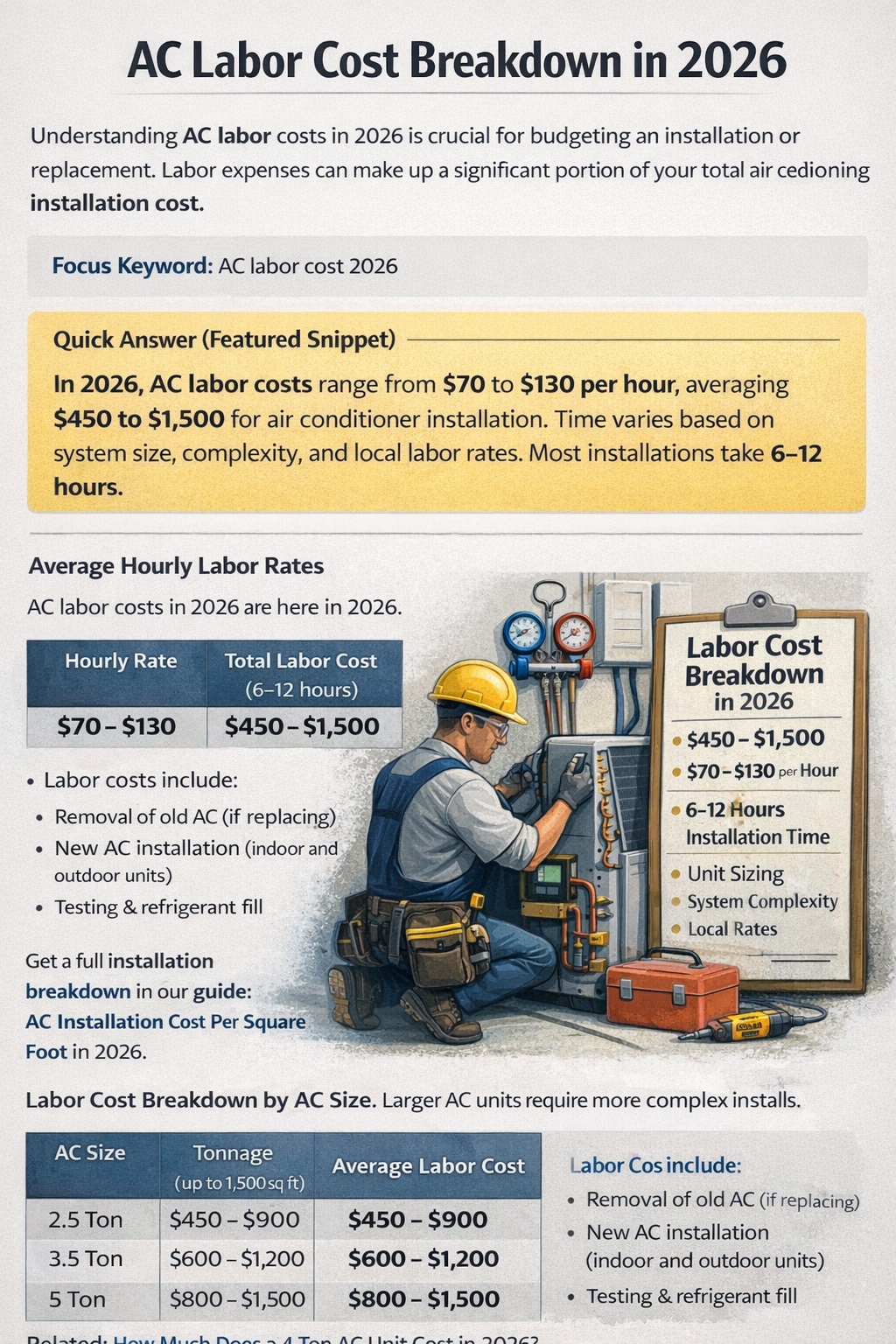
    AC labor cost 2026 infographic showing $70–$130 hourly HVAC installation rates and total labor cost between $450 and $1,500

    AC labor cost in 2026 usually ranges from $2,000 to $5,500, depending on system size, installation complexity, duct condition, and regional labor rates.

    That is because installing or replacing an AC system involves far more than setting a condenser outside and turning the unit on. A proper job includes refrigerant work, electrical connections, system startup, airflow setup, and code-compliant installation details that directly affect comfort and equipment life.

    Quick Answer

    In 2026, average AC labor cost usually falls between $2,000 and $5,500, depending on system size, installation complexity, duct condition, and regional labor rates.

    As a rough rule:

    • basic AC replacement labor: $2,000–$3,500
    • full system installation labor: $3,000–$5,500
    • complex installs with duct or electrical complications: $5,000+

    In many jobs, labor accounts for roughly 30% to 40% of the total project cost.

    If you want the full system budget first, read Central AC Replacement Cost in 2026.

    What AC labor cost usually includes

    Labor charges are not just “installer time.” A professional AC labor quote usually covers multiple steps that happen before, during, and after the physical equipment swap.

    Typical labor items include:

    • removing the old unit
    • setting the new outdoor condenser
    • installing the evaporator coil
    • brazing refrigerant lines
    • pulling a vacuum and charging refrigerant
    • making electrical connections
    • system startup and testing
    • basic permit coordination

    What labor usually does not include:

    • major ductwork replacement
    • electrical panel upgrades
    • structural modifications
    • major line-set rerouting

    Those items are often quoted separately, which is why one proposal can look much cheaper than another at first glance.

    Typical HVAC labor cost per hour

    In 2026, licensed HVAC labor rates often fall between $75 and $150 per hour per technician, depending on region and company overhead.

    Most standard AC replacements need:

    • 2 technicians
    • around 6 to 10 hours for a straightforward replacement

    Example:

    2 technicians × 8 hours × $110/hour = about $1,760 in raw labor time

    But homeowners do not pay only raw wage time. The billed labor number also reflects:

    • insurance
    • company overhead
    • warranty support
    • travel and setup time
    • business operating costs

    That is why a real labor line item often ends up closer to $2,500 to $3,500 even when the simple hourly math looks lower.

    AC labor cost by system size

    System SizeAverage Labor Cost
    2–3 Ton$2,000–$3,000
    3.5–4 Ton$2,500–$4,000
    5 Ton$3,000–$5,000

    Larger systems often need more labor because they involve heavier equipment, more refrigerant handling, and more airflow setup.

    If you are not sure what system size your house needs, see Air Conditioner Sizing Guide and AC Size Chart.

    When AC labor costs increase

    Labor cost rises quickly when the job is more complicated than a basic same-size replacement. Some of the most common labor multipliers are:

    • undersized or poorly designed ductwork
    • electrical panel issues
    • relocating the system
    • difficult attic or crawlspace access
    • high-efficiency equipment with more setup requirements
    • line-set replacement instead of reuse

    Even attic difficulty alone can add roughly $800 to $1,500 in extra labor and handling complexity.

    Replacement vs new installation labor

    There is a major difference between replacing an existing AC and installing a full central air system in a home that does not already have one.

    Replacement job

    When the house already has usable ductwork and the system is being replaced in place, labor is usually lower because the basic structure is already there.

    New installation

    Brand-new installations require much more labor because the contractor may need to design and build the airflow system from scratch.

    That often includes:

    • duct design
    • supply vent placement
    • return air layout
    • balancing and airflow setup

    New installs can add roughly $2,000 to $6,000 in extra labor compared with a straightforward replacement.

    For broader project context, compare AC Installation Cost Per Square Foot in 2026.

    Regional labor differences

    HVAC labor rates vary a lot by city and state. Higher labor is common in places with:

    • high cost of living
    • strong seasonal AC demand
    • strict permit and inspection requirements

    Labor often runs higher in places like:

    • California
    • New York
    • Florida high-demand markets

    It is often lower in:

    • many Midwest states
    • smaller rural markets
    • areas with lower permit and overhead costs

    Is high labor cost always a red flag?

    No. A higher labor quote does not automatically mean you are being overcharged.

    Sometimes a higher labor number means the contractor is including things that cheaper bids leave out, such as:

    • licensed and insured installation
    • proper load calculation
    • code-compliant work
    • correct refrigerant charging
    • startup testing and airflow verification
    • better warranty support

    Very low labor quotes can sometimes signal the opposite:

    • no permit
    • poor commissioning
    • shortcuts on refrigerant charging
    • little or no post-install testing

    That matters because poor installation can shorten system life even if the equipment itself is good.

    How to reduce AC labor costs

    You usually cannot eliminate labor cost, but you can often keep it from rising unnecessarily.

    • replace during the off-season if possible
    • get at least 3 written quotes
    • keep existing ductwork if it is still usable
    • avoid unnecessary system relocation
    • confirm electrical capacity before install day

    Many expensive labor surprises happen because duct or electrical issues are discovered late. For those add-on categories, read Ductwork Replacement Cost and AC Electrical Panel Upgrade Cost in 2026.

    Why correct sizing lowers labor waste

    One of the easiest ways homeowners overpay is by approving the wrong tonnage. If the system is upsized unnecessarily, the contractor may need larger airflow support, more duct changes, or added labor that never should have been needed in the first place.

    That is why load calculation matters before the installation begins. A properly sized system usually means fewer install surprises and a more efficient final setup.

    If you are still sizing the home, read How Many BTU Do I Need?.

    Final 2026 labor cost summary

    ScenarioEstimated Labor Cost
    Basic Replacement$2,000–$3,000
    Standard Install$2,500–$4,000
    Complex Install$4,000–$5,500+

    In 2026, many homeowners pay somewhere around $3,000 to $4,000 in AC labor for a typical project, with more complicated jobs going well above that.

    Bottom line

    AC labor cost is not just the price of a few hours of installer time. It reflects the skill, system setup, refrigerant handling, testing, warranty support, and installation complexity that determine whether the AC actually performs the way it should.

    The best quote is not always the cheapest labor line. It is the one that gives you a correctly sized, correctly installed system without hidden shortcuts.

  • Central AC Replacement Cost in 2026 ($7,500–$15,000 Guide)

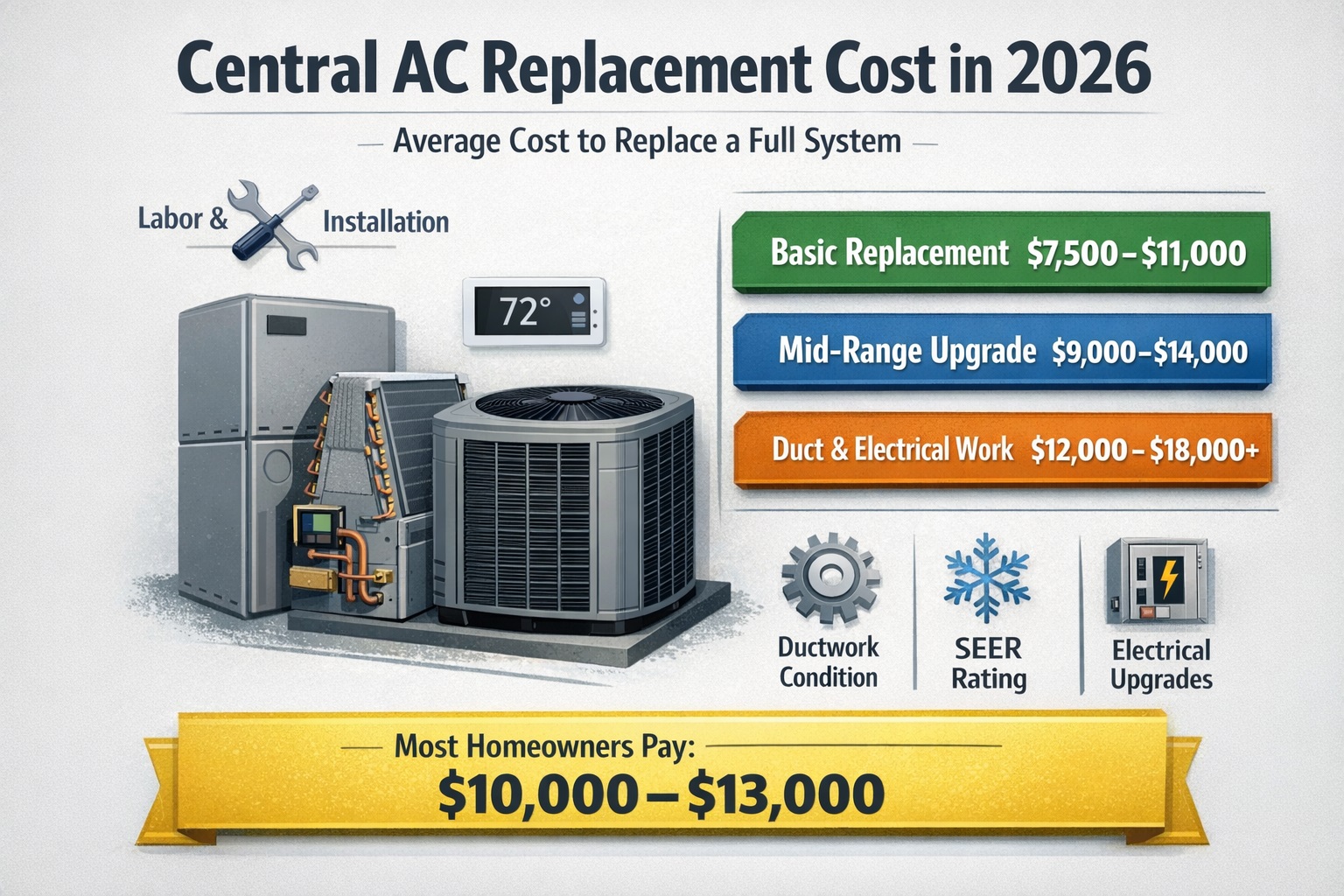
    Central AC replacement cost in 2026 infographic showing average full system replacement price between $7,500 and $15,000 including duct and electrical upgrades

    Replacing a central air conditioner is one of the biggest HVAC expenses most homeowners face. In 2026, the price of a full replacement usually depends on four things more than anything else: system size, efficiency level, duct condition, and labor complexity.

    That is why two homes with similar square footage can still receive very different quotes. The equipment matters, but airflow, installation difficulty, and supporting upgrades often change the final number just as much.

    Quick Answer

    The average central AC replacement cost in 2026 usually falls between $7,500 and $15,000 for a full replacement. In many homes, the most common real-world total lands around $10,000 to $13,000.

    If duct modifications, panel upgrades, or premium high-efficiency equipment are involved, the total can climb beyond $18,000.

    What a central AC replacement usually includes

    When contractors quote a full central AC replacement, they are usually talking about replacing the core cooling equipment while keeping the existing duct system in place—assuming the ducts are still usable.

    A standard replacement often includes:

    • outdoor condenser unit
    • indoor evaporator coil
    • refrigerant and charging work
    • electrical disconnect and wiring adjustments
    • startup, testing, and calibration
    • labor and permit-related work

    If the ducts also need resizing or replacement, the price moves into a different category. For the sizing side of that decision, read Air Conditioner Sizing Guide.

    Central AC replacement cost by home size

    Home SizeTypical Cost Range
    1,500 sq ft$7,500 – $10,500
    2,000 sq ft$8,500 – $12,000
    2,500 sq ft$10,000 – $14,000
    3,000 sq ft$12,000 – $18,000

    Those ranges depend heavily on choosing the right tonnage. Related guides: What Size AC for 2000 Sq Ft House? and What Size AC for 3000 Sq Ft House?.

    Where the money goes

    Most replacement projects break down into three main buckets:

    • equipment: about 50–60%
    • labor: about 30–35%
    • permits and materials: about 10–15%

    In a $12,000 replacement, that might look roughly like this:

    • equipment: about $6,500
    • labor: about $3,800
    • permits and materials: about $1,700

    This is why a lower equipment price does not always mean a lower final bill.

    Why quotes vary by thousands of dollars

    Many homeowners are surprised when contractor estimates differ by $3,000 to $5,000 for what sounds like the same job. That usually happens because the quotes are not actually identical once you look closer.

    Common reasons for large price differences include:

    • brand choice
    • single-stage vs two-stage vs variable-speed equipment
    • line-set replacement vs reuse
    • attic or crawlspace difficulty
    • permit and inspection requirements
    • regional labor pricing

    That is why line-item detail matters more than the headline quote number.

    Cost by system size

    Tonnage changes replacement cost more than most homeowners realize. Bigger systems cost more for equipment, refrigerant handling, and sometimes airflow support too.

    System SizeTypical Installed Cost
    3 Ton$7,500 – $10,500
    4 Ton$9,000 – $13,000
    5 Ton$11,000 – $16,000

    If you need a refresher on tonnage, read What Is a Ton in HVAC?. For size-specific pricing, compare How Much Does a 4 Ton AC Unit Cost in 2026?.

    How SEER affects replacement price

    Efficiency level has a direct impact on cost. Higher-SEER equipment usually costs more up front, but can reduce long-term electricity bills—especially in hot climates with long cooling seasons.

    SEER RatingCost Impact
    14–15 SEERBase price
    16–18 SEER+$800 – $1,500
    20+ SEER+$2,000 – $4,000

    For a deeper explanation, read SEER Rating Explained.

    Hidden costs homeowners often miss

    A replacement quote may look complete but still leave out items that turn into surprise add-ons later.

    Common hidden costs include:

    • duct sealing
    • return-air resizing
    • electrical panel upgrades
    • smart thermostat upgrades
    • drain line replacement
    • refrigerant line replacement

    Typical add-on ranges:

    • electrical upgrades: $1,500 – $3,500
    • duct modifications: $2,000 – $6,000

    For related pricing, see AC Electrical Panel Upgrade Cost in 2026 and Ductwork Replacement Cost.

    When replacement makes more sense than repair

    Sometimes homeowners start out asking for a repair quote, then realize full replacement is the smarter long-term choice.

    Replacement becomes easier to justify when:

    • the system is 12 to 15+ years old
    • the compressor has failed
    • the system uses outdated refrigerant
    • repair cost is already 30–40% of replacement value

    If you are weighing a big repair first, compare with AC Compressor Replacement Cost in 2026.

    How to avoid overpaying

    The best way to protect your budget is to make sure the replacement is correctly sized and correctly scoped before comparing equipment brands.

    Good rules to follow:

    • get at least three quotes
    • ask whether a Manual J load calculation was used
    • avoid automatic upsizing
    • ask about duct airflow capacity
    • compare warranty terms, not just price

    Many homeowners overpay by moving up in tonnage when the house does not actually need it. For the BTU side of that, see What Size AC Do I Need?.

    Climate changes the replacement cost

    Hot-climate states often push replacement pricing upward because they tend to require larger systems, higher-efficiency equipment, and longer labor demand during cooling season.

    This is especially common in places like:

    • Texas
    • Florida
    • Arizona
    • California

    That is one reason the same house can receive very different replacement quotes in different parts of the country.

    2026 central AC replacement cost summary

    ScenarioEstimated Cost
    Basic replacement$7,500 – $11,000
    Mid-range upgrade$9,000 – $14,000
    High-efficiency system$11,000 – $16,000
    With duct and electrical work$12,000 – $18,000+

    In 2026, many homeowners end up spending around $10,000 to $13,000 for a full central AC replacement.

    Final Thoughts

    Central AC replacement cost is about much more than square footage. The final number depends on correct sizing, airflow support, duct condition, efficiency level, and how complicated the installation is.

    Before approving a replacement, make sure you:

    • verify the required tonnage
    • confirm airflow and duct compatibility
    • compare SEER options realistically
    • review a complete contractor estimate line by line

    A correctly sized and properly installed replacement system can improve comfort, lower energy waste, reduce humidity issues, and extend equipment life.

  • How Much Does a 4 Ton AC Unit Cost in 2026?

    4 ton AC unit cost in 2026 infographic showing unit price $3,500–$6,000 and installed cost $7,500–$13,500 for 2,000–2,500 sq ft homes

    If you are asking how much does a 4 ton AC unit cost in 2026, you are usually pricing a system for a home in the 2,000 to 2,500 sq ft range. This is one of the most common residential AC sizes, which is why 4-ton systems sit in a very competitive part of the market.

    In most cases, the equipment itself costs less than the full project once labor, refrigerant, materials, and airflow-related adjustments are included. That is why two quotes for the same tonnage can still come back far apart.

    Quick Answer

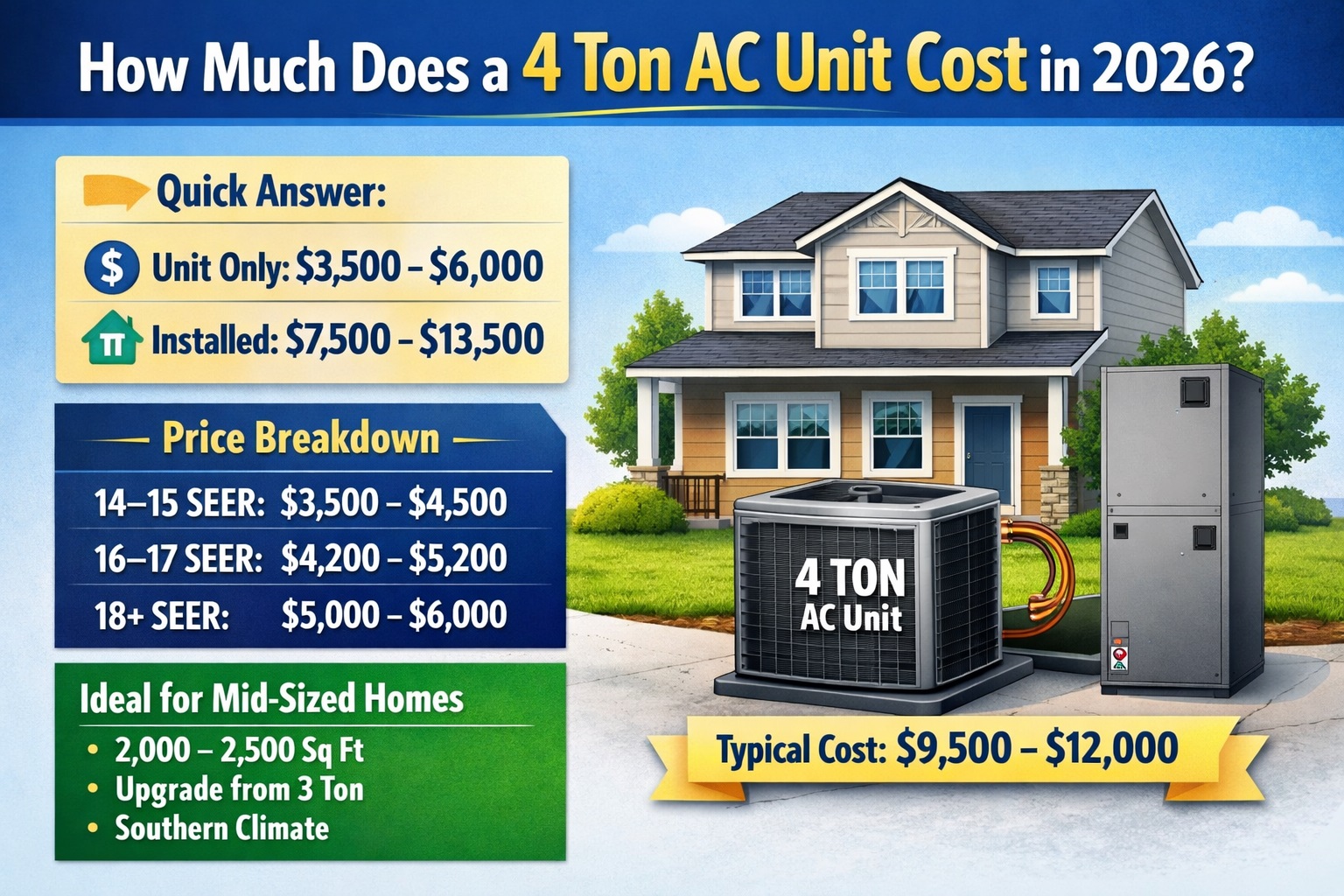
    A 4 ton AC unit usually costs about $3,500 to $6,000 for the equipment only and around $7,500 to $13,500 installed in 2026.

    For many homeowners, the realistic all-in cost ends up somewhere around $9,500 to $12,000, depending on efficiency level, duct condition, and local labor pricing.

    Why 4 ton AC systems are so common

    A 4-ton unit is often the “middle ground” size for medium-to-large houses. It is large enough for many homes that outgrow 3-ton territory, but not so large that it automatically creates the same installation complexity as a 5-ton system.

    In many homes, a 4-ton system:

    • needs about 1,600 CFM of airflow
    • fits common 2,000 to 2,500 sq ft sizing ranges
    • often works without a major electrical redesign
    • can be a practical upgrade from smaller systems

    If you are not sure whether 4 tons is actually the correct size, compare What Size AC for 2000 Sq Ft House? and What Size AC for 2500 Sq Ft House?.

    4 ton AC unit price (equipment only)

    If you are only comparing equipment prices, most 4-ton systems fall into these rough efficiency tiers:

    SEER RatingUnit Cost
    14–15 SEER$3,500 – $4,500
    16–17 SEER$4,200 – $5,200
    18+ SEER$5,000 – $6,000

    Higher-efficiency models cost more up front, but they can lower long-term operating costs—especially in places where cooling season is long or electricity is expensive.

    For the efficiency side of the decision, read SEER Rating Explained.

    Installed cost breakdown

    The installed price is always much higher than the equipment-only number because the job includes much more than the outdoor unit.

    A full installation usually includes:

    • outdoor condenser
    • indoor evaporator coil
    • line set and refrigerant
    • labor
    • permit fees
    • electrical connections
    • startup and testing

    Typical installed range:

    $7,500 to $13,500

    If the ductwork needs resizing or airflow correction, total cost can rise by another $1,000 to $3,000.

    For broader pricing context, see AC Installation Cost Per Square Foot in 2026.

    Why the total price varies so much

    Homeowners often expect one simple answer, but 4-ton pricing changes a lot based on the installation around the unit. The biggest cost drivers usually include:

    • SEER rating
    • local labor rates
    • duct capacity
    • electrical requirements
    • how difficult the installation is

    That is why a basic replacement in a home with good ducts may land near the low end, while a more complicated upgrade can move far above it.

    4 ton vs 3 ton upgrade cost

    Many homeowners moving up from a smaller system want to know whether upgrading from 3 tons to 4 tons is a big cost jump.

    Usually, the equipment difference alone is not huge. In many cases, the added equipment cost is around:

    $500 to $1,200

    The bigger question is whether the duct system can support the added airflow. A 4-ton system needs more air movement than a 3-ton or 3.5-ton unit, and that is where hidden cost can appear.

    For a nearby sizing comparison, read 3 Ton vs 3.5 Ton AC – Which One Should You Choose?.

    Monthly electricity cost

    A 4-ton central AC in 2026 often costs around $120 to $300 per month to operate in warmer climates, but that range can move a lot depending on:

    • climate zone
    • runtime hours
    • SEER rating
    • insulation quality
    • sun exposure

    If you want to estimate the cooling load behind the system size, read How Many BTU Do I Need?.

    Oversizing risk

    Not every home that “can fit” a 4-ton unit actually needs one. If a home would be better served by 3.5 tons, jumping to 4 tons can create performance issues instead of solving them.

    Common oversizing problems include:

    • short cycling
    • poor humidity control
    • uneven room temperatures
    • higher wear on the compressor

    For warning signs, read Oversized AC Symptoms and AC Short Cycling Explained.

    Replacement vs new installation

    The price changes a lot depending on whether you are replacing an existing compatible system or building a new installation around the unit.

    Replacement (existing ducts compatible)

    $7,500 to $11,000

    Full new install (new duct design or major rework)

    $10,000 to $15,000

    If the problem is only a failed component rather than the full system, compare with AC Compressor Replacement Cost in 2026.

    When 4 tons is the right choice

    A 4-ton AC is often a strong fit for homes that are:

    • about 2,000 to 2,500 sq ft
    • two-story but not extremely large
    • in moderate-to-hot climates
    • upgrading from undersized 3-ton equipment

    If the home is much larger than that, you may need to compare with bigger-system or zoning strategies. See What Size AC for 3000 Sq Ft House? and How Much Does a 5 Ton AC Unit Cost in 2026?.

    Final Cost Summary

    ItemEstimated Cost
    Unit Only$3,500 – $6,000
    Installed$7,500 – $13,500
    With Minor Duct Upgrades$9,000 – $15,000

    In 2026, most homeowners paying for a full 4 ton AC installation end up somewhere near $9,500 to $12,000. The smartest way to control cost is to confirm the size is correct, make sure the ductwork can handle the airflow, and compare multiple quotes before committing.

  • What Size AC for 1400 Sq Ft House? (Oversizing Risk Guide – 2026)

    2 ton vs 2.5 ton AC comparison for a 1400 sq ft house showing BTU and airflow difference

    A 1,400 sq ft house usually needs about 24,000 to 30,000 BTU, which puts it in the 2 to 2.5 ton range. At this size, the biggest mistake is often not buying too little AC. It is buying too much.

    That is why many 1,400 sq ft homes end up feeling cold for a moment, then damp, uneven, and uncomfortable later. The system may look powerful on paper, but the runtime is too short to control humidity properly.

    Quick Answer

    For most 1,400 sq ft homes, the usual AC size range is:

    • 24,000–30,000 BTU
    • 2 to 2.5 tons

    In many moderate climates, 2 tons is enough. In hotter climates or homes with more sun exposure, 2.5 tons may be the better fit. A 3-ton system is often too large for this house size unless a real load calculation proves otherwise.

    Why 1,400 sq ft homes get oversized so often

    This house size sits in an awkward spot. It is close enough to 1,500 sq ft that some contractors or homeowners assume the same tonnage should work without looking more closely.

    That shortcut creates problems because 1,400 sq ft homes often cool faster than expected. Once the unit is too large, the system may satisfy the thermostat quickly and shut off before doing the full job.

    If you want the basic capacity concepts first, read What Is BTU in Air Conditioning? and What Is a Ton in HVAC?.

    When 2 tons is usually the right choice

    A 2-ton AC provides about 24,000 BTU of cooling and usually needs around 800 CFM of airflow. For many 1,400 sq ft homes, that is enough to cool properly without creating unnecessary oversizing risk.

    It is often the better fit when:

    • the climate is moderate
    • the home is reasonably well insulated
    • ceilings are close to 8 feet
    • sun exposure is fairly normal
    • the layout is not unusually open

    In those conditions, 2 tons usually allows longer cooling cycles, more stable humidity control, and smoother comfort from room to room.

    When 2.5 tons makes sense

    A 2.5-ton system delivers about 30,000 BTU and needs roughly 1,000 CFM of airflow. That extra capacity can make sense, but only when the home truly has a higher cooling load.

    Leaning toward 2.5 tons is more reasonable when:

    • you live in a hot climate
    • the house has large west-facing windows
    • the attic gets very hot in summer
    • ceilings are higher than standard
    • the home has poor shading or weak insulation

    That does not mean 2.5 tons is automatically better. It means the house may have enough heat gain to justify it.

    Why 3 tons is often too much

    This is where many small and mid-size homes run into trouble. A 3-ton system can cool the space so quickly that the AC shuts off before it removes enough moisture from the air.

    That usually leads to:

    • short cycling
    • clammy indoor air
    • noticeable temperature swings
    • higher wear on the compressor
    • less efficient operation over time

    If that sounds familiar, read AC Short Cycling Explained and Oversized AC Symptoms.

    Humidity control matters more in smaller homes

    Smaller homes cool faster. That sounds like an advantage, but it can become a problem when the AC is oversized. If the system reaches the thermostat setting too quickly, the cycle ends before enough moisture is removed.

    That can leave behind:

    • sticky air
    • musty smells
    • cold-but-uncomfortable rooms
    • more noticeable mold or mildew risk over time

    That is one reason a correctly sized 2-ton unit can feel better than a larger unit in a moderate climate.

    If humidity is already a problem in the house, also read Why Is My House Humid Even With the AC On?.

    Airflow can change the whole result

    Even when the tonnage number looks right, the system still needs ductwork that can support the required airflow. A simple HVAC rule is:

    400 CFM per ton

    • 2 tons → about 800 CFM
    • 2.5 tons → about 1,000 CFM

    If the existing duct system was built around 800 to 900 CFM, jumping to 2.5 tons without checking airflow can create:

    • higher static pressure
    • louder vents
    • reduced efficiency
    • comfort problems that feel like the system is too small

    For more on that, read How Many CFM Per Ton? and Undersized AC Symptoms.

    Climate-based recommendation for 1,400 sq ft

    A practical way to think about this size is:

    • Moderate climates: 2 tons is often enough
    • Mixed climates: 2 to 2.5 tons depending on insulation and windows
    • Hot and humid climates: 2.5 tons is often more realistic

    That is why location matters so much. Two homes with the same floor area can need different sizes because their heat load is different.

    For state-specific examples, compare What Size AC Do I Need in Texas? and What Size AC Do I Need in Florida?.

    Ceiling height and layout still matter

    Basic sizing charts usually assume:

    • 8-foot ceilings
    • average insulation
    • a normal room layout

    You may need to lean toward 2.5 tons if the house has:

    • vaulted ceilings
    • a large open living area
    • big west-facing windows
    • poor attic insulation

    That is because air volume and sun load can push the cooling demand higher than square footage alone suggests.

    How 1,400 sq ft compares with nearby house sizes

    It helps to look at the homes just above and below this size range. That gives you a better sense of whether the house is closer to 2 tons or already pushing into 2.5-ton territory.

    Should you still get a Manual J calculation?

    Yes. This is exactly the kind of house size where a Manual J load calculation can prevent unnecessary upsizing.

    Manual J evaluates:

    • insulation values
    • window heat gain
    • orientation
    • air leakage
    • duct losses

    For the full sizing framework, read Air Conditioner Sizing Guide.

    Final Recommendation

    For most 1,400 sq ft homes:

    • 2 tons is usually right in moderate climates
    • 2.5 tons is more common in hotter or higher heat-gain homes
    • 3 tons should usually be avoided unless a real load calculation proves it is necessary

    At 1,400 sq ft, bigger is rarely better. The best system is the one that runs long enough to cool evenly, control humidity, and match the house without overshooting.

    FAQ

    Is 3 tons too big for 1,400 sq ft?

    In many moderate climates, yes. It often creates short cycling and humidity problems.

    How many BTU do I need for 1,400 sq ft?

    Usually about 24,000 to 30,000 BTU, depending on climate, insulation, and ceiling height.

    Is 2 tons enough for 1,400 sq ft?

    Often yes, especially in well-insulated homes in moderate climates.

  • AC Compressor Replacement Cost in 2026 (Full Price Breakdown)

    HVAC technician replacing a residential AC compressor inside outdoor condenser unit

    An AC compressor is one of the most expensive parts in your air conditioning system. When it fails, the fan may still run, but the system can no longer move heat the way it should. That is why compressor replacement is often one of the biggest repair bills a homeowner sees.

    If you understand the price range before calling a contractor, it becomes much easier to tell whether the quote makes sense—or whether replacing the entire system may be the smarter move.

    Quick Answer

    The average AC compressor replacement cost in 2026 is usually between $1,200 and $3,500 total.

    That price often includes:

    • the new compressor
    • labor
    • refrigerant recovery and recharge
    • basic system testing

    On larger 4- to 5-ton systems, total cost can climb beyond $4,000.

    Average AC compressor replacement cost by tonnage

    AC SizeAverage Total Cost
    2 Ton$1,200 – $2,000
    3 Ton$1,500 – $2,800
    4 Ton$2,000 – $3,500
    5 Ton$2,800 – $4,500

    If you are not sure what size system you have, read What Is a Ton in HVAC and compare with the AC Size Chart (BTU & Tonnage by Square Footage).

    Why compressor replacement costs so much

    The compressor is a sealed part inside the outdoor unit, and replacing it is not a quick swap like changing a thermostat or capacitor. The technician has to open the refrigeration circuit and perform several labor-intensive steps correctly.

    That usually includes:

    • recovering refrigerant
    • removing the failed compressor
    • brazing in the new unit
    • pressure testing the system
    • vacuuming the lines
    • recharging refrigerant
    • verifying electrical operation

    That is why labor alone can easily run from $700 to $1,500, depending on region and system size.

    Typical cost breakdown

    A common mid-range repair might look something like this:

    • compressor unit: $900 – $1,500
    • labor: $800 – $1,200
    • refrigerant: $200 – $600
    • miscellaneous materials: $100 – $200

    In hot states with heavy summer demand, quotes often come in toward the higher side of the range.

    What usually causes compressor failure?

    Compressors rarely fail for no reason. In many cases, the compressor is damaged because the system has been operating under stress for a long time.

    Common causes include:

    • electrical surges
    • low refrigerant
    • dirty condenser coils
    • restricted airflow
    • short cycling
    • improper system sizing

    If the unit is running but not actually cooling, compressor trouble can be one possible cause. See AC Running But Not Cooling.

    Repeated short cycling can also damage a compressor over time, especially in oversized systems. Read AC Short Cycling Explained.

    Repair vs replace the entire AC system

    This is the biggest decision in many compressor failures. Replacing only the compressor is not always the smartest move—especially if the rest of the system is already near the end of its life.

    Full replacement becomes more attractive if the system is:

    • more than 10 to 12 years old
    • using older refrigerant types
    • already having repeated repair issues
    • inefficient compared with newer equipment

    In some cases, replacing the entire system costs only $2,000 to $4,000 more than a major compressor repair.

    For full-system pricing context, compare Central AC Replacement Cost in 2026, How Much Does a 3 Ton AC Unit Cost in 2026?, and How Much Does a 5 Ton AC Unit Cost in 2026?.

    Warranty coverage can change the math

    Before approving compressor replacement, always check the manufacturer warranty. Many systems come with a 5- to 10-year compressor warranty, but that does not always mean the whole repair is free.

    In many cases:

    • the compressor part is covered
    • labor is not covered
    • refrigerant and other materials may not be covered

    A warranty claim can reduce the bill significantly, but it rarely brings the total cost to zero.

    Signs your compressor may be failing

    Compressor problems can look like several different AC issues. Common warning signs include:

    • AC runs but no cold air comes out
    • the outdoor unit hums but does not cool properly
    • breaker trips repeatedly
    • loud clanking or hard-start noises
    • energy bills rise even though comfort drops

    Some of these signs can overlap with low refrigerant, capacitor failure, or airflow problems, which is why diagnosis matters before approving a big repair.

    Why sizing affects compressor life

    Compressor lifespan is closely tied to how hard the system has to work. A properly sized AC usually runs in balanced cycles. A poorly sized one often operates under more stress.

    If the system is too large, it may short cycle and create repeated hard starts. If it is too small, it may run for very long stretches and overheat under load. Both patterns can shorten compressor life.

    For the sizing side of the issue, read Air Conditioner Sizing Guide, Oversized AC Symptoms, and Undersized AC Symptoms.

    Climate also changes compressor lifespan

    In hotter climates, compressors usually wear faster because they run longer and operate under higher pressure for more of the year.

    That is especially true in places like:

    • Texas
    • Florida
    • Arizona

    In milder climates, compressors often last longer because total runtime is lower and the system gets more rest between heavy cooling periods.

    Can you replace just the compressor?

    Technically, yes. In many cases the compressor can be replaced without replacing the entire outdoor unit. But that does not always mean it is the best choice.

    Sometimes a failed compressor leaves behind metal debris or contamination inside the system. In other cases, the condenser, coil, or refrigerant circuit may already be compromised.

    That is why some technicians recommend replacing the entire condenser—or even the full system—instead of only installing a new compressor into an aging setup.

    How to reduce the risk of compressor failure

    The best way to avoid compressor replacement is to reduce system stress over time.

    • change air filters regularly
    • clean the condenser yearly
    • schedule annual AC maintenance
    • install surge protection if needed
    • avoid oversizing the system

    Efficiency and system behavior also matter. See SEER Rating Explained if you are comparing replacement options.

    Final Cost Summary

    In 2026, AC compressor replacement cost usually falls between $1,200 and $3,500, with larger systems sometimes going beyond $4,000.

    If the system is relatively new and under warranty, compressor replacement can make sense. If the system is older or already showing multiple failures, full replacement may be the better long-term decision.

    A compressor is expensive—but replacing the entire AC without comparing both options can cost even more.

    FAQ

    Is it worth replacing an AC compressor?

    Often yes, if the system is under 10 years old or still under warranty. On older systems, full replacement may offer better value.

    Why is compressor replacement so expensive?

    Because the job requires refrigerant recovery, sealed-system work, labor, recharging, and full testing—not just swapping a simple part.

    How long does an AC compressor last?

    In many homes, about 10 to 15 years, depending on climate, maintenance, sizing, and operating stress.